
Topic hub
Refining and assay
How doré becomes four-nines bullion, and how purity is proven rather than asserted.
Between the mine and the market sits an industry most readers never see. Refiners take doré bars of uncertain composition, dissolve or electrolyse away the base metals, and cast bars whose stated fineness has to survive independent testing. Assay is the part that makes the whole chain tradable: without a credible purity claim, a bar is just heavy metal.
This hub covers refinery practice, fire assay and XRF, hallmarking regimes, and the documentation that establishes where a bar's metal came from.
Start here
Industry · 17 min read
The Refiner's Ledger
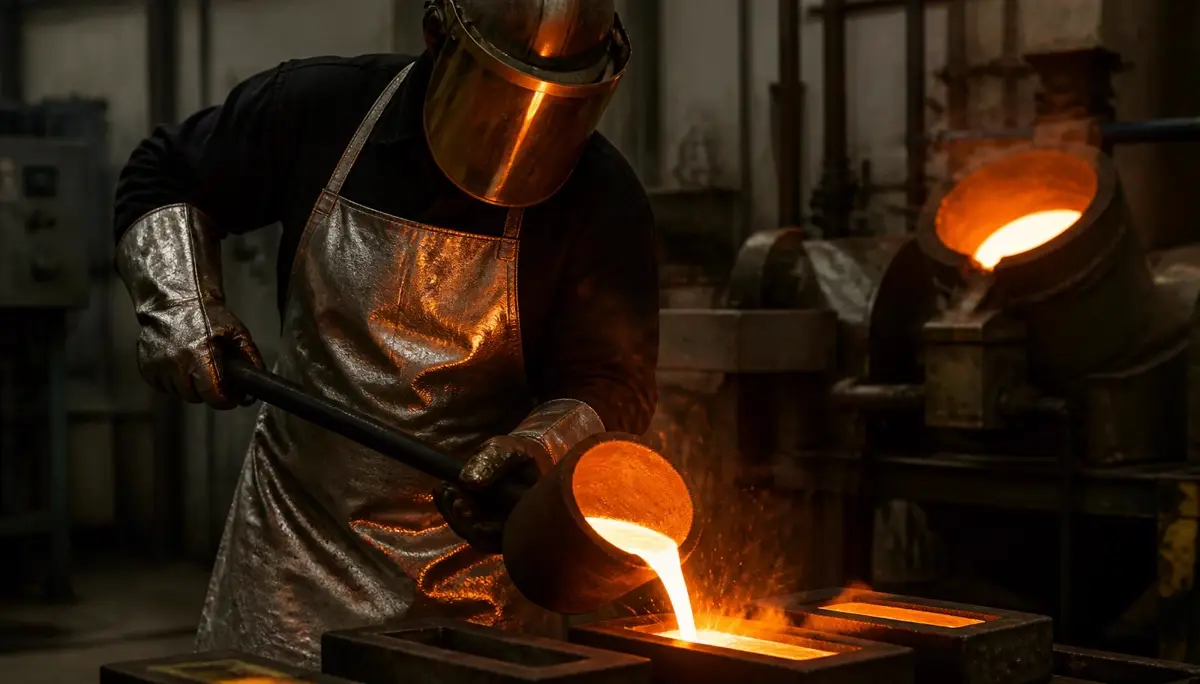
Somewhere between a mine's doré bar and a Good Delivery brick sits a chain of chlorination furnaces, electrolytic cells, assay labs and accreditation committees that decides which gold the world's markets will accept without question — and which gold gets quietly refused.
Tomas Herrera · 20 August 2026
More on refining and assay
Science
The Metallurgy of Karat
Pure gold is too soft to hold a stone, too soft to hold an edge, and the wrong colour for half the world's taste. Almost everything you own that is gold is a designed alloy — and the design is where the engineering lives.
9 August 2026 · 17 min read
Industry
How Fake Gold Is Detected
Counterfeiting gold is not about making something that looks right. It is about defeating a specific test, and the industry's defences are an escalating conversation between forgers and instruments.
7 August 2026 · 16 min read
Industry
The Scrap Trade
Roughly a quarter of the world's annual gold supply has been gold before. It arrives as broken chains, single earrings and dental crowns, and it moves through a chain of intermediaries that most sellers never see past the first counter.
6 August 2026 · 16 min read
Craft
The Wedding-Season Bid: How Jewellery Demand Sets the Floor
Half the world's gold is worn, not stored. In India and China that distinction barely exists — and the buying behaviour it produces is the most reliably contrarian force in the entire market.
3 August 2026 · 15 min read
Craft
Hallmarks and Assay: How Anyone Proves Gold Is Gold
A hallmark is one of the oldest consumer protection technologies in continuous use. It is also, on close inspection, a small masterpiece of institutional design — and it is being quietly eroded.
22 July 2026 · 15 min read
Industry
Nine Nines: Inside a Modern Gold Refinery
A doré bar arrives at 85 per cent purity and leaves at 99.99. Between those two numbers sit chlorine gas, aqua regia, an electrolytic cell and a chain of custody that is now as valuable as the metal itself.
2 July 2026 · 19 min read
Craft
The Alchemy of Craft: What Goldsmiths Know That Machines Don't
Gold's working properties are so extreme they border on the absurd — one gram drawn into three kilometres of wire. Inside a trade where the tools have barely changed and the hands are irreplaceable.
5 June 2026 · 16 min read
Terms used in this topic
- Good Delivery bar
- The wholesale unit of the London market: a bar of roughly 400 troy ounces (about 12.4 kg) at minimum 995 fineness, carrying the stamp of an accredited refiner, a serial number, the year of manufacture and the assayed fineness. Weight is variable rather than fixed, so bars are traded on their actual fine gold content. A bar that leaves the vault chain of custody must be re-assayed before it is accepted back.
- Fineness
- Gold purity expressed in parts per thousand. 999.9 fineness — 'four nines' — is 99.99 percent gold, the standard for investment bars and coins. 995 is the London Good Delivery minimum. Fineness is the wholesale market's language because it is a direct mass fraction, unlike karat, which expresses the same idea in twenty-fourths and is used in jewellery.
- Karat
- A twenty-fourths scale for gold content in an alloy: 24k is pure gold, 18k is 750 parts per thousand, 14k is 583, 9k is 375. Karat measures only how much gold is present, not which metals make up the rest — and the balance determines colour, hardness and tarnish behaviour. Pure gold is too soft for most settings, which is why almost all worn jewellery is alloyed.
- Fire assay
- The reference method for determining gold content, unchanged in principle for centuries. A weighed sample is fused with lead and fluxes, then heated in a porous cupel where the lead oxidises and is absorbed, leaving a bead of precious metal. The bead is parted in acid to remove silver and the remaining gold is weighed. It is slow and destructive, but it remains the arbiter when a result is disputed.
- XRF analysis
- X-ray fluorescence, the fast non-destructive check used at pawn counters, scrap desks and customs benches. The instrument excites the sample and reads the characteristic emission of each element present. Its weakness is depth: XRF reads only the surface, so it can be defeated by heavy gold plating over a tungsten or base-metal core. Serious verification pairs it with density, ultrasound or a drilled sample.
- Hallmark
- A set of marks struck by an independent assay office certifying that an article's gold content has been tested and meets the declared standard. A full hallmark typically records the sponsor, the fineness, the assay office and a date letter. In jurisdictions with compulsory hallmarking it is a legal guarantee rather than a maker's claim, which is why hallmarked antique pieces can be dated and attributed so precisely.
- Miller process
- Chlorine refining. Chlorine gas is bubbled through molten doré; base metals and silver form chlorides that rise as a slag and are skimmed off, leaving gold at roughly 99.5 percent purity in a matter of hours. It is fast and cheap, which is why it is the first stage in most refineries, but it cannot reach investment-grade purity on its own — that requires electrolysis afterwards.
- Wohlwill process
- Electrolytic refining that takes gold to 999.9 fineness. Impure gold anodes are dissolved in a chloroauric acid electrolyte and pure gold plates onto the cathode while impurities either dissolve or drop out as anode slime, from which platinum-group metals are recovered. It ties up a substantial gold inventory in the cells and takes days rather than hours, so refiners run it only for the purity grades that need it.
Questions readers ask
- What does 999.9 fine mean?
- That the bar is 99.99 percent gold by mass — four nines. Good Delivery bars must be at least 995.0 fine; small investment bars are usually 999.9.
- How is gold purity tested?
- Fire assay remains the referee method: a sample is cupelled and the resulting gold bead weighed. XRF is faster and non-destructive but reads only the surface, which is why it can miss a tungsten-cored fake.
Other topics
- The gold standard
- Central-bank reserves
- Mining economics
- Recycling and recovery
- Price and market structure
- Goldsmithing and craft
- The science of gold
Reported from the Industry desk.