
Topic hub
The gold standard
How gold became money, how the link to currency was broken, and what survived the break.
For most of recorded commerce, a unit of currency was a claim on a weight of metal. The gold standard formalised that claim: a state fixed the price of gold in its own money, promised convertibility, and accepted the monetary discipline that followed. It collapsed twice in the twentieth century — in the 1930s and again at Bretton Woods in 1971 — and neither collapse was caused by gold running out.
This hub gathers our reporting on the monetary history of the metal: the classical standard and its balance-of-payments mechanics, the interwar gold-exchange standard, Bretton Woods, and the residual role gold plays on central-bank balance sheets today.
Start here
Markets · 22 min read
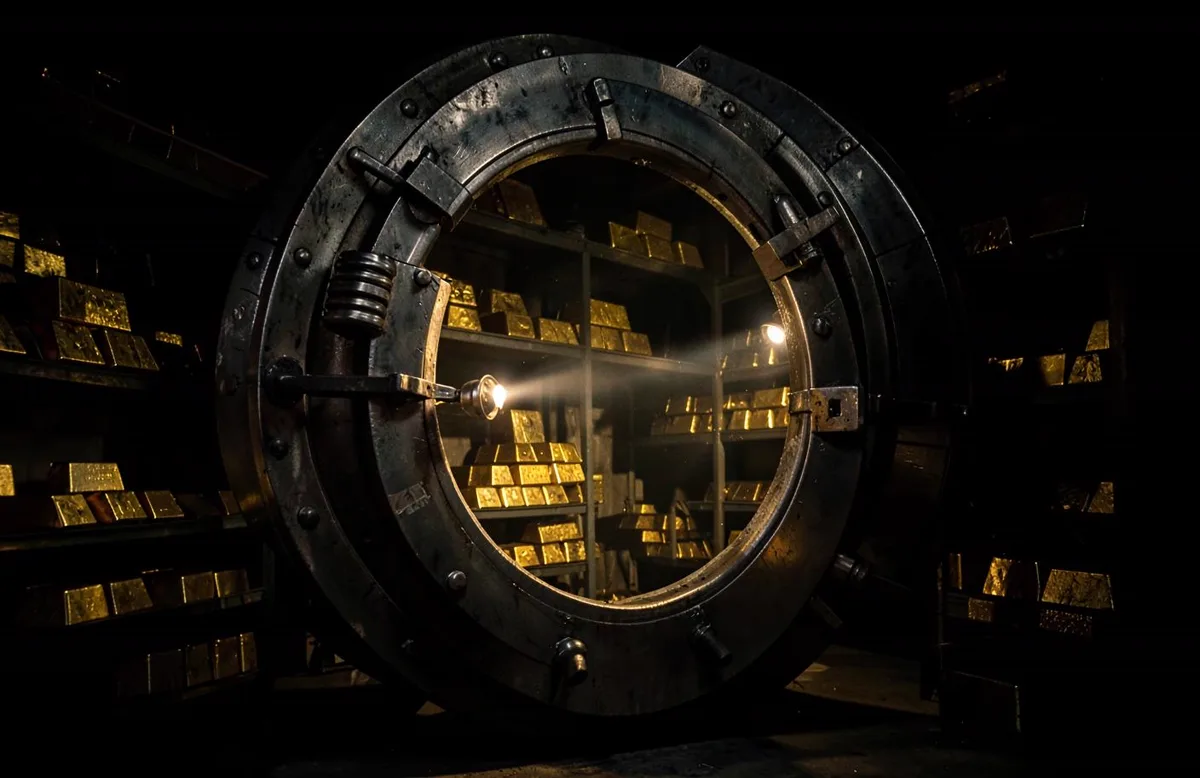
The Last Audit: What We Actually Know About the World's Official Gold
Governments report holding roughly 36,000 tonnes of gold — a figure quoted everywhere and verified almost nowhere. Between the published number and the physical bar sits a chain of certificates, custodians and fifty-year-old count sheets. This is an attempt to walk that chain honestly.
Ingrid Sørensen · 11 September 2026
More on the gold standard
Markets
The Real-Rate Trade: Why Gold Moves When Bond Yields Do
For two decades the gold price could be read off an inflation-linked bond screen. Then, somewhere after 2022, the relationship stopped behaving — and the argument about why has become the most consequential debate in the metal's market.
8 September 2026 · 25 min read
Markets
The Vault Beneath the City
Beneath the Bank of England and beneath lower Manhattan sit two of the largest concentrations of monetary gold on earth, moved between anonymous compartments by a handful of porters who never touch the metal with bare hands. This is how sovereign gold is actually stored, audited and, occasionally, brought home.
18 August 2026 · 22 min read
History
The Hoard Problem: What Buried Gold Actually Tells Us
A field of gold torcs and coins is a spectacular find and a treacherous document. The people who buried it were not writing to us, and the reasons they had for putting it in the ground are exactly what the ground does not record.
9 August 2026 · 16 min read
Markets
Why Central Banks Started Buying Gold Again
For three decades official institutions were net sellers of bullion, and the policy consensus treated the metal as a museum piece. Then, quietly, the world's reserve managers reversed. The reasons are less about inflation than about the plumbing of settlement.
6 August 2026 · 14 min read
History
The Gold Standard: How a Soft Yellow Metal Became Money
For roughly five thousand years, humanity kept returning to the same element to settle its debts. The story is less about greed than about the unusually boring chemistry of atomic number 79.
14 July 2026 · 14 min read
Markets
Bring It Home: Central Banks and the Great Gold Repatriation
For half a century it was rational to store your gold in someone else's basement. Then the calculus of counterparty risk changed, and reserve managers started chartering aircraft.
20 June 2026 · 14 min read
Terms used in this topic
- Troy ounce
- The unit gold is priced and traded in, equal to 31.1034768 grams — about 10 percent heavier than the avoirdupois ounce used for groceries. A quoted gold price of $2,400 an ounce always means a troy ounce. The unit descends from the medieval fairs at Troyes in Champagne and survived into modern bullion markets because contracts, refinery bars and assay certificates were all written in it.
- LBMA Gold Price
- The twice-daily benchmark, set at 10:30 and 15:00 London time through an electronic auction operated by ICE Benchmark Administration. Participants submit buy and sell volumes at a proposed price; the price moves until the imbalance falls within tolerance and the auction settles. Because it produces a single printable number for a fixed moment, it is what miners, refiners, ETFs and central banks write into contracts.
- Central bank reserve gold
- Gold held by a monetary authority as a foreign reserve asset. It carries no counterparty and no currency of issue, which is why it is bought most heavily by central banks seeking to reduce exposure to any single sovereign. Holdings are reported monthly to the IMF, usually valued at market price, and are often stored abroad — a large share of the world's reserve gold sits in New York, London and Basel rather than at home.
Questions readers ask
- What was the gold standard?
- A monetary system in which a currency's value was fixed to a defined weight of gold and, in its classical form, freely convertible into that weight on demand. Money supply was therefore constrained by gold reserves rather than by policy choice.
- Why did the gold standard end?
- Because convertibility became incompatible with domestic policy goals. Governments that needed to fund deficits, defend employment or run independent monetary policy could not simultaneously guarantee redemption at a fixed price. The final break came in 1971, when the United States suspended dollar convertibility.
- Could a country return to a gold standard?
- Mechanically yes, at some price; practically it would require surrendering discretionary monetary policy and accepting price adjustment through wages and output instead of the exchange rate. No major economy has proposed it seriously in decades.
Other topics
- Central-bank reserves
- Refining and assay
- Mining economics
- Recycling and recovery
- Price and market structure
- Goldsmithing and craft
- The science of gold
Reported from the Markets desk.