Investigation
The Vault Beneath the City
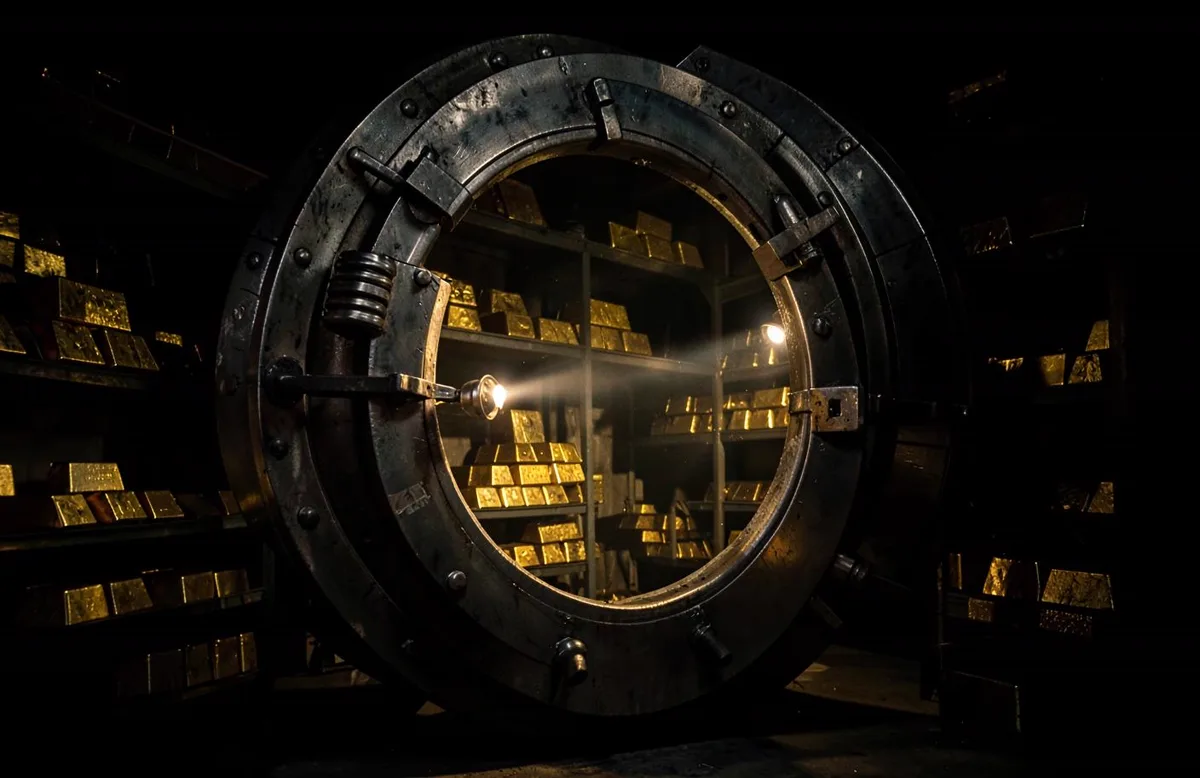
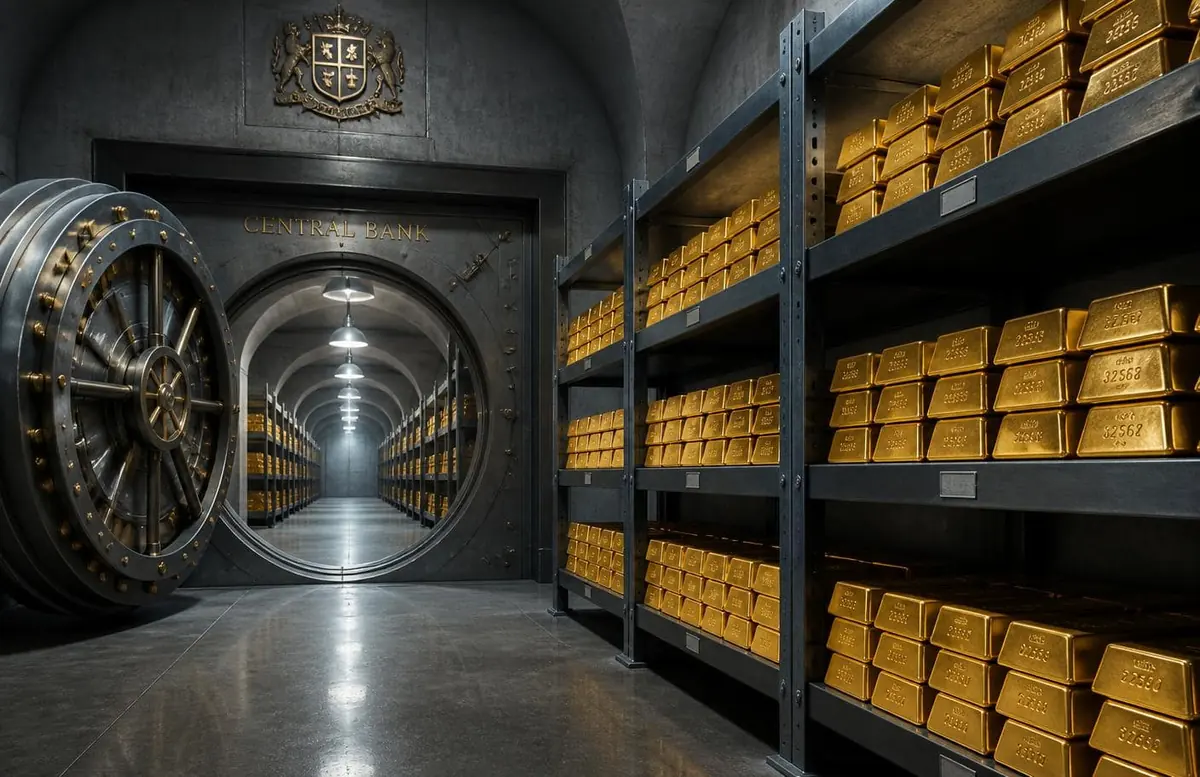
Beneath the Bank of England and beneath lower Manhattan sit two of the largest concentrations of monetary gold on earth, moved between anonymous compartments by a handful of porters who never touch the metal with bare hands. This is how sovereign gold is actually stored, audited and, occasionally, brought home.
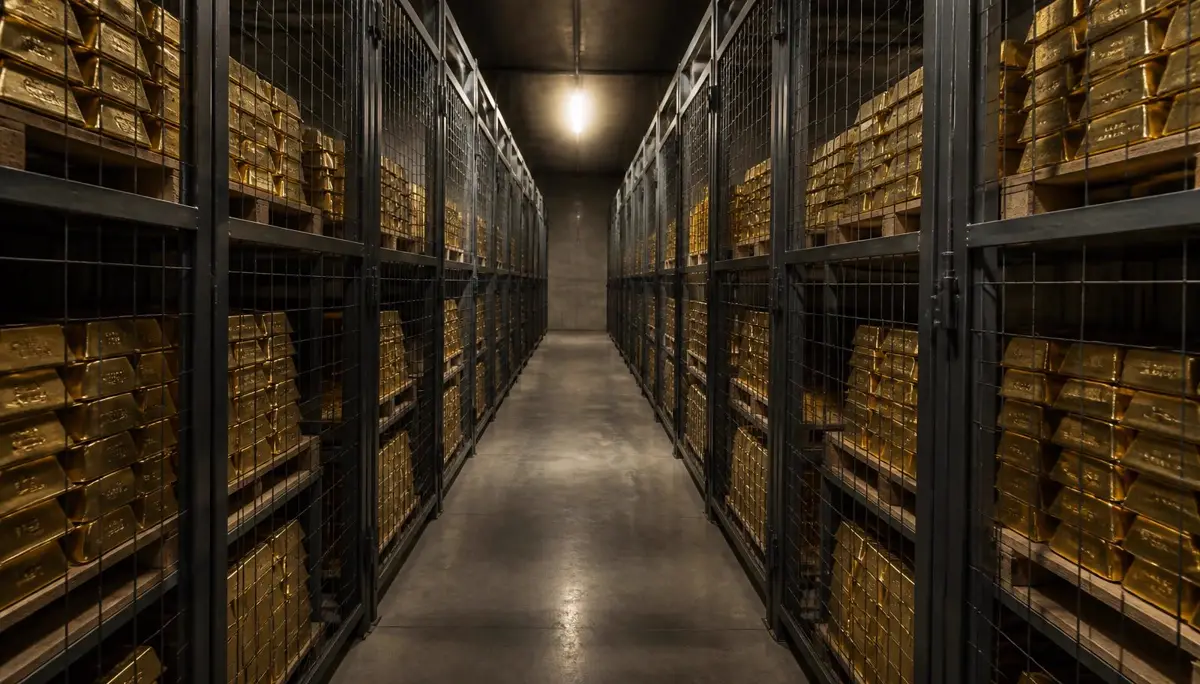
There is a particular kind of quiet in the sub-basements beneath the Bank of England that has nothing to do with soundproofing. It is the quiet of a building that has been engineered, floor by floor, to make sure nothing unplanned ever happens to what is stored there. Eight vaults sit below Threadneedle Street, cut into London clay, secured behind doors that weigh many tonnes apiece and combination locks the length of a wristwatch's face, tended by a small rotating staff whose job, reduced to its essentials, is to move heavy metal objects from one numbered shelf to another and to write down, precisely, that they have done so.
This is sovereign gold custody: less a fortress than an accounting exercise conducted with extraordinary physical seriousness. Somewhere between 400,000 and 500,000 gold bars sit in those vaults at any given time, weighing collectively more than 5,000 tonnes, worth at current prices well over a third of a trillion dollars. Almost none of it belongs to the United Kingdom. It belongs to roughly a hundred other central banks, monetary authorities and international institutions, each of which pays the Bank of England a fee to look after bars that, on paper, never leave their ownership even while sitting under a foreign city.
Two vaults, one architecture
The world's sovereign gold is concentrated overwhelmingly in two buildings. The first is the Bank of England, whose vaults hold gold on behalf of the UK Treasury and of foreign central banks that have used London as a storage location for the better part of two centuries, drawn by the depth and liquidity of the London bullion market and by a legal and political stability that has, so far, survived two world wars, the end of empire and any number of currency crises. The second is the Federal Reserve Bank of New York, whose vault sits five storeys below street level in lower Manhattan, built directly into the bedrock of the island because bedrock, unlike landfill, does not need reinforcing to hold tens of thousands of tonnes of metal.
Both institutions run on the same basic principle, inherited from centuries of goldsmith banking: they are custodians, not owners, of the overwhelming majority of what they hold. The gold in each vault belongs to specific account holders, and the vault operator's job is to make absolutely certain that Country A's bars never become confused with Country B's bars, that nothing enters or leaves without instruction from the legal owner, and that the paper record of who owns what remains, at every moment, an exact mirror of the metal on the shelf.
Earmarking, and why it is not the same as ownership by the custodian
The legal mechanism that makes this possible is called earmarking. An earmarked bar is identified by a unique serial number, a refiner's stamp, a fineness assay and a weight, and it is allocated in the vault's records to one specific owner. It sits physically in a caged compartment assigned to that owner, stacked on wooden pallets in the same way it would sit in any bullion vault, and it is never pooled, lent, leased or rehypothecated by the custodian without separate, explicit instruction. This is the opposite arrangement to an unallocated bullion account in the wholesale market, where a bank owes a customer a quantity of gold rather than specific bars and where, in an insolvency, the customer stands as an unsecured creditor rather than an owner of segregated property.
This distinction sounds abstract until you notice how much monetary history has been organised around it. States that might plausibly go to war with each other, or that do not entirely trust each other's courts, have nonetheless been willing to store gold in one another's vaults for a century, precisely because earmarking removes the custodian from the ownership chain. The gold is not the custodian's to seize, freeze or spend — except, as later sections of this piece will show, when politics finds a way around even that protection.
Inside the Bank of England's vaults
The Bank of England has occupied its Threadneedle Street site since 1734, and its underground vaults were expanded significantly during the twentieth century as the volume of gold under its care grew. The compartments themselves are unglamorous: bare concrete, sodium lighting, wooden pallets stacked with 400-ounce Good Delivery bars, each weighing around 12.4 kilograms, arranged so that porters wearing felt-soled shoes — leather-soled boots strike sparks and scuff the vault floor — can move them with hand trolleys designed specifically for the weight and dimensions of a bullion bar.
Access follows a strict separation of duties. No single employee holds all the combinations, keys and authorisations required to enter a vault chamber alone, and every movement of metal is recorded against the specific compartment and the specific bar numbers involved. The Bank periodically discloses aggregate figures — total tonnage, approximate bar count, the fact that holdings are dominated by foreign official-sector accounts — but it does not publish which country's compartment holds which bars, treating that information as confidential to the relationship between custodian and client, in the same way a private bank would not publish an individual depositor's balance.
- Bars are Good Delivery standard, minimum 995 fineness, individually stamped with refiner, assay and serial number.
- Each compartment is assigned to a single account holder and physically segregated from every other holder's metal.
- Movement of a bar between compartments — a sale, a swap, a transfer of ownership — is a paperwork event that need not involve moving the bar at all if it stays within the same building.
- Withdrawal for physical export requires notice, verification against the bar list, and coordination of armoured transport and insurance, which is why repatriation is measured in months, not days.
That last point is worth dwelling on, because it explains a detail that surprises most people encountering this world for the first time: a very large share of gold 'trading' between nations never involves moving a single bar. If a central bank sells gold to another central bank, and both hold their accounts at the Bank of England, the transaction can be settled by relabelling which compartment a given stack of bars belongs to — a change of ownership record, not a change of location. The London gold market's entire wholesale architecture depends on this fact; it is why so much of what looks, from a trading floor, like enormous volumes of gold moving around the world is really enormous volumes of paperwork moving around a handful of basements.
The Fed's vault in the bedrock
New York's equivalent sits roughly 25 metres below street level at the Federal Reserve Bank of New York's Liberty Street headquarters, resting directly on Manhattan schist because the bedrock there is solid enough to bear the vault's weight without artificial foundations, and deep enough that it sits below the water table and below the tunnels of the subway system running nearby. The vault door alone weighs around 90 tonnes and is built to a tolerance that allows it to be moved by a single technician despite its mass, engineered in the same era — the 1920s — that produced the great transatlantic ocean liners and drew on similar heavy-engineering expertise.
Like the Bank of England, the New York Fed is overwhelmingly a custodian rather than an owner. It holds gold for around three dozen foreign governments, central banks and international organisations, along with a small holding for the US government itself, though the bulk of the United States' own official gold reserve is held not in New York but at the US Bullion Depository at Fort Knox, Kentucky, and at facilities in Denver and West Point. The New York vault's foreign holdings became, during the twentieth century, the default parking place for a huge share of the world's monetary gold, in part because of the depth of the dollar-denominated financial system built around it and in part, bluntly, because it was judged a safer place to keep gold than a Europe twice devastated by continental war within living memory.
~400,000
Approximate bar count, Bank of England vaults
~5,000 t
Approximate Bank of England gold holdings
~6,000 t
Estimated gold held at the New York Fed for foreign accounts
90 t
Approximate weight of the New York Fed's main vault door
“We are not a vault that happens to have a central bank attached. We are a central bank that happens, as an accident of geology and history, to sit on some very good bedrock.”
The politics of bringing it home
For most of the postwar era, where a country's gold physically sat was treated as an operational detail, not a political one. That changed, gradually and then quickly, over the last fifteen years, as a wave of scepticism about central bank transparency, amplified by the 2008 financial crisis and by a resurgent gold-standard-adjacent political movement in several countries, turned vault location into a subject of parliamentary debate.
Germany: the audit that became a withdrawal
The clearest case is Germany's. The Bundesbank held a substantial share of its gold reserves abroad for decades, split principally between New York, Paris and London, a legacy of Cold War-era planning that placed reserves beyond the reach of a feared Soviet advance into West Germany. By the early 2010s, with that strategic rationale long expired, German auditors and members of the Bundestag's budget committee began pressing publicly for verification that the gold recorded on the Bundesbank's books actually existed in the quantities and locations claimed.
The Bundesbank's response, in 2012 and 2013, combined reassurance with action. It arranged a small, symbolic test withdrawal of gold from the New York Fed to confirm that the transfer process worked as expected, and then announced a formal plan to repatriate 674 tonnes from New York and Paris to Frankfurt by 2020. The operation, when it actually ran, moved faster than scheduled and finished in 2017, three years ahead of plan, and the Bundesbank has since made a point of publishing its holding locations and bar lists with more granularity than most other major reserve holders, treating transparency itself as the actual product of the episode rather than the tonnage moved.
What the German case demonstrates, more than any custodial failing, is how quickly an entirely sound arrangement can become politically untenable once trust in institutions generally starts to erode. Nobody produced evidence that the Bundesbank's gold in New York was mishandled, diverted or missing. The pressure came instead from a broader climate of suspicion toward opaque financial institutions in the wake of the crisis, and the repatriation functioned as a public demonstration of sovereignty and oversight as much as a technical correction.
Venezuela: when politics freezes the vault itself
If Germany shows repatriation as reassurance, Venezuela shows the opposite: a case where custodial location became an instrument of geopolitical leverage rather than a neutral storage arrangement. Venezuela holds roughly 31 tonnes of gold at the Bank of England, accumulated over decades as part of its official reserves. Since 2018, amid a domestic political crisis in which the legitimacy of Nicolás Maduro's government has been disputed both internally and by a succession of foreign governments, the Bank of England has declined to release the gold on the instruction of Maduro's officials, citing uncertainty over which authority is entitled to act on the country's behalf.
The dispute has run through multiple rounds of litigation in the English courts, with rulings turning on fine questions of which government the United Kingdom recognised as Venezuela's legitimate executive at any given moment — recognition that itself shifted over the period in question. The practical effect has been straightforward and stark: the gold has sat immobile in London for years, unavailable to a country experiencing a severe economic and humanitarian crisis, its custodial safety guaranteed by the very institutional caution that also makes it impossible to move.
Poland, and repatriation as routine diversification
Not every repatriation carries the same political charge. Poland's central bank, Narodowy Bank Polski, moved roughly 100 tonnes of gold from the Bank of England to domestic vaults in 2019, as part of a broader and less dramatic policy of building up and diversifying its reserves following years of accumulation. Polish officials framed the move explicitly around risk diversification of storage location rather than distrust of London, and continued to hold a substantial remaining share of the country's gold abroad even after the transfer. The Polish case is closer to what most central banks quietly do on a smaller scale on an ongoing basis: adjusting the geographic split of reserves as part of routine reserve management, without the drama that attended the German and Venezuelan episodes.
How a bar list actually works, and how it is checked
Every account holder at the Bank of England or the New York Fed is entitled to a bar list: a document identifying every bar allocated to their account by serial number, refiner, gross weight, fine weight and assay. This is the fundamental instrument by which an owner verifies that the metal recorded on their books corresponds to specific, identifiable physical objects rather than an abstract balance. Reconciling a bar list against a physical vault inspection is, in principle, straightforward — count the bars, read the stamps, compare against the document — and central banks with holdings abroad are entitled to conduct or commission such inspections.
In practice, full independent physical audits happen far less often than the public imagines, for reasons that are more bureaucratic than sinister. Vault inspections are logistically disruptive, require significant staff time from the custodian, and for institutions with no history of discrepancy, the marginal reassurance of a bar-by-bar recount rarely justifies the cost against competing priorities. The United States' own gold reserve has been the subject of the most persistent public scepticism on this point, and the record of formal audits — a limited, congressionally observed inspection of a portion of the Fort Knox holdings in 1974, periodic Treasury inventory work since, and a series of Inspector General reviews — falls well short of the comprehensive, independently verified, bar-by-bar count that a vocal minority of commentators, including some in Congress, have periodically demanded.
- A bar list identifies each bar by serial number, refiner stamp, gross and fine weight, and assay fineness.
- Reconciliation compares the physical bars in a compartment against the list, ideally through independent inspection rather than custodian self-certification.
- Full audits are logistically expensive and, for institutions with no history of discrepancy, are conducted far less frequently than public assumption suggests.
- The gap between 'auditable in principle' and 'regularly audited in practice' is the single largest source of public distrust in sovereign gold custody.
None of this amounts to evidence that reserves are missing. Every documented instance of a serious discrepancy in modern sovereign gold custody has turned out, on investigation, to be a paperwork or bar-numbering error rather than an actual loss of metal, and the institutions involved — the Bank of England and the New York Fed chief among them — have operated without a confirmed case of missing sovereign gold for the better part of a century. What the audit gap produces instead is a durable, low-grade public suspicion that periodically flares into exactly the kind of domestic political pressure that drove Germany's repatriation, whether or not any underlying problem exists.
What custody actually costs, and who pays
Storing gold at the Bank of England or the New York Fed is not free, though the fees involved are modest relative to the value of the metal stored, typically a small fraction of a percentage point annually, reflecting the low marginal cost of storing an inert, non-perishable asset that requires no active management once it is safely on a shelf. The revenue is not the point for either institution; the arrangement functions instead as a service to the broader monetary system, cementing London's and New York's positions as the two indispensable hubs of the physical gold market and giving both cities' gold-trading infrastructure — the bullion banks, the refiners, the clearing systems — a captive and liquid pool of metal that can, when account holders agree, be lent, swapped or used to settle wholesale market transactions.
Repatriation, by contrast, is genuinely expensive, and the expense is almost entirely borne by the country doing the moving. Shipping bullion internationally requires specialist insurance, armoured transport, often military or paramilitary escort, and coordination between the sending and receiving central banks over weeks or months to schedule withdrawals in a way that does not disrupt either vault's operations or, in some cases, does not visibly signal the transfer to markets before it is complete. Germany's repatriation of 674 tonnes reportedly cost the Bundesbank tens of millions of euros in logistics, security and new domestic vault construction — a bill it judged worth paying for the political and public-trust benefits, not for any operational improvement in how safely the gold was held.
What the vault beneath the city actually protects
It is tempting, reporting on these buildings, to write about them as fortresses guarding treasure, and in a narrow physical sense that description is accurate: the doors are enormous, the walls are thick, the access controls are genuinely formidable. But the deeper function of the Bank of England's basements and the Fed's bedrock chamber is not physical security in the sense a heist film imagines. Nobody seriously worries that a criminal gang will tunnel into the Threadneedle Street vaults and drive away with a 400-ounce bar; the metal is too heavy, too traceable and too illiquid outside the formal chain to make such a theft rational even before considering the security involved.
What these vaults actually protect is a set of promises between states: the promise that a bar earmarked to your account remains yours regardless of what happens to the custodian, the promise that the bar list matches the shelf, and the promise, mostly honoured, that access will not be denied for reasons unrelated to your ownership. The Venezuelan case shows how fragile that last promise can be when a state decides sovereignty questions override custodial neutrality. The German case shows how the first two promises, even when perfectly kept, can still fail to satisfy a domestic public primed to distrust institutions it cannot personally inspect. Between those two poles sits the quiet, undramatic majority of the world's sovereign gold, sitting exactly where it has sat for decades, earning its keep by doing absolutely nothing at all.
What comes next for vault geography
The direction of travel among reserve managers over the past decade has been toward modest diversification rather than wholesale repatriation. Central banks that have been net buyers of gold since 2010 — many of them in Asia, the Gulf and parts of the developing world — have tended to build new purchases into domestic vaults from the outset rather than routing them through London or New York and then bringing them home later, sidestepping the repatriation question altogether by never creating the foreign holding in the first place. This is arguably the more consequential long-run trend than any single country's repatriation announcement: a gradual shift in where newly acquired official-sector gold is stored from the start, driven by the same sanctions-era caution about foreign-held assets that has reshaped reserve currency composition more broadly.
The Physics of Inertia: Why Gold Never Needs to Move
There is a physical weight to the silence in a sovereign vault that transcends the merely acoustic. A standard Good Delivery bar, the fundamental unit of central bank settlement, weighs approximately 12.4 kilograms or 400 troy ounces. While a single bar is easily lifted by a healthy adult, a pallet of them — the standard unit of movement within the Bank of England’s basements — can weigh upwards of a tonne. This density is gold’s most underrated logistical asset: you can store the entire annual output of a major mining nation in a space no larger than a garden shed. It is this concentration of value that makes the architecture of the vault possible. When you are guarding billions of dollars of value that is physically too heavy to be moved quickly, your security problems shift from high-speed chases to the slow, meticulous verification of inventory.
The porters who work these floors operate with a rhythmic, almost meditative caution. Because gold is soft, bars stacked directly on top of one another for decades can actually begin to bond at a microscopic level, requiring a practiced technique to separate them without scuffing the refiner’s stamp. The specialized trolleys used to move these pallets are engineered with low centres of gravity and reinforced axles, and the porters wear felt-soled shoes to ensure that no stray spark ever meets the industrial-strength cleaning agents used to keep the floors immaculate. Every movement of the metal is a choreography of necessity; because every gram is accounted for, the physical effort required to move a stack of bars is mirrored by the administrative effort required to document that movement across the internal ledgers.
This physical inertia is also what makes the London and New York vaults the 'black holes' of the gold market. Once a bar enters the system, it tends to stay there for decades, changing ownership a hundred times on paper while never shifting an inch on its wooden pallet. The gold is an anchor of stability in a financial world that moves at the speed of light. While high-frequency trading algorithms settle millions of transactions a second in the buildings above, the bars beneath stay exactly where they were placed by men who might now be long retired. This permanence is not a bug of the system; it is the system’s primary product. In a world of digital promises that can be retracted with a keystroke, a 12-kilogram bar of 99.5% pure metal is a fact that cannot be argued with.
“In the vault, time does not exist for the metal, only for the porters. A bar poured in 1920 and a bar poured in 2020 sit side-by-side, identical in their indifference to the century that passed between them.”
The Audit Trail: The Paperwork of Physical Trust
The fundamental instrument of trust in the world of sovereign gold is not the vault door, but the bar list. A bar list is a comprehensive biography of every physical object in a given account, recording the refiner’s mark, the serial number, the gross weight, and the precise assay of fineness. For a central bank, this document is more than a receipt; it is the legal proof of the asset’s existence. When an auditor from a foreign treasury arrives in London to verify their national reserve, they are not there to 'look at the gold' in a general sense; they are there to reconcile every single line of their bar list against the physical stamps on the metal sitting in their designated compartment.
This reconciliation process is where the friction of the physical world meets the precision of modern accounting. Discrepancies, when they occur, are almost always the result of historical record-keeping errors rather than missing metal. A bar might have been recorded with a weight of 400.02 ounces in the 1960s using a beam balance, but a modern digital scale might read it as 400.018 ounces. Resolving these minute differences requires a diplomatic dance between the custodian and the owner, often involving the re-assaying of the metal or the formal adjustment of the ledger. These episodes, though rare, illustrate the extreme level of granularity required to maintain the integrity of a system where a single ounce is worth thousands of dollars.
Furthermore, the politics of the audit have become increasingly fraught in the 21st century. As populist movements in several countries have questioned the transparency of their central banks, the demand for 'full, independent physical audits' has become a recurring political theme. Custodians like the New York Fed and the Bank of England generally resist these requests, not because they have something to hide, but because the logistical disruption and security risk of opening every vault chamber for an outside inspection are immense. Each such audit requires weeks of preparation, the presence of multiple layers of security and oversight, and the physical handling of thousands of tonnes of metal — an exercise that most vault managers consider an unnecessary risk to the safety of the staff and the metal itself.
400 oz
Standard weight of a Good Delivery gold bar
0.001 oz
Precision of modern weighing scales in major vaults
24/7
Monitoring of vault temperatures and humidity
3+
Independent keys required to open a main vault door
The Digital Vault: Tokenization and the Bedrock
As the world of finance moves toward blockchain-based settlement, a new tension has emerged between the ancient physical reality of the vault and the frictionless potential of digital assets. Tokenization — the process of creating a digital representation of a specific physical bar on a distributed ledger — is being touted as the next evolution of the gold market. In theory, this allows for the 'democratization' of sovereign-grade gold, enabling institutional and even retail investors to trade fractional interests in a specific bar sitting in the Bank of England with the same ease they trade a stock or a cryptocurrency. The bars stay in the bedrock, but the ownership moves at the speed of light.
However, this digital-physical bridge introduces new risks that traditional custodians are only beginning to grapple with. If a digital token represents a legal claim on a specific bar, the security of that token becomes as important as the security of the vault itself. A cyber-attack that scrambles the ownership ledger would create a chaotic situation where multiple parties might claim the same physical metal. Moreover, the 'Venezuelan lesson' remains a haunting precedent: even if a digital ledger says you own a bar, the physical custodian’s government can still prevent you from moving it if there is a dispute over your legal identity or political status. Tokenization makes the gold more liquid, but it does not make it any more sovereign if the vault is still under someone else’s control.
Despite these concerns, the momentum toward digital custody seems irreversible. Several major central banks are quietly experimenting with 'digital twin' systems, where every physical movement of a bar in the vault is mirrored by an automated update to a secure, private blockchain. This provides a level of real-time transparency that traditional bar lists can never match, allowing reserve managers to verify their holdings instantly without needing to send a team of auditors to London or New York. The future of the vault beneath the city, it seems, will be one where the heavy lifting is still done by porters in felt-soled shoes, but the verification is done by cryptographic hashes that are as immutable as the metal they represent.
- Tokenization allows for the fractional ownership of 400oz bars, increasing market liquidity.
- Cryptographic proof of reserve provides real-time auditability without physical disruption.
- Smart contracts can automate the leasing and swapping of sovereign gold reserves.
- Cybersecurity now ranks alongside physical security as a top priority for vault operators.
The Bank of England and the New York Fed are not going to empty out. Too much of the wholesale gold market's plumbing depends on their vaults functioning as the settlement points where earmarked ownership can change hands without a bar physically moving, and no rising reserve manager has built anything close to an alternative hub with comparable liquidity, legal certainty and market depth. But the unquestioned centrality both cities enjoyed for most of the twentieth century is being quietly renegotiated, one new central bank purchase and one domestic vault expansion at a time, by states that have watched Venezuela's gold sit frozen in London and drawn their own conclusions about where they would prefer their own reserves to sit when the next crisis of trust arrives.
Frequently asked
Questions readers ask
- How much gold does the Bank of England actually hold?
- The Bank of England's published figures put its holdings at somewhere around 400,000 bars, weighing in excess of 5,000 tonnes, making it the second-largest single gold depository in the world after the Federal Reserve Bank of New York. The great majority belongs to other central banks and to the UK's own Exchange Equalisation Account, held on their behalf in a custodial capacity. The Bank charges a storage fee and publishes aggregate figures in its annual report, though it does not publish which country owns which vault compartment.
- Is gold held at the Bank of England actually owned by the UK?
- Only a modest fraction. The Bank is principally a custodian: roughly 90 per cent of the metal in its vaults belongs to other central banks, monetary authorities and international institutions that pay to store gold in London because of its deep, liquid bullion market. The UK's own reserves, managed through the Treasury's Exchange Equalisation Account, form a much smaller share of the total and were themselves controversially reduced in the Brown-era sales of 1999–2002.
- What does 'earmarked' gold mean?
- Earmarking is the custodial arrangement under which specific, serial-numbered bars are allocated to a specific account holder and legally remain that holder's property, physically segregated within a vault compartment. It differs from a pooled or unallocated account, where the custodian owes a quantity of gold rather than specific bars. Nearly all central bank gold held abroad is earmarked, which is precisely why it survives the custodian's own insolvency and why the paperwork — the bar list — matters so much to the owner.
- Why did Germany repatriate its gold?
- The Bundesbank announced in 2013 that it would bring home 674 tonnes held in New York and Paris by 2020, completing the move three years early in 2017. Officially the plan was framed around building trust with the domestic public and diversifying storage locations. Unofficially it followed years of pressure from German politicians and auditors who questioned why the country could not verify its own gold, and it followed a wave of similar scepticism after a small, symbolic Bundesbank test withdrawal from New York in 2012 revealed slower-than-expected transfer logistics.
- What happened to Venezuela's gold in London?
- Roughly 31 tonnes of Venezuelan gold, worth well over a billion dollars, has sat frozen at the Bank of England since 2018, caught in a legal dispute over whether Nicolás Maduro's government or the opposition, at various points recognised by the United Kingdom as the legitimate authority, has the right to instruct its release. UK courts have heard multiple rounds of litigation on the question, and the gold has remained immobile throughout, illustrating how custodial location can become a direct instrument of foreign policy rather than a neutral storage decision.
- Has the US gold reserve at Fort Knox ever been independently audited?
- Partial, government-conducted audits and inventories have occurred over the decades, including a limited congressional-witnessed inspection in 1974 and periodic Treasury and Mint inventory work since, but a comprehensive, fully independent, bar-by-bar physical audit open to outside verification has never taken place in the way gold-standard advocates have long demanded. This gap is less a sign of missing metal, most economists argue, than of an entrenched bureaucratic reluctance to undertake a costly and logistically difficult exercise for an asset whose custody has never been seriously challenged in court.
- Why do countries store gold abroad at all instead of at home?
- Historically, for liquidity and wartime security. Gold held in London or New York can be mobilised instantly in the world's deepest bullion market, used as collateral, swapped, or sold without the delay and expense of shipping bars across oceans. Many reserves were also moved to New York and London during the mid-twentieth century specifically to keep them beyond the reach of invading armies, a rationale that outlived the wars that produced it and hardened into standing practice.