Investigation
Nine Grams a Tonne
What does it actually cost to pull an ounce of gold out of the ground? The honest answer runs through grade decline, energy and water bills, permitting delays and the closure liabilities nobody prices until the mine is already exhausted.
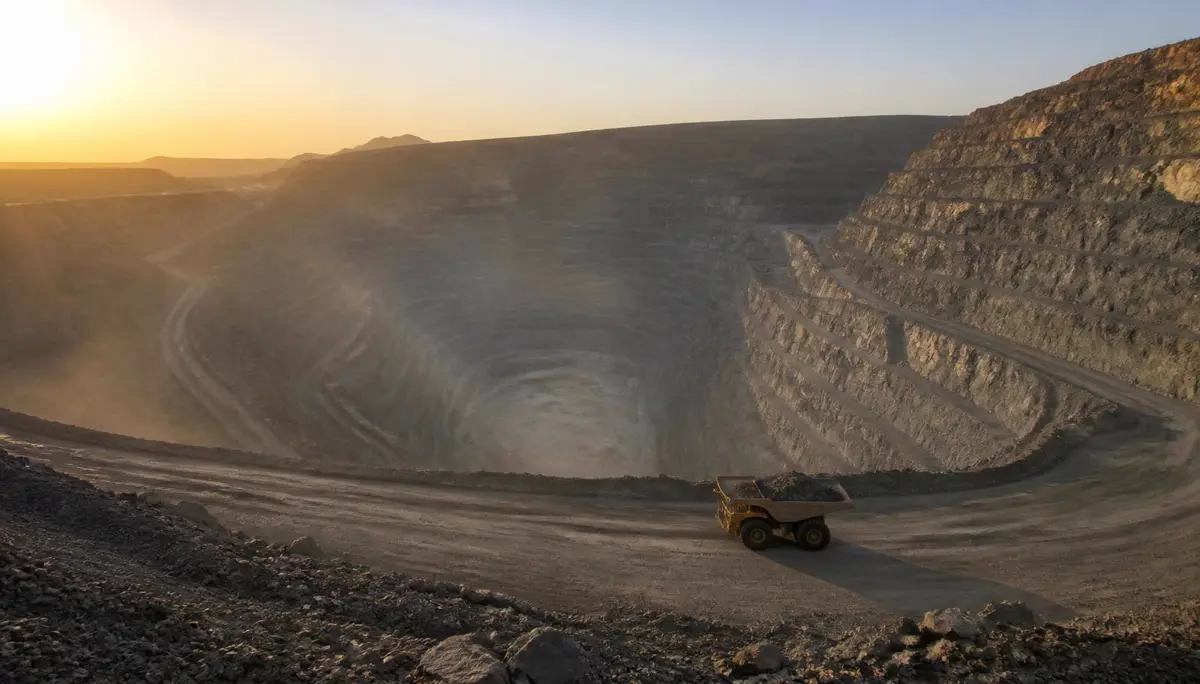
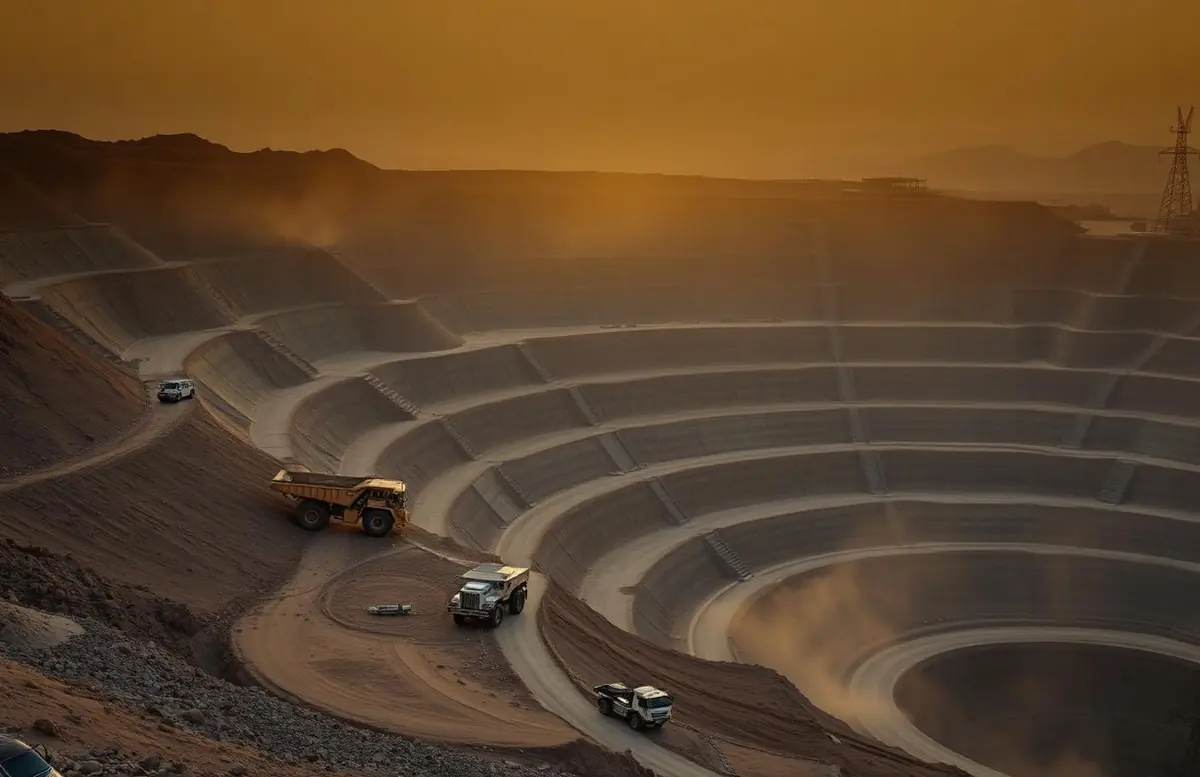
Stand at the rim of a large modern open-pit gold mine and the first thing that registers is not the gold. It is the absence of anything resembling gold. Below you, terraced benches of grey-brown rock descend in a spiral several hundred metres deep, worked by haul trucks the height of a two-storey house, each carrying a load that, once crushed, milled and leached, will yield perhaps a few dozen grams of metal — a load that, laid on a table, would look like nothing more than gravel. The gold is not visible anywhere in the pit, because at the grades most modern mines run, it is not visible anywhere in the rock either. It has to be coaxed out chemically, tonne by tonne, from ore in which it is present at concentrations closer to a contaminant than a resource.
This is the physical reality behind a number that sounds abstract on a mining company's earnings call: all-in sustaining cost, quoted in dollars per ounce, the industry's standard measure of what it costs to keep an existing mine producing gold. It is a genuinely useful number, and it is also, on close inspection, a carefully bounded one — designed to answer a narrower question than most people assume, and silent on several of the costs that actually determine whether gold mining as an industry can keep doing what it has done for the last century and a half.
What AISC actually measures, and what it leaves out
The all-in sustaining cost metric emerged from a 2013 World Gold Council guidance note, adopted industry-wide in response to years of investor complaints that companies were quoting 'cash costs' that excluded so much spending — sustaining capital, exploration near existing mines, reclamation accruals, corporate overhead attributable to operations — that two mines with identical cash costs could have wildly different actual profitability. AISC folded most of those items in, and it remains the most commonly quoted and most useful single figure for comparing operating mines against each other.
What it deliberately excludes is almost as important as what it includes. AISC does not capture the capital cost of building a new mine from scratch, the exploration spending required to find the next deposit once an existing one is exhausted, or growth capital spent expanding an operation's footprint. A company can report a healthy AISC margin at an existing mine while its reserve base quietly shrinks, because nothing in the metric forces it to account for the cost of finding gold's replacement. Sustaining a company's total production a decade out — as opposed to sustaining this year's operating mine — is a fundamentally different, larger and less advertised number.
The arithmetic of grade decline
Ore grade — the concentration of gold within mined rock, typically expressed in grams per tonne — is the single variable that does more than any other to determine a mine's cost structure, and it has been falling for the better part of a century as the highest-grade, easiest-to-find deposits are progressively worked out. Nineteenth-century alluvial workings and early Witwatersrand reef could run to tens of grams per tonne in their richest sections. Many of today's large open-pit operations run at grades close to one gram per tonne or below, a decline of well over an order of magnitude across the industry's history, driven not by any single mine's decline but by the systematic exhaustion of higher-grade deposits and their replacement, in the production mix, by larger and lower-grade ones.
The consequence of low grade is not merely that less gold comes out; it is that vastly more rock must go in to get it. A mine running at one gram per tonne must move, crush and process roughly a thousand tonnes of ore to produce a single kilogram of gold, before accounting for the additional waste rock that must be stripped away simply to expose the ore body in the first place — often several tonnes of waste for every tonne of ore at a deep open pit. Every one of those tonnes costs money to drill, blast, load, haul and crush, whether or not it contains an economic quantity of gold, and every one of those tonnes requires energy, water, explosives, tyres, and the wages of the people and the fuel of the machines doing the moving.
~1 g/t
Typical grade at large modern open-pit gold mines
1,000+ t
Ore that must be processed for roughly one kilogram of gold at that grade
20–35%
Typical share of operating cost attributable to energy
20–40%
Typical share of operating cost attributable to labour
Cut-off grade: the line an economist draws through the geology
Not every gram of gold in the ground is worth mining, and the line between ore and waste — the cut-off grade — is not a geological fact but an economic decision, recalculated whenever costs or the gold price move. Cut-off grade is, at its simplest, the ore grade at which the value of gold recovered from a tonne of rock just covers the cost of mining and processing that tonne. Rock above the cut-off is ore; rock below it is waste, hauled to a dump pile and never processed, regardless of how much gold it technically contains.
A rising gold price lowers the cut-off grade and, in doing so, converts previously uneconomic rock into ore overnight, which is why gold reserves — the portion of a known deposit judged profitably extractable — can grow or shrink from one annual report to the next without a single new drill hole being sunk. This is also why gold mining companies' reserve statements should never be read as a fixed inventory: they are a snapshot of geology filtered through a price assumption, and a company that books larger reserves at a higher gold price is not discovering new gold so much as reclassifying rock it already knew about.
Energy, water and the physical inputs nobody hedges away
A large open-pit gold mine is, from an energy accounting perspective, closer to an industrial-scale earth-moving and crushing operation than to the popular image of mining. Diesel powers the haul trucks, drills and loaders that shift the rock; grid or captive-generation electricity runs the crushers, mills, thickeners and, where used, cyanide leach circuits that liberate the gold chemically from crushed ore. Across the industry, energy typically accounts for somewhere between a fifth and a third of total cash operating cost, and because grade decline means more tonnes must be moved for the same ounce over a mine's life, energy's absolute cost tends to climb even at operations where energy prices themselves have stayed flat.
Fuel price volatility hits miners harder than their hedging books usually anticipate, because unlike gold price exposure — which companies can and do hedge through forward sales, options or streaming arrangements — diesel exposure is operational and continuous, tied directly to daily fleet consumption at remote sites often served by a single, expensive supply chain. A mine in the high Andes or the Sahel pays not just the benchmark diesel price but a substantial logistics premium to truck fuel hundreds of kilometres to site, and that premium widens exactly when global fuel markets are already under strain.
“People think a gold mine's biggest risk is the gold price. Anyone who has actually run one will tell you it's the diesel price, the water permit, and the exchange rate on your labour costs, roughly in that order, and the gold price is a distant fourth.”
Water: the constraint that permits, not prices, now decide
Water has overtaken energy as the single hardest input to secure for many prospective new gold mines, and unlike energy it cannot simply be shipped in at a premium — it must be sourced locally, competing directly with agricultural, municipal and ecological demands in the same watershed. Gold processing, particularly heap leaching of low-grade ore and flotation of sulphide concentrates, is genuinely water-intensive, and much of the world's most prospective remaining gold geology sits in arid or semi-arid terrain across the Andes, the Sahel, southern Africa and inland Australia, where water scarcity is already a source of social and political conflict independent of mining.
- Chile and Peru have both seen major gold and copper projects delayed or blocked outright over community objections to proposed water use, regardless of the underlying deposit's economics.
- Desalination and seawater pumping have become standard, if expensive, workarounds for some coastal Latin American operations, adding a permanent energy and capital cost that earlier-generation mines never carried.
- Dry-stack tailings and reduced-water processing technologies exist and reduce consumption meaningfully, but at a capital and operating cost premium that many marginal projects cannot absorb.
- Permitting authorities increasingly require water-use modelling and community consent processes as a precondition for approval, turning water allocation into a multi-year critical-path item for new mine development.
The practical effect is that a deposit's gold grade and gold price sensitivity, the traditional inputs to a feasibility study, are no longer sufficient to determine whether a mine gets built. A high-grade, low-cost deposit in a water-stressed basin can sit undeveloped for a decade over permitting disputes that have nothing to do with the price of gold, while a lower-grade deposit in a wetter jurisdiction with faster permitting moves to production first. Investors who model gold mining purely on cost curves and price decks are, increasingly, missing the variable that actually decides the order in which the industry's next generation of mines comes online.
Labour, permitting and the years before the first ounce
Labour costs at a formal gold mine typically run between a fifth and two-fifths of operating expenditure, varying with the degree of mechanisation and with local wage conditions, and the trend across most jurisdictions has been upward, driven by skills shortages in remote regions, safety-driven staffing requirements, and a straightforward feedback loop in which a rising gold price raises the wages a mine can afford to pay to attract workers away from competing employers, which then feeds back into the industry's own cost base.
Before any of that labour cost is incurred in production, however, a project typically absorbs years, sometimes over a decade, of exploration, feasibility study and permitting expenditure with no revenue at all. Environmental and social impact assessments, community consultation processes, water and land-use permits, and — in an increasing number of jurisdictions — formal free, prior and informed consent processes with affected indigenous or local communities, can each take years to complete and can each independently halt a project regardless of how favourable its underlying geology and gold-price sensitivity look on paper.
The closure bill nobody wants to price honestly
The final and most chronically underestimated item in the true cost of an ounce of gold is what happens after the ore runs out. Responsible mine closure requires stabilising or backfilling the pit, managing waste rock and tailings so they do not generate acid mine drainage for decades or centuries after operations cease, treating any residual water contamination, and rehabilitating the surface toward some agreed post-mining land use. In well-regulated jurisdictions, operators are required to post a closure bond, calculated against an estimated reclamation cost, before mining even begins, precisely so that the money exists regardless of what happens to the company later.
The record of that system working as intended is mixed at best. Closure cost estimates are frequently revised upward as actual reclamation work proceeds and unanticipated problems — persistent acid drainage, unstable tailings dams, groundwater contamination extending further than modelled — come to light. Several major historical mine abandonments, particularly where the operating company entered bankruptcy before completing closure obligations, have left state and federal governments, and ultimately taxpayers, to fund cleanup costs that ran to many multiples of the bonds originally posted, a pattern documented repeatedly by government auditors in mining jurisdictions across North America, Australia and southern Africa.
Reading the industry's real cost curve
Put the pieces together and the honest cost of an ounce of gold looks less like a single number on an earnings slide and more like a layered structure: a cash operating cost driven overwhelmingly by grade, energy and labour; a sustaining capital layer required simply to keep an ageing mine's equipment and infrastructure functional; a growth and exploration layer, largely invisible in AISC, required to replace the ore body once it is exhausted; and a closure liability, deferred for years or decades, that is systematically estimated under assumptions that later prove optimistic. Add them honestly and the industry's true all-in cost of replacing an ounce of gold, rather than merely producing one from an existing mine, sits meaningfully above the AISC figure that dominates public reporting.
None of this makes gold mining an unprofitable business; margins across the industry have generally been healthy over the past decade because the gold price has risen faster than costs have. But it does mean that the industry's profitability is running against a permanent physical headwind — falling ore grades requiring ever more rock moved, energy consumed and water secured per ounce — that no amount of operational efficiency can fully reverse, only slow. Every mining engineer interviewed for this piece offered some version of the same observation: the geology does not negotiate, and the grade of what is left in the ground, on average, only ever goes one direction.
What the arithmetic means for the next decade of supply
The practical consequence of grade decline, rising input costs and lengthening permitting timelines is a structural tightening of new mine supply that shows up not as a dramatic shortage but as a slow erosion of the industry's ability to replace what it mines each year through new discoveries brought efficiently to production. Exploration budgets across the sector have, in real terms, struggled to keep pace with the scale of new discovery required to offset depletion at existing mines, and the deposits that are being found tend, on average, to be lower grade, more remote, and more water- or politically constrained than the generation of mines they are meant to replace.
Geological Scarcity: The Search for the Next Deposit
The narrative of gold mining is often framed as a quest for new frontiers, but the reality is that the industry is increasingly mining the ghosts of past discoveries. Most of the 'low-hanging fruit' — high-grade deposits near the surface in stable jurisdictions — was found and exhausted in the 19th and 20th centuries. Today, exploration teams are forced to look deeper, in more remote locations, and beneath layers of 'cover' (unproductive rock and sediment) that can be hundreds of metres thick. This has turned exploration from a prospector’s gamble into a multi-billion dollar exercise in high-stakes geophysics, where a single drill hole can cost hundreds of thousands of dollars and the odds of finding a Tier-1 deposit are vanishingly small.
Even when a significant deposit is found, the lead time from discovery to the first pour of gold has lengthened significantly. In the 1970s, a mine could be brought online in five to seven years; today, the average is closer to fifteen. This delay is a product of more complex geology, more stringent environmental regulations, and the sheer scale of the infrastructure required to support a modern operation. A mine in a remote part of the Canadian Arctic or the Gobi Desert requires its own power plant, its own roads, its own airstrip, and a supply chain that can operate in extreme temperatures. The capital required to build these 'islands of industry' means that only the largest gold deposits — those with millions of ounces in reserves — are even considered for development.
The result is a 'discovery gap' that haunts the industry’s long-term forecasts. While the gold price has remained high, the rate of new major discoveries has not kept pace with the rate at which existing mines are being depleted. This is not because the world is 'running out' of gold in a literal sense, but because it is running out of deposits that are both geologically suitable and economically viable at current costs. The industry is effectively eating its own seed corn, relying on the expansion of existing ore bodies rather than the discovery of new ones to maintain production levels. Without a significant technological breakthrough in how we find gold beneath the earth’s surface, the 2030s could see a structural decline in global mine output.
“We are no longer looking for needles in haystacks. We are looking for slightly different shades of yellow in a field of hay, using sensors that cost more than the hay itself.”
The Regulatory Wall: Permitting and Social License
If geology is the first hurdle for a new gold mine, the regulatory process is often the most formidable. In the modern era, a 'Social License to Operate' is no longer an optional extra; it is the fundamental requirement for a mine’s existence. Communities located near prospective deposits now demand a much larger share of the economic benefits and a much higher degree of environmental protection than they did even twenty years ago. In jurisdictions ranging from Romania to El Salvador, massive gold deposits have been left in the ground because the local population decided that the risks to their water supply and traditional way of life were not worth the royalties and jobs a mine would provide.
This shift has transformed the way mining companies approach project development. Environmental Impact Assessments (EIAs) have grown from modest technical documents into multi-volume encyclopedias that take years to compile and even longer for regulators to review. These studies must account for everything from the impact on local bird migrations to the long-term stability of tailings dams in a changing climate. The cost of this process is immense, but the cost of getting it wrong is higher: a single successful legal challenge by an NGO or a community group can tie a project up in court for a decade, burning through capital while the gold stays in the ground. Permitting is now the 'critical path' for every major gold project, and the timeline is increasingly dictated by politics rather than engineering.
Furthermore, the rise of Environmental, Social, and Governance (ESG) investing has brought a new set of auditors into the mix. Major institutional investors now require gold miners to demonstrate not just profitability, but a commitment to net-zero emissions, responsible water management, and the protection of human rights in their supply chains. A company that fails to meet these standards may find itself locked out of the capital markets, even if its mines are highly profitable. This has led to a paradoxical situation where the 'cleanest' gold is also the most expensive to produce, as companies invest heavily in renewable energy and water recycling to satisfy their shareholders and the public. The 'real cost' of an ounce of gold now includes a permanent premium for environmental and social compliance.
15 years
Average time from discovery to first gold pour
1 in 100
Success rate of exploration drill targets
$50M+
Typical cost of a full Environmental Impact Assessment
200%
Increase in ESG-related disclosure requirements since 2015
Automation and the Future of Extraction
As ore grades decline and labour costs rise, the industry is turning to automation as its primary survival strategy. The vision of a modern gold mine is increasingly one where the 'miner' is a technician sitting in an air-conditioned control room hundreds of kilometres from the pit, operating a fleet of autonomous haul trucks and remote-controlled drills. This technology allows for greater precision, higher productivity, and — most importantly — a significant reduction in the safety risks associated with moving millions of tonnes of rock. By removing humans from the most dangerous parts of the mine, companies can operate longer hours and extract gold from deposits that were previously considered too dangerous or too remote to work.
Automation also allows for a level of 'selective mining' that was previously impossible. Advanced sensors mounted on shovels and conveyors can now distinguish between ore and waste in real-time, allowing the mine to only process the rock that is actually profitable. This reduces the energy and water required by the mill and minimizes the volume of tailings produced. In an era of one-gram-per-tonne ore, this kind of efficiency is the difference between a profitable mine and a stranded asset. The 'digital mine' is not just about robots; it is about using data to optimize every single blast, every haul cycle, and every chemical reaction in the processing plant.
However, the transition to an automated future is not without its own costs. The initial capital investment required to digitize a mine is enormous, and it requires a new kind of workforce that is often in short supply in traditional mining regions. Moreover, automation can create tension with local communities who were promised thousands of manual labour jobs that no longer exist. The 'social contract' of mining — the trade-off between environmental impact and local employment — is being renegotiated as the industry becomes more capital-intensive and less labour-intensive. The gold mine of the future will produce more metal with fewer people, but the political challenge of ensuring that the benefits of that metal are shared fairly will only grow.
- Autonomous haulage systems increase truck utilization by up to 15%.
- Remote drilling reduces personnel exposure to high-risk areas by 90%.
- Real-time ore sensing minimizes the 'dilution' of high-grade ore with waste rock.
- Predictive maintenance algorithms reduce equipment downtime and spare parts costs.
This is the quiet, unglamorous story sitting underneath every headline about the gold price: the metal is not becoming harder to find because it is running out in any absolute sense — known and inferred resources remain very large relative to annual production — but because each successive generation of deposits costs more, in energy, water, labour, capital and time, to bring into production than the generation before it. Nine grams a tonne was, not so many decades ago, considered a mediocre grade barely worth developing. Today, a mine averaging even half of that, worked at industrial scale with modern processing technology, can be a perfectly viable and profitable operation — which tells you less about how the rock has changed than about how much more expensive, and how much more sophisticated, the industry has had to become simply to keep pace with a resource that gets thinner every year.
Frequently asked
Questions readers ask
- What is all-in sustaining cost (AISC) and why does it matter?
- AISC is the mining industry's standardised measure, adopted from World Gold Council guidance, of the cost to produce and sell an ounce of gold from an operating mine, including cash operating costs, sustaining capital, general and administrative costs, and mine-site exploration. It deliberately excludes major growth capital, new project development, and much exploration aimed at finding entirely new deposits. That exclusion is the source of most disputes about the metric: it tells you what it costs to keep an existing mine running, not what it costs to replace it once the ore is exhausted.
- What is a typical ore grade for gold mining today?
- It varies hugely by deposit type, but global average grades have fallen steadily for decades as high-grade deposits are depleted and mining moves to lower-grade, larger-tonnage bodies. Many modern open-pit operations run at roughly one gram of gold per tonne of ore or less, meaning a tonne of rock — about the volume of a small car — must be blasted, hauled, crushed and processed to recover a sliver of metal smaller than a wedding ring.
- Why do energy costs matter so much to gold mining?
- Because moving and crushing rock is an energy-intensive business long before any chemistry happens. Diesel powers the haul trucks that move ore and waste, and electricity runs the crushers, mills and processing plants. Energy typically represents somewhere between a fifth and a third of total operating costs at a large mine, and because grades are falling, more rock must be moved for the same ounce over time, which means energy's share of cost tends to rise even when energy prices themselves are flat.
- Why is water becoming a bigger constraint than gold price for new mines?
- Ore processing, particularly heap leaching and flotation, requires large volumes of water, and many of the world's most prospective new gold districts sit in arid or water-stressed regions of Latin America, southern Africa and Australia where agricultural and municipal users already compete for scarce supply. Permitting authorities in these jurisdictions increasingly treat water allocation, not gold price forecasts, as the decisive constraint on whether a new mine can be built at all, and community opposition to mining water use has stalled or killed several large projects regardless of their underlying gold economics.
- What happens to a mine once the gold runs out?
- In a well-regulated jurisdiction, the operator is required to close the pit or underground workings, remove or stabilise waste rock and tailings, treat any residual water contamination, and rehabilitate the surface, funded by a closure bond posted before mining even begins. In practice, closure costs are frequently underestimated at the planning stage, and several major historical mine closures — particularly from companies that went bankrupt before completing reclamation — have left governments and taxpayers to cover cleanup costs that dwarfed the bonds originally posted.
- Does a higher gold price simply make low-grade ore profitable to mine?
- Up to a point, yes — this is the basic logic of cut-off grade, the ore grade below which processing a tonne of rock costs more than the gold recovered from it is worth. A higher gold price lowers the cut-off grade and brings more of a deposit into profitable range. But the relationship is not linear: lower-grade ore requires moving and processing proportionally more rock for the same ounce, which raises energy, water and labour costs, and eventually a mine hits a point where even a much higher gold price cannot outrun the physical cost of moving enough rock to matter.
- How much of the cost of a gold mine is labour?
- It varies by jurisdiction and by whether the operation is highly mechanised or labour-intensive, but labour typically represents somewhere between a fifth and two-fifths of operating costs at a formal mine, and considerably more at underground operations that cannot substitute capital equipment as easily as open pits can. Skilled labour shortages in remote mining regions, and rising wage expectations tied to the gold price itself, have pushed labour costs up steadily even as automation has reduced headcount per tonne processed at the most modern operations.