Mine Economics
Grade, Cut-off and the Arithmetic of an Open Pit
A gold mine is not a hole with gold in it. It is a spreadsheet with a hole attached — and the single number that decides which rock is ore and which rock is waste moves every time the price does.
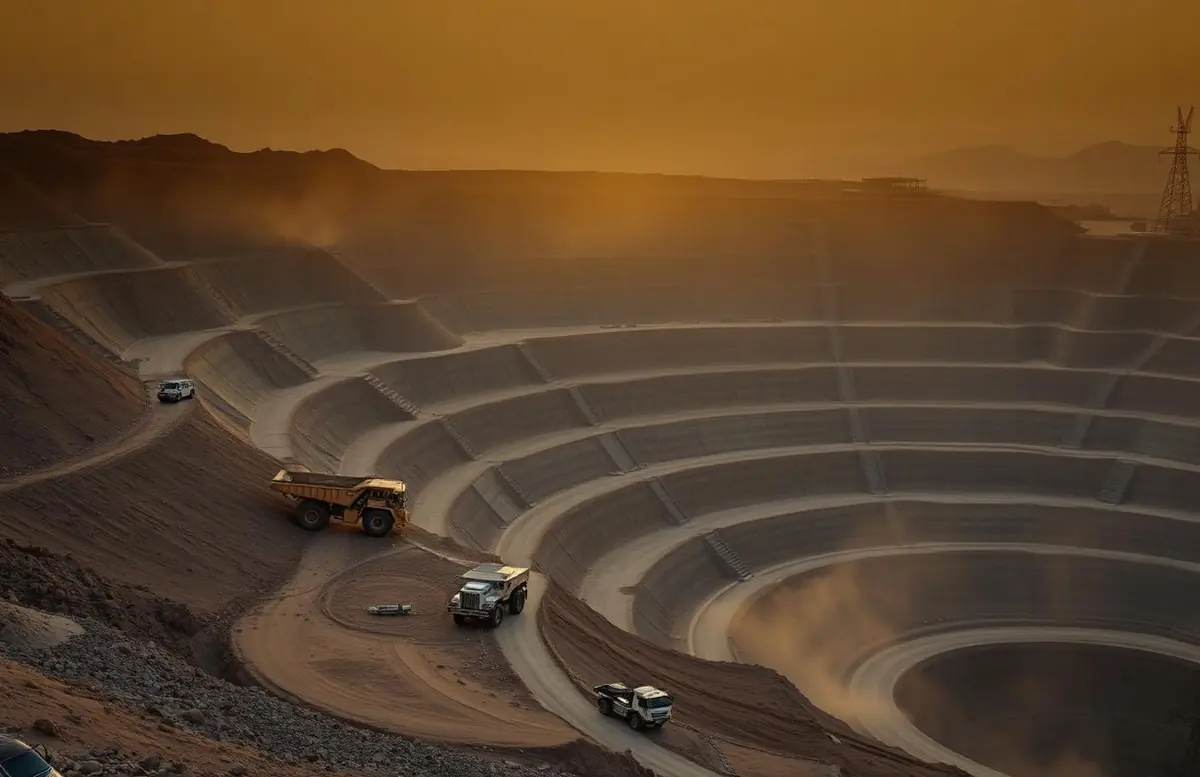
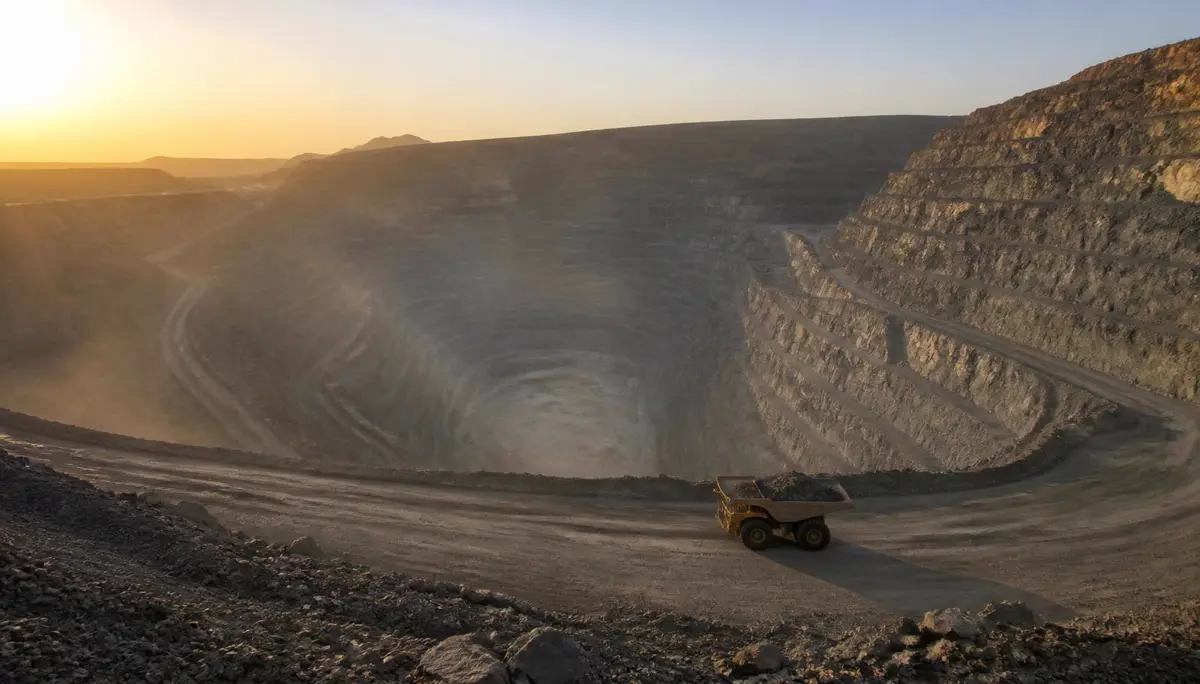
Stand on the rim of a modern open-pit gold mine and the first thing that fails is intuition about scale. The haul trucks at the bottom of the pit look like toys, and they are moving material at a rate that would fill a football stadium in a fortnight. The second thing that fails is intuition about content. Almost none of that rock contains gold in any quantity a person could see. The ore is a fine-grained grey andesite that looks exactly like the waste beside it, and the difference between the two is a number produced in a laboratory.
That number is the entire business. Everything else at a mine — the fleet, the mill, the tailings facility, the workforce, the community agreement, the closure bond — is machinery for turning grade into cash flow at an acceptable cost per tonne. To understand why gold mining behaves as it does through a price cycle, you have to understand the arithmetic that sits underneath the machinery.
Grams per tonne, and what that means physically
Gold grade is quoted in grams per tonne. A typical large open pit operates on ore in the range of roughly 0.6 to 2 g/t. One gram per tonne is one part per million: a single gram of metal — less than a wedding band — dispersed through a tonne of rock, which is about the load of a small pickup truck filled to the brim.
This is why the industry is a bulk materials business that happens to sell a precious metal. The operational problem is not finding gold; it is moving, crushing and chemically stripping tens of millions of tonnes of rock per year cheaply enough that a few parts per million pays for all of it. Every economy of scale in modern mining — the 400-tonne trucks, the semi-autogenous mills the size of houses, the heap-leach pads measured in square kilometres — exists to reduce the cost per tonne by fractions of a dollar.
1 g/t
One part per million — a common open-pit ore grade
3:1
Typical strip ratio: waste tonnes moved per tonne of ore
88–94%
Recovery range for conventional carbon-in-leach circuits
1–2 yrs
Time from ore in the pit to metal at the refinery, including stockpiles
The energy-grade trade-off
The fundamental constraint on modern mining is not the availability of gold but the availability of energy. As average ore grades decline globally, the amount of rock that must be crushed and moved to produce a single ounce of gold rises exponentially. This increases the energy intensity of production, making mine margins highly sensitive to the cost of diesel and electricity, which together can account for a third or more of a mine's operating expenses.
Mining companies have responded by investing heavily in energy efficiency and, increasingly, on-site renewable power generation. Solar and wind farms, coupled with large-scale battery storage, are becoming common features at remote mine sites where the cost of hauling fuel is prohibitive. These investments not only reduce the mine's carbon footprint but also provide a degree of protection against the volatility of global energy markets.
However, there is a physical limit to the efficiency gains that can be achieved. Breaking rock requires a fixed amount of work, and as the industry moves toward ultra-low-grade deposits, the energy cost per ounce will continue to rise. This structural trend suggests that the long-term price floor for gold is increasingly dictated by the cost of the kilowatts required to extract it from the crust.
“A mine is a living organism that consumes capital and energy to produce metal; if you starve it of either, the organism dies.”
Water scarcity as a geological constraint
In many of the world's most productive gold regions, from the Atacama Desert to the Western Australian outback, water is as precious a commodity as the metal itself. Modern gold processing, particularly heap leaching and milling, requires vast quantities of water to function. As climate patterns shift and local competition for water resources intensifies, securing a reliable water supply has become a primary bottleneck for new mine development.
To address this, companies are increasingly turning to capital-intensive solutions like seawater desalination and long-distance piping. These projects add hundreds of millions of dollars to the initial build cost and raise the ongoing operational expense. In some jurisdictions, the inability to secure a long-term water licence is enough to render a geologically superior deposit completely unmineable.
Furthermore, the management of water after it has been used in processing is a major environmental and regulatory concern. The requirement to treat and recycle water, and to ensure that no contaminated effluent reaches the local water table, adds another layer of complexity and cost. Water management is no longer a supporting function but a central pillar of a mine's economic and social viability.
The digitisation of the pit
The modern gold mine is increasingly a data-driven enterprise. From real-time sensing of ore grades on the conveyor belt to the use of machine learning algorithms to optimise mill throughput, digitisation is touching every aspect of the operation. These technologies allow mine planners to react much faster to changes in geology or market conditions, squeezing extra margin out of deposits that would have been marginal a decade ago.
Digital twins — virtual models of the entire mining operation — allow engineers to test different scenarios and predict maintenance needs before a failure occurs. This proactive approach reduces unplanned downtime and extends the life of expensive machinery. The ability to model the mine's performance with high precision also makes it easier to secure project financing, as lenders have more confidence in the production forecasts.
As the industry continues to evolve, the distinction between a mining company and a technology company is blurring. The most successful operators are those that can effectively integrate advanced data analytics with traditional geological expertise. In the future, the competitive edge in gold mining may depend as much on the quality of a company's software as on the quality of its rock.
Cut-off grade: where accounting becomes geology
Every tonne coming out of the pit is assigned to one of two destinations. If the value of the recoverable metal it contains exceeds the incremental cost of processing it, it goes to the mill and is called ore. If not, it goes to the waste dump. The grade at which those two quantities are equal is the cut-off, and it is calculated, not discovered.
The consequence is one of the least intuitive facts about the industry. When the gold price rises, mines do not simply earn more on the same ore; they lower their cut-off and mill rock that was waste last quarter. Total reserve tonnage rises, average grade falls, and the mine life extends — all without a new discovery. When the price falls, the process runs in reverse, and ounces vanish from the reported reserve of a deposit that has not changed at all.
“People imagine the orebody has an edge. It does not. It has a price at which we choose to stop calling it ore.”
This flexibility is also a trap. Milling lower grade to chase a high price fills the plant with rock that only works at that price, and mining companies have repeatedly destroyed value by doing it near a cycle top: the high-grade ounces get diluted into a longer, thinner mine life, and when the price retreats the operation is left with a stockpile nobody wants and a strip ratio it can no longer justify.
Strip ratio: the cost of getting to the ore
An open pit must be wide at the top to be deep at the bottom, because rock walls have to be cut back to an angle at which they do not fail. Every tonne of ore beneath therefore carries a burden of waste rock that must be removed to reach it. That burden is the strip ratio, and it climbs as the pit deepens.
A pit that starts at two tonnes of waste per tonne of ore may end its life at eight. Since the cost of moving waste is nearly identical to the cost of moving ore, and the waste generates no revenue, the strip ratio quietly sets the depth at which the pit stops. Mines do not usually close because the gold runs out. They close because the next slice of gold sits under too much rock.
Recovery: the ounces you do not get
Milling does not extract everything. Conventional cyanide leaching with carbon adsorption recovers something like 88 to 94 percent of contained gold from amenable ore. The remainder — locked in sulphide minerals, adsorbed onto carbonaceous material, or simply too finely disseminated — reports to the tailings and is gone for practical purposes.
Ore that resists leaching is called refractory, and it is an increasing share of the global pipeline as the easy oxide caps of known deposits are exhausted. Treating it requires pressure oxidation, roasting or bio-oxidation before leaching: capital-intensive processes that add hundreds of millions to a build and materially raise the price at which a deposit works. A large proportion of the undeveloped gold in the world is undeveloped for precisely this reason.
Reserves, resources and the honesty of the categories
Reporting codes distinguish resources — mineralisation with reasonable prospects for eventual economic extraction — from reserves, the subset demonstrated to be economically mineable under a stated set of assumptions. The distinction is routinely flattened in press coverage, which reports the larger number because it is larger.
- Inferred resource — estimated from limited drilling; cannot legally be converted directly into a reserve.
- Indicated and measured resource — denser drilling, higher confidence in grade and continuity.
- Probable and proven reserve — the measured or indicated material that survives a mine plan, a cost model and a price assumption.
- Stated price assumption — the figure that quietly determines all of the above, and which companies disclose but few readers check.
What all-in sustaining cost leaves out
AISC was introduced to replace an older cash-cost measure that flattered the industry by ignoring the capital required to keep a mine functioning. It was a genuine improvement. It is still not the cost of producing gold.
It excludes the initial capital that built the mine, which for a large greenfield project can exceed a billion dollars and is never recovered in the metric. It excludes exploration for the deposits that will replace the current one. It typically understates the full lifetime obligation for closure, water treatment and rehabilitation, some of which persists for decades after the last ounce is poured. A sector can report a comfortable margin over AISC across a full cycle and still, in aggregate, have returned less to shareholders than it consumed.
None of this is hidden. It is all in the annual reports, in the technical reports filed under the reporting codes, and in the closure provisions in the notes to the accounts. It is simply less quotable than a single dollar figure, and the industry has learned that a single dollar figure is what gets printed.
The permitting clock runs longer than the price cycle
A discovery does not become a mine on the schedule the gold price suggests it should. Between a positive drill result and first pour sits, typically, a decade or more of resource definition drilling, feasibility studies, environmental and social impact assessment, permitting across multiple layers of government, land agreements with communities and, increasingly, financing arranged years before construction begins. None of these steps compress meaningfully just because the price has doubled.
Why supply cannot chase price the way people expect
This mismatch between the pace of the gold price and the pace of the supply chain is the single most important structural fact in mine economics, and it explains a pattern repeated across every cycle: prices rise, the applause goes to explorers and developers, capital floods into the sector, and the resulting new supply arrives five to ten years later — often just as the price cycle that funded it has turned. Mining companies that time construction decisions to the top of a price cycle frequently commission a mine into a lower price environment than the one that justified building it.
The rational response, which the best-run companies have learned slowly and expensively, is to build project economics around a conservative long-term price assumption rather than the spot price on the day the board approves capital, and to treat any price above that assumption as a bonus rather than as the basis for the investment case. Companies that ignored this discipline during previous booms are, disproportionately, the companies whose names now appear in case studies about capital destruction in mining.
The social and environmental ledger
A modern gold mine's economics no longer stop at the mine gate. Community agreements, water licences, biodiversity offsets and closure bonds are contractual and financial obligations with real cash costs, not reputational add-ons, and they increasingly determine whether a deposit that is geologically and metallurgically attractive is actually financeable at all.
- Water — a large open pit and mill can be among the largest water users in its region, and securing rights or building desalination and recycling capacity is now a major line item in feasibility studies.
- Tailings storage — the facility holding processed waste is a mine's most consequential long-term liability, and failures elsewhere in the industry have driven a global tightening of design and independent review standards.
- Closure and rehabilitation — regulators increasingly require bonds posted upfront, covering decades of post-closure water treatment and land rehabilitation, funded before a single ounce is produced.
- Community agreements — negotiated benefit-sharing, employment quotas and local procurement commitments, now standard conditions for a social licence to operate in most major gold-mining jurisdictions.
Underground economics: a different arithmetic entirely
Everything above describes an open pit, but a meaningful share of the world's gold, particularly the highest-grade deposits, is mined underground, where the economics invert in important ways. There is no strip ratio in the open-pit sense — waste rock is still removed to access ore, but through development drives and stopes rather than benches — and the constraint shifts from moving overburden to the sheer physical difficulty and cost of working at depth: ventilation, ground support, rock-burst risk in deep, high-stress mines, and the logistics of moving people and material vertically rather than along a ramp.
Because underground development is so much more expensive per tonne than open-pit mining, underground mines generally need materially higher grade to work at all — commonly several grams per tonne rather than the sub-two-gram grades that support a large open pit. This is why grade and mining method are not independent choices: a deposit's geometry and grade distribution often dictate whether it can only ever be an underground mine, only ever an open pit, or a pit that transitions to underground once the strip ratio at depth becomes uneconomic, a transition that is itself one of the more difficult and expensive engineering decisions in the industry.
“The pit tells you what the rock will give up cheaply. Going underground is the industry admitting the cheap part is finished and the rest will cost what it costs.”
5–10+ g/t
Typical minimum grade to justify underground mining
10+ years
Common span from discovery to first production
Decades
Post-closure water treatment obligation at many modern mines
How a pit is actually optimised
Nobody designs an open pit by eye. The shape of a modern pit is the output of an optimisation algorithm run against a three-dimensional block model of the deposit — a grid of estimated grades, typically in blocks of ten or twenty metres on a side, built up from thousands of drill-hole assays and interpolated between them using geostatistical methods. Each block is assigned an estimated grade, a mining cost, a processing cost and a metallurgical recovery, and from those inputs the software calculates whether that block is worth mining at all, and if so, whether it is worth mining as ore or simply moved and dumped as waste on the way to something better underneath it.
The classic algorithm for this, developed decades ago and still the conceptual basis for the commercial packages every major mining company runs today, is known in the industry by the names of its originators, Lerchs and Grossmann. It treats the problem as a graph: which combination of blocks, respecting the physical constraint that you cannot mine a block without first removing everything sitting above it at a stable wall angle, maximises total undiscounted value. Run at a single gold price, it produces the ultimate pit limit — the largest shape that could ever be justified at that price. Run at a sequence of ascending price assumptions, it produces a set of nested shells, each one a candidate final pit at a different price, and mine planners use that nest to decide not just how big to dig but in what order.
This is the part that separates a mine plan from a resource estimate. A resource tells you where the gold is. A pit optimisation and a mine schedule tell you the order in which you are financially permitted to go and get it, because value that arrives sooner is worth more than the identical value arriving in year twelve. The nested-shell approach lets planners chase the highest-value ore first — usually the shallowest, highest-grade material with the lowest strip ratio — and defer the expensive, deep, low-grade material to later years when, if the price has risen as hoped, it might have become economic in its own right.
“The optimiser does not know what gold is. It knows numbers in cells. Our job is making sure the numbers we feed it are honest, because it will find the most profitable way to be wrong.”
Net present value and the discipline of sequencing
A pit shell answers the question of where the boundary of the mine should sit. It does not answer the more commercially important question of what order to mine it in, and that question is decided by net present value rather than total undiscounted metal content. Two mine plans can contain the exact same ounces and differ enormously in value, because one front-loads the high-grade, low-strip ore into the first three years and the other spreads it evenly across the mine's life.
This is why experienced mine planners talk about sequencing with something close to reverence. A schedule that mines the best ore first maximises early cash flow, pays back construction capital faster, and gives the operator more room to survive a price downturn later in the mine's life, when the ore remaining is by definition worse than what has already been processed. A schedule that mines conservatively, holding back high-grade ore to blend with lower-grade material and smooth the head grade delivered to the mill, produces a more even production profile but a lower net present value, because the deferred high-grade ounces are worth less in today's money than the same ounces mined tomorrow.
The tension between these two instincts — mine the best rock first to maximise value, or blend deliberately to protect mill performance and extend visible mine life for the market — recurs at every large gold operation, and the choice a company makes says as much about its capital structure and its investors' time horizon as it does about the geology underneath it.
Byproduct credits and the true cost of an ounce
Very few gold deposits produce only gold. Silver is a near-universal companion in the same ore, and depending on the deposit, copper, lead, zinc or molybdenum can arrive alongside it in quantities large enough to matter. When a mine sells that byproduct metal, standard industry practice is to net the revenue against the cost of producing gold rather than reporting it as separate income, which produces the byproduct-adjusted cost figures that appear in almost every quarterly earnings release.
This convention is defensible — the ore had to be mined and milled regardless of which metal paid for it — but it also means that two mines with identical gold-only economics can report dramatically different headline costs purely because one happens to sit on a silver-rich vein system and the other does not. A copper-gold porphyry with a strong copper credit can report a gold cost near zero, or even negative, in a strong copper price environment, which tells you a great deal about copper and comparatively little about the underlying difficulty of producing the gold itself.
Taxation, royalties and the government's share
Every tonne of ore that clears cut-off and pays for its own processing still owes a share of its value to the state before a shareholder sees a cent. Royalties, levied on revenue rather than profit, are payable whether the mine is making money or not, which makes them a particularly unforgiving cost in a downturn. Corporate income tax, import duties on capital equipment, withholding taxes on dividends and, in some jurisdictions, a direct government equity stake or a requirement to process ore domestically rather than export concentrate, all sit on top of the operating arithmetic described earlier in this piece.
Fiscal terms vary enormously between jurisdictions and change over the life of a mine far more often than most investors appreciate; a government facing budget pressure can and does revisit royalty rates on operating mines, and a company that modelled a project against one fiscal regime can find itself producing under a materially different one a decade later. Sovereign risk in mining is therefore not only about expropriation or civil unrest, the headline scenarios, but about the slower and more common risk that the tax and royalty terms embedded in a feasibility study simply do not survive contact with a future government's revenue needs.
Currency, hedging and the price a mine actually receives
Gold is priced and sold in US dollars almost everywhere, but a mine's costs are overwhelmingly denominated in the local currency of the country it operates in — wages, diesel, local contractor invoices, some portion of the royalty. A mine's margin is therefore a function of two prices moving independently: the dollar gold price, and the exchange rate between the dollar and the local currency in which the mine actually pays its bills. A depreciating local currency can improve a mine's margin even while the dollar gold price is falling, because costs measured in dollars shrink faster than revenue does, and the reverse is equally true.
Some producers hedge part of their future gold sales, locking in a price for a portion of production months or years ahead, usually to satisfy a project lender that requires certainty of cash flow to service construction debt. Hedging protects the downside and gives it away in equal measure: a mine that hedged production at a fixed price during a period of rising prices delivers that gold at the old, lower price while unhedged peers capture the rally in full, which is why heavily hedged producers have periodically been treated by investors as a worse way to own gold exposure than the metal itself, even when the underlying mine is performing exactly as planned.
10–20 m
Typical block size in a resource model, in metres per side
Nested shells
Output of pit optimisation run across a range of price assumptions
0–100%
Range of government equity stakes seen across mining jurisdictions
A worked illustration of grade decline
Consider a hypothetical but representative pit that begins production processing ore at 1.4 grams per tonne and a strip ratio of 2:1. In its early years, mining the shallowest and richest part of the deposit, it might comfortably beat that average, delivering 1.8 grams per tonne to the mill while the strip ratio sits below its life-of-mine average, because there is simply less overlying waste to remove near the surface. Cash costs in these early years look excellent, margins are strong, and the operation is, on paper, one of the better assets in its peer group.
By year eight, the pit has deepened substantially. The strip ratio has climbed past 4:1 as the walls have to be pushed back further to maintain stability at depth, and the remaining ore, having been mined selectively from the top down, now averages closer to 1.1 grams per tonne. Costs per ounce rise for two compounding reasons at once — more waste per tonne of ore, and less gold per tonne of ore — even though nothing about the underlying orebody has changed and the mine plan is executing exactly as designed. An investor who benchmarked the mine against its glowing first-year cost figures and did not read the life-of-mine schedule will experience this decline as a surprise. A mine planner experiences it as the plan working correctly.
Heap leach versus mill: a cheaper answer for lower grade
Not every deposit justifies a conventional mill, with its crushing, grinding and agitated-tank leaching circuit built to extract every recoverable percentage point of gold at high cost per tonne. For lower-grade, more amenable oxide ore, many operators instead use heap leaching: crushed ore is stacked on an impermeable pad in heaps tens of metres high, irrigated with a dilute cyanide solution that percolates slowly downward, and the pregnant solution is collected at the base and processed for gold recovery. It is dramatically cheaper per tonne than milling and requires far less capital, which is precisely why it exists — it allows ore too low-grade to justify a mill to be processed economically at all.
The trade-off is recovery and time. Heap leaching typically recovers a smaller share of contained gold than a well-run mill circuit, and it does so over weeks or months of percolation rather than the hours a mill takes to process the same tonnage, which means heap-leach operations carry more inventory in process at any given moment and are slower to respond when a mine planner wants to change what is being fed to the pad. Many large gold complexes run both a mill and a heap-leach pad side by side, directing higher-grade or refractory ore to the mill and lower-grade, amenable oxide ore to the pad, extracting value from parts of the deposit that would be waste under either method alone.
Reading a mining company like a mine planner
For an investor or a curious reader, the practical lesson of all this arithmetic is which numbers to distrust on first reading. A headline resource figure says little without the price assumption behind it. A quoted AISC says little without knowing what sustaining capital was excluded. A strip ratio quoted as a single average hides the fact that it rises through the mine's life, back-loading cost onto the years when the ore is hardest to reach. The rock does not change. The number describing it changes constantly, and understanding why is the difference between reading a mining report and merely skimming one.
Frequently asked
Questions readers ask
- How much gold is in a tonne of ore?
- At a typical modern open-pit operation, roughly one to two grams per tonne. High-grade underground mines can run five to ten grams or more; a handful of exceptional deposits exceed thirty. One gram per tonne is one part per million — the metal is invisible in the rock and is detected by assay, not by eye.
- What is cut-off grade?
- The lowest grade at which a tonne of rock generates more revenue than it costs to process. Rock above it is ore and goes to the mill; rock below it is waste and goes to the dump. Because the calculation depends on the gold price, energy costs and recovery rate, the boundary between ore and waste moves with the market.
- What does all-in sustaining cost actually measure?
- Cash operating costs plus royalties, corporate overhead and the sustaining capital needed to keep the current operation running. It deliberately excludes the initial construction capital, exploration for new deposits, and usually mine closure and rehabilitation in full. It is a useful comparative measure and a poor measure of whether a mine repaid its build.
- Why do reserves change every year?
- Because reserves are defined against an assumed gold price and a cost model. Companies restate them annually; a lower price assumption can delete millions of ounces from a reported reserve without a single rock changing composition.
- Why does it take so long to build a new gold mine?
- Resource definition drilling, feasibility studies, environmental and social impact assessment, multi-layered permitting and project financing typically span a decade or more before construction even begins. None of these steps compress meaningfully when the price rises, which is why new supply consistently lags the price cycle that motivated it.
- Why do underground mines need much higher grade than open pits?
- Underground development — ventilation, ground support, vertical haulage — costs far more per tonne than open-pit mining, so a deposit generally needs several grams per tonne or more to cover that cost. Open pits can work profitably on sub-two-gram ore because moving rock along a ramp is comparatively cheap.
- What is the difference between a brownfield and a greenfield project?
- A greenfield project is a new discovery in an area with no existing infrastructure, requiring a full build from scratch. A brownfield project is an expansion or satellite deposit near an existing mine, which can leverage existing mills and fleets, significantly lowering the capital cost and grade threshold required for viability.