Industrial Demand
The Gold Inside Your Phone
Industrial demand is the quietest third of the gold market: a few tenths of a gram per handset, multiplied by billions of devices, chosen not for prestige but because nothing else conducts as reliably for as long.
The gold market is usually described in two halves: jewellery on one side, investment and official reserves on the other. Between them sits a third category that rarely gets a paragraph, because it involves quantities too small to photograph and applications too dull to romanticise. Technology consumes a few hundred tonnes of gold a year in the form of films a fraction of a micron thick and wires thinner than a hair, and it does so for reasons that have nothing to do with what gold looks like.
Engineers do not specify gold because it is precious. They specify it because of a narrow and unglamorous property: it does not build up an insulating layer. Everything else follows from that.
The oxide problem
Copper is a superior conductor to gold and costs a tiny fraction as much. In a sealed, soldered joint it is the obvious choice and it is used everywhere. The difficulty appears at any surface exposed to air, particularly one that is repeatedly separated and remated — a connector, a card edge, a switch contact, a relay.
Copper oxidises. Silver, the best conductor of all, forms sulphide films in ordinary indoor air. Both films are electrically resistive, both grow with time and temperature, and both concentrate at exactly the microscopic high spots where a contact actually touches. The result is a connection whose resistance drifts upward over years — the intermittent fault that appears on a cold morning and disappears when someone wiggles the plug. Gold does not form these films at all. A gold-plated contact behaves in year fifteen approximately as it did on the assembly line.
“We are not buying conductivity. Copper wins on conductivity. We are buying the guarantee that the surface will still be a surface in ten years.”
Where the metal actually sits
Open a phone and the gold is distributed across a handful of unremarkable places, none of them visible without magnification.
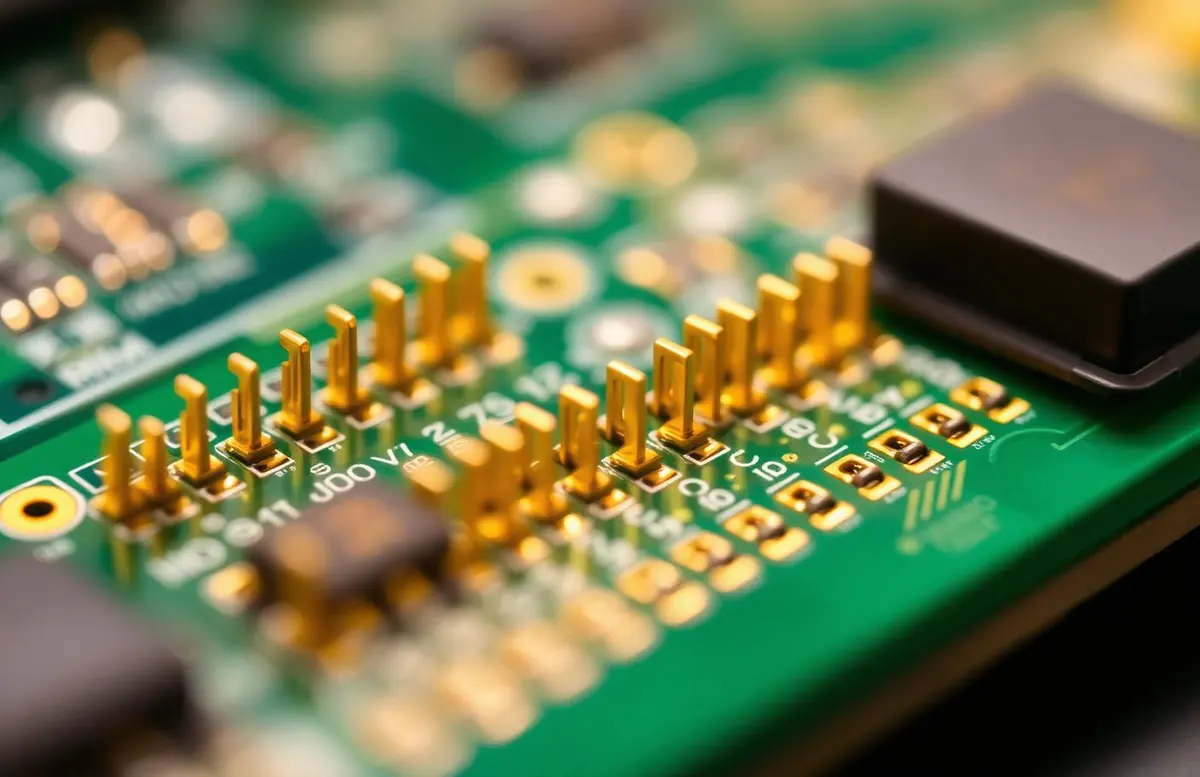
- Connector and contact plating — board-to-board connectors, SIM and card contacts, test pads and antenna springs, typically a hard gold layer under a micron thick over a nickel barrier.
- PCB surface finish — electroless nickel immersion gold, a very thin gold film that keeps copper pads solderable and flat during storage and assembly.
- Die interconnect — the wires or bumps joining a silicon chip to its package, historically gold, now substantially copper in high-volume parts.
- Specialist and legacy hardware — aerospace, medical implants, defence and long-life industrial equipment, where qualification cost dwarfs metal cost and nobody changes a proven material.
The medical application frontier
Gold's biocompatibility and chemical inertness make it an essential material in the rapidly growing field of medical electronics. From cochlear implants to pacemakers and neurostimulators, gold is used in electrodes and internal wiring where the metal must remain stable and non-toxic inside the human body for decades. The reliability requirements in these applications are absolute; a failure could have catastrophic consequences for the patient.
Beyond electronics, gold nanoparticles are being used in targeted drug delivery systems and as contrast agents in advanced imaging. Their ability to be functionalised with specific proteins allows them to bind to cancer cells, enabling more precise diagnosis and treatment. While the volume of metal used in these high-tech medical applications is small, the value added is enormous, and the demand is completely independent of the gold price.
As the global population ages and the demand for sophisticated medical devices grows, gold's role in healthcare is set to expand. The rigorous testing and certification processes required for medical-grade materials create a high barrier to entry for alternatives, ensuring that gold remains the gold standard for life-critical implants for the foreseeable future.
“We use gold because failure is more expensive than the element; in aerospace, there is no such thing as a cheap repair.”
Gold in the quantum computing race
The nascent field of quantum computing is creating new and highly specialised demand for gold. Quantum processors operate at temperatures close to absolute zero, and the materials used in their construction must maintain their properties in these extreme conditions. Gold's excellent thermal and electrical conductivity at cryogenic temperatures makes it a preferred material for the wiring and shielding within quantum fridges.
Furthermore, gold's lack of magnetic properties is crucial in a quantum environment where even tiny magnetic fields can decohere the qubits and disrupt the computation. High-purity gold is used to plate the various components of the quantum processor's housing, ensuring a stable and shielded environment. As the race to build a practical quantum computer intensifies, the demand for these specialised gold-plated components is likely to grow.
While quantum computing is still in its early stages, the potential applications in cryptography, material science and drug discovery are vast. The contribution of gold to this technological frontier is another example of how the metal's unique physical properties make it indispensable in the most advanced corners of modern science.
The ethics of urban mining
The rise of 'urban mining' — the recovery of gold and other metals from electronic waste — has brought new focus to the ethical and environmental standards of the recycling industry. While formal recycling facilities operate under strict regulations, a significant portion of the world's e-waste is still processed in informal settings where worker safety and environmental protection are often ignored. This has led to calls for greater transparency and traceability in the secondary gold market.
Responsible electronics brands are increasingly seeking to use 'closed-loop' gold, sourced directly from their own recycled products. This not only reduces the need for primary mining but also provides a clearer ethical narrative for environmentally conscious consumers. The challenge lies in building the collection and processing infrastructure required to make closed-loop sourcing economically viable at scale.
The transition toward a circular economy for gold will require cooperation between manufacturers, recyclers and regulators. By creating clear standards for 'recycled gold' and ensuring that the recovery process is as clean as the metal itself, the industry can improve its social licence and provide a sustainable source of supply for the technologies of the future.
The substitution that already happened
The most consequential change in industrial gold demand this century was not a price spike but a packaging decision. Bonding wire — the fine strand connecting a chip's pads to its lead frame — was gold by default for decades, and semiconductor assembly consumed the metal by the tonne. Over the 2000s and 2010s the industry converted the bulk of high-volume packaging to copper wire, driven by cost and helped by genuine improvements in bonder control and mould compound chemistry.
That transition removed a large block of demand permanently and is not coming back. What it also demonstrated is the shape of substitution risk in this market: it is slow, it is capital-intensive, it requires requalification of every affected part, and once it happens it is irreversible. Nobody converts back to gold because the price fell.
What remains is the residue that resists substitution — surfaces that must survive the field, connections that must be separable, and applications where a failure costs more than the entire metal budget of a factory. That residue is small, but it is unusually stable.
Concentration, and what that means for recycling
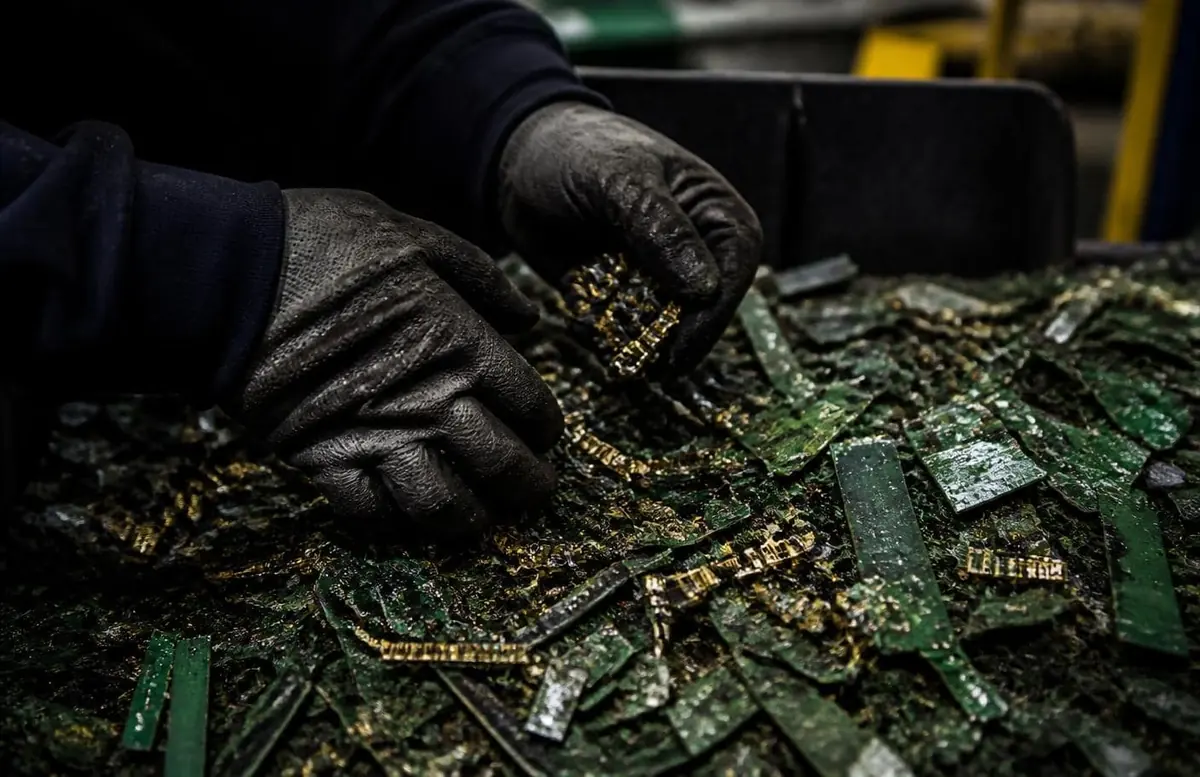
The comparison that makes waste-stream recovery interesting is with the mine. Typical open-pit ore runs around one gram of gold per tonne. Populated circuit boards from consumer equipment commonly assay in the hundreds of grams per tonne, and dense telecom and computing hardware can run higher still. In grade terms, a container of scrap boards is a spectacular orebody that arrives pre-crushed and needs no drilling.
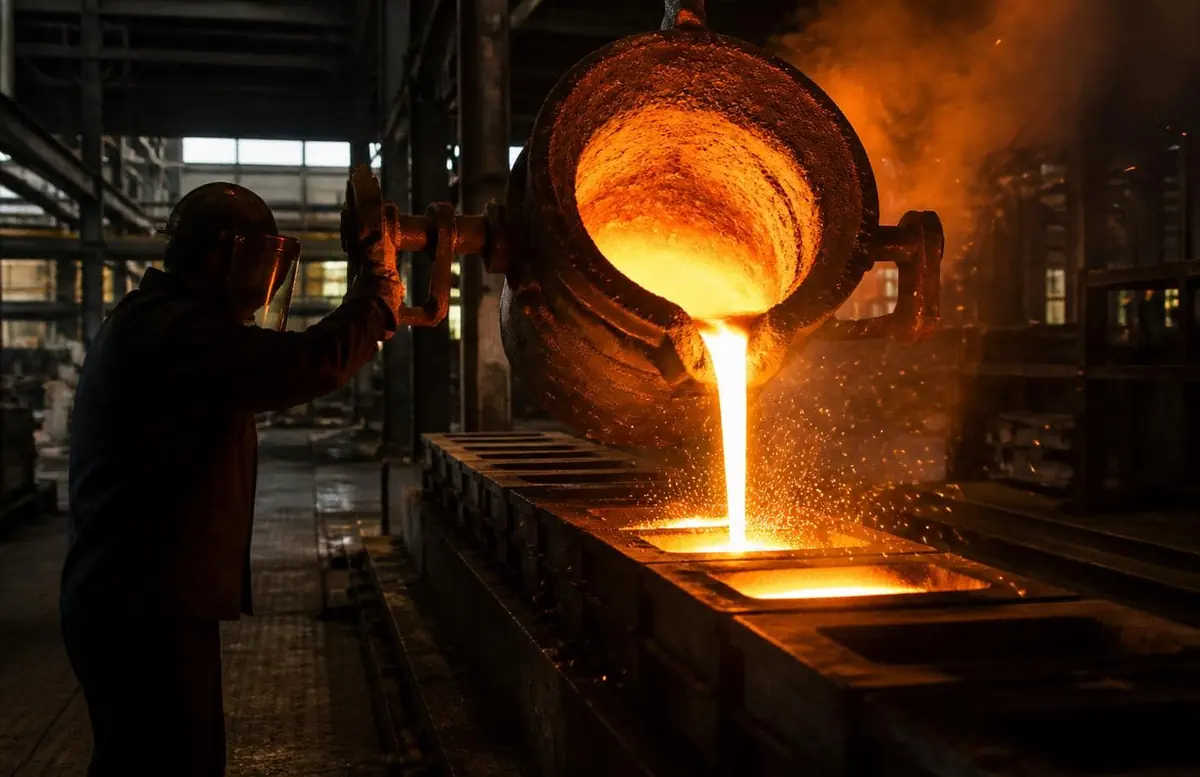
The catch is that the gold arrives bonded to twenty other elements — copper, tin, lead, palladium, brominated plastics — in an assembly designed to be permanent. Recovering it properly means integrated smelting and refining, off-gas treatment and a permit regime, which is why formal e-waste refining is concentrated in a small number of very large facilities. Where that infrastructure is absent, the same material is processed with open acid baths and burning, which recovers a fraction of the metal and poisons the people doing it.
Industrial gold, then, is a small market that behaves nothing like the rest of the metal. It does not care about the price. It does not respond to sentiment. It shrinks when an engineer finds a cheaper material that passes qualification, and it holds when nobody does. It is the one part of the gold market where demand is decided by a reliability specification rather than by a view about the world.
How much gold the sector actually consumes
Technology demand — electronics, dentistry and a long tail of specialist uses — has run in the low hundreds of tonnes a year for the past decade, against total annual demand measured in the low thousands. Within that, electronics is the overwhelming majority and dentistry a shrinking remnant, displaced steadily by ceramics and zirconia that are cheaper, whiter and adequately durable.
The sector's defining characteristic is not its size but its stability. Jewellery demand swings with weddings, festivals and price; investment demand swings with real interest rates and fear; central-bank buying swings with geopolitics. Electronics demand tracks unit shipments of hardware and the gold content per unit, and both move slowly. That makes it the least interesting third of the market to trade and the most predictable one to forecast.
Where the next substitution comes from
Having lost bonding wire, the remaining gold in a device sits in places where the case for it is stronger. That does not make it safe. Three pressures are live: palladium and silver-based plating chemistries for contacts that do not need gold's full corrosion margin, thinner deposits achieved through better plating control rather than material change, and package-level integration that removes separable connectors altogether.
The third is the quiet one. Every board-to-board connector deleted by putting two functions on one substrate removes plated contacts permanently, and that consolidation is happening for reasons of space and reliability that have nothing to do with metal cost. Gold demand in electronics can decline without anyone ever making a decision about gold.
- Reduce thickness — the most common lever, since much legacy plating is specified well above what the application needs.
- Change alloy — hard gold with cobalt or nickel co-deposits gives wear resistance at lower gold thickness.
- Change metal — palladium-nickel with a thin gold flash on top, widely qualified in connectors.
- Delete the interface — integration that removes the separable contact entirely, and with it all of its plating.
What this means for recyclers and for the market
Falling gold content per device cuts both ways. It lowers primary industrial demand, and it also degrades the grade of tomorrow's e-waste stream, which is the feedstock a growing formal recycling industry has built capacity around. A recycler commissioning a smelter today is making a twenty-year bet on the metal content of equipment that has not been designed yet.
For the market as a whole the conclusion is unchanged: industrial use is a small, slow, engineering-driven slice that neither rescues the price in a downturn nor caps it in a rally. Its interest is analytical. It is the one place where gold is bought by people with no view about gold at all — only about whether a contact will still conduct in fifteen years.
Beyond phones: where else the metal hides
Consumer electronics dominates the volume conversation because handset shipments are counted in the billions, but the more interesting industrial gold sits in equipment nobody replaces on a two-year upgrade cycle. Aerospace connectors, satellite electronics, implantable medical devices and the guidance systems of long-life industrial machinery specify gold not because a cheaper alternative doesn't exist, but because switching means requalifying a part against certification standards that can take years and cost far more than any plausible metal saving.
The tyranny of qualification
A commercial aircraft connector qualified with gold-plated contacts in the 1990s is very often still specified with gold-plated contacts today, not from inertia but because requalifying the part means re-running accelerated life testing, resubmitting airworthiness documentation, and in some cases re-certifying the whole assembly it sits within. The gold in that connector might cost the manufacturer a few cents more per unit than an alternative finish. The requalification programme to remove it can run into millions of dollars and years of engineering time. Nobody does that arithmetic and chooses to switch.
The same logic protects gold in implantable medical electronics, where biocompatibility and multi-decade reliability inside a human body are non-negotiable, and in space hardware, where a connector failure cannot be fixed by a technician after launch. These are small markets in tonnage terms but they are the least price-sensitive gold demand that exists anywhere, because the alternative to using gold is not a cheaper product — it is a redesign, a recertification and, in the worst case, a recall.
Dentistry's long decline
Gold's other historic industrial application — dental restorations — is in the opposite position. Gold alloys were the standard for crowns and bridges for most of the twentieth century because gold does not corrode in the mouth, is biocompatible, and can be cast and burnished to a precise fit against the surrounding tooth. That combination of properties made gold dentistry a meaningful line item in world demand for decades.
It has been in near-continuous decline since ceramics and, more recently, zirconia became durable enough to match gold's longevity while looking like a tooth rather than a coin. Patients prefer the cosmetic outcome, dentists prefer materials that do not require an outside casting laboratory and a second visit, and insurance schedules in many markets now favour ceramic. What remains of gold dentistry is concentrated among older patients with existing gold restorations and in a handful of markets — parts of East Asia among them — where a gold tooth still carries a status connotation rather than a stigma.
“Nobody is choosing gold for a crown today because it performs better. A handful of patients are choosing it because their grandfather had one and it never gave him trouble in forty years.”
Measuring a market that barely moves
Because technology demand changes so slowly, analysts treat any material shift in it as a genuine signal rather than noise, in sharp contrast to jewellery or investment flows where a single quarter can be dominated by a festival calendar or a rate decision. A sustained decline in gold content per device, tracked across successive teardown studies of flagship handsets, tells you something real about material substitution trends across the whole industry — because it reflects thousands of independent engineering decisions converging on the same conclusion.
- Teardown analysis — independent labs strip representative devices and assay component-level gold content, the primary data source for the sector.
- Refiner intake data — specialist e-waste refiners report incoming feedstock grades, a lagging but concrete check on teardown estimates.
- Bonding-wire shipment data — semiconductor equipment suppliers report gold-wire bonder volumes, an early indicator of packaging-technology shifts.
- Dental alloy sales — reported separately by a small number of specialist dental-metal suppliers, now a marginal but trackable series.
A brief history of gold in electronics
Gold's role in electronics is not a recent accommodation to modern engineering standards; it dates to the earliest days of the transistor. When semiconductor packaging emerged in the 1950s and 1960s, gold was the default choice for bonding wire and lead-frame plating almost by default, because the industry was small, the volumes were low, and gold's reliability advantages made it an easy specification to write into a standard before cost pressure had built up around it. For roughly three decades, gold in a component was simply how a component was built.
That changed as semiconductor volumes exploded through the 1980s and 1990s. Rising demand for gold from a booming electronics industry, combined with a series of sharp gold price spikes, forced the industry to confront just how much metal it was consuming, and the substitution programmes that quietly reshaped the sector — copper bonding wire, thinner plating specifications, alternative connector finishes — trace their origins to that period rather than to any single recent price shock. The industry's relationship with gold has therefore always been more dynamic than the popular image of an unchanging, prestige-driven material suggests; it has simply reached, after decades of engineering pressure, a smaller and more stable core of applications where substitution genuinely does not work.
Gold ink, flexible electronics and printed circuits
A newer frontier for gold in electronics is not plating at all but printing. Flexible and wearable electronics — sensors embedded in clothing, skin-mounted medical patches, printed antennas for low-cost radio tags — increasingly use conductive inks formulated with gold nanoparticles, which can be printed or sprayed onto flexible substrates that would be damaged by conventional plating or soldering processes. The gold quantities involved are minute, often a few micrograms per printed feature, but the application category is expanding quickly as flexible and disposable electronics move from laboratory demonstration toward genuine commercial products.
Gold nanoparticle inks are attractive for this purpose for reasons that echo the rest of this industry's logic: gold nanoparticles can be sintered into a conductive film at far lower temperatures than bulk gold requires, which matters enormously when the substrate underneath is a plastic film or a woven textile that would melt or scorch under conventional processing heat. As printed and flexible electronics scale from prototypes to mass-market wearables, this application could in time become a meaningful, if still modest, line in the technology demand ledger — one driven by a genuinely new manufacturing method rather than by an old one simply persisting.
“We are not plating anything. We are printing gold the way you would print ink, at a temperature a shirt can survive, and it still conducts like gold because at that scale it still is gold.”
Gold, silver and palladium: the substitution triangle
Gold does not compete with copper alone. Within the family of precious and near-precious metals used in connectors and contacts, silver and palladium form a substitution triangle with gold, and the choice between them is a genuine engineering trade-off rather than a simple hierarchy of prestige. Silver is a better conductor than gold and considerably cheaper, but it tarnishes readily in sulphur-bearing atmospheres, which rules it out for any contact exposed to ordinary air over a long service life unless it is itself plated with something else. Palladium and palladium-nickel alloys resist corrosion well and cost less than gold, and have been qualified into a large share of the connector market over the past two decades specifically to reduce gold consumption, typically finished with a very thin gold flash on top to solve palladium's own weaknesses at very low contact forces.
The result of this three-way competition is not that gold has been eliminated but that it has been engineered down to the minimum thickness the application can tolerate, layered over cheaper metals that do most of the mechanical and electrical work underneath. A modern high-reliability connector is frequently a composite: a nickel barrier layer to stop diffusion, a palladium-nickel layer for wear resistance and cost control, and a gold flash measured in tens of nanometres on top, purely to guarantee the final exposed surface never tarnishes. Gold's role has narrowed from being the whole solution to being the last, thinnest and most stubborn layer of it.
The primary versus recycled question
A growing share of the gold used in new electronics is recycled rather than freshly mined, sourced from refined scrap circuit boards, industrial process residues and, increasingly, formal take-back programmes run by electronics manufacturers themselves. Recycled gold is chemically identical to mined gold once refined to the same purity standard — there is no physical test that can distinguish an atom of gold recovered from a smartphone from one dug out of an open pit — which makes the distinction entirely one of supply chain documentation rather than material property.
That documentation matters more than it once did. Manufacturers under pressure to demonstrate lower-carbon and more circular supply chains increasingly specify a minimum recycled content in the gold they purchase, verified through chain-of-custody certification schemes that track the metal from scrap intake through refining to finished component. The economics of secondary refining are already favourable, given the concentration figures discussed elsewhere in this piece; what has changed is that recycled content is now also a marketing and compliance asset in its own right, adding a second reason, beyond simple cost, for the industry to keep investing in urban mining infrastructure.
Forecasting the next decade of technology demand
Extrapolating technology demand forward requires tracking three trends that pull in different directions. Unit volumes of connected devices continue to grow as more categories of consumer and industrial equipment gain electronic components, which on its own would push gold consumption higher. Gold content per device continues to fall as thinner plating, alloy substitution and connector deletion proceed, which pulls in the opposite direction and has been the dominant force for most of the last two decades. And entirely new application categories — flexible and printed electronics, quantum computing hardware, an ageing population's growing demand for implantable medical devices — introduce fresh, if currently small, sources of demand that did not exist in the historical data at all.
The reasonable expectation, on the evidence of the last two decades, is that the second force continues to dominate the first in the near term, keeping aggregate technology demand roughly flat to modestly declining even as the number of connected devices in the world keeps rising. The interesting open question is whether the third force — new, high-reliability applications in medicine and advanced computing — eventually becomes large enough to offset the steady erosion happening everywhere else. On current volumes it is nowhere close, but it is the only part of the technology demand story that is growing rather than shrinking, which makes it worth watching even while it remains a rounding error in the annual numbers.
What teardown studies actually show over time
Independent teardown analysis of flagship handsets across successive generations shows a slow, consistent decline in gold content per device, driven almost entirely by thinner plating specifications and the steady deletion of separable connectors as manufacturers integrate functions onto fewer boards. This is not a dramatic story — no single generation shows a collapse — but the cumulative direction over a decade is unmistakable, and it is the clearest quantitative evidence available that the substitution pressures described throughout this piece are real and ongoing rather than theoretical.
What the same studies also show is that the decline has a floor. Certain gold-plated features — the SIM contact, the battery connector, the small number of board-to-board interfaces that integration has not yet eliminated — have persisted at broadly similar thickness for years, because they represent the residual set of connections that genuinely cannot be engineered away without a redesign more expensive than the metal it would save. Reading a decade of teardown data side by side is therefore the most direct way to see the argument of this article made visible: an industry aggressively removing gold everywhere it safely can, and stopping precisely at the point where removing it further would cost more than it saves.
The circuit board as a mine, revisited
The comparison between a tonne of scrap circuit boards and a tonne of mined ore is not just a curiosity; it is reshaping where recovered gold actually comes from. Formal urban-mining operations — large, permitted, integrated smelters that process electronic scrap alongside other secondary materials — now recover gold, silver, palladium and copper simultaneously from a single feedstock stream, at grades no conventional gold mine could match, and do so with none of the overburden removal, tailings management or multi-decade closure liability of a primary mine.
The constraint on scaling this further is not technology but collection. The gold in a smartphone is only recoverable if the phone reaches a facility equipped to process it rather than a landfill or an informal scrapyard, and collection rates for consumer electronics remain low in most of the world precisely because the metal content per device is too small for an individual to bother separating it out. The paradox of technology gold is that it is simultaneously the highest-grade orebody on the planet and one of the hardest to actually mine, because it arrives one gram at a time inside a billion different pockets.
Frequently asked
Questions readers ask
- How much gold is in a smartphone?
- Roughly 0.2 to 0.35 grams, depending on the model and generation, spread across connector plating, printed-circuit-board surface finish, and the fine wires or bumps connecting silicon dies to their packages. At typical prices that is a few dollars of metal — negligible per unit, substantial across a billion units.
- Why use gold instead of cheaper copper?
- Copper is a better conductor and far cheaper, and it is used wherever a connection is sealed and permanent. Gold is specified where a surface must stay conductive after years of exposure and repeated mating, because copper and silver grow oxide and sulphide films that raise contact resistance while gold does not.
- Is it worth recovering gold from old electronics?
- At industrial scale with proper facilities, yes: a tonne of scrap circuit boards contains far more gold than a tonne of typical mined ore. At household scale it is not economic and the informal chemical methods used to attempt it are genuinely dangerous.
- Does a higher gold price reduce electronics demand?
- Barely, in the short run. Gold is a rounding error in a device's cost structure, so a designer will not redesign a package to save two dollars. Sustained high prices do accelerate longer-term substitution programmes that were already underway for other reasons.
- Why does gold dentistry keep declining?
- Ceramics and zirconia now match gold's durability while looking like a natural tooth, patients overwhelmingly prefer the cosmetic result, and dentists prefer materials that avoid an outside casting laboratory. What remains is concentrated among older patients with existing restorations and a few markets where a gold tooth still carries social status.
- Why is e-waste recycling harder than the high gold grade suggests?
- The gold in a scrap circuit board is bonded to a dozen other materials in an assembly built to be permanent, so recovering it properly requires integrated smelting, refining and off-gas treatment under a permit regime. Collection is the bigger constraint: most of the world's small electronics never reach a facility equipped to process them at all.
- What is the difference between hard gold and soft gold plating?
- Hard gold contains small amounts of cobalt or nickel to increase wear resistance, making it suitable for connectors that are frequently plugged and unplugged. Soft gold is pure and more ductile, used primarily for bonding wires and in applications where the metal must be deformed without cracking.