Industry Report
Nine Nines: Inside a Modern Gold Refinery
A doré bar arrives at 85 per cent purity and leaves at 99.99. Between those two numbers sit chlorine gas, aqua regia, an electrolytic cell and a chain of custody that is now as valuable as the metal itself.
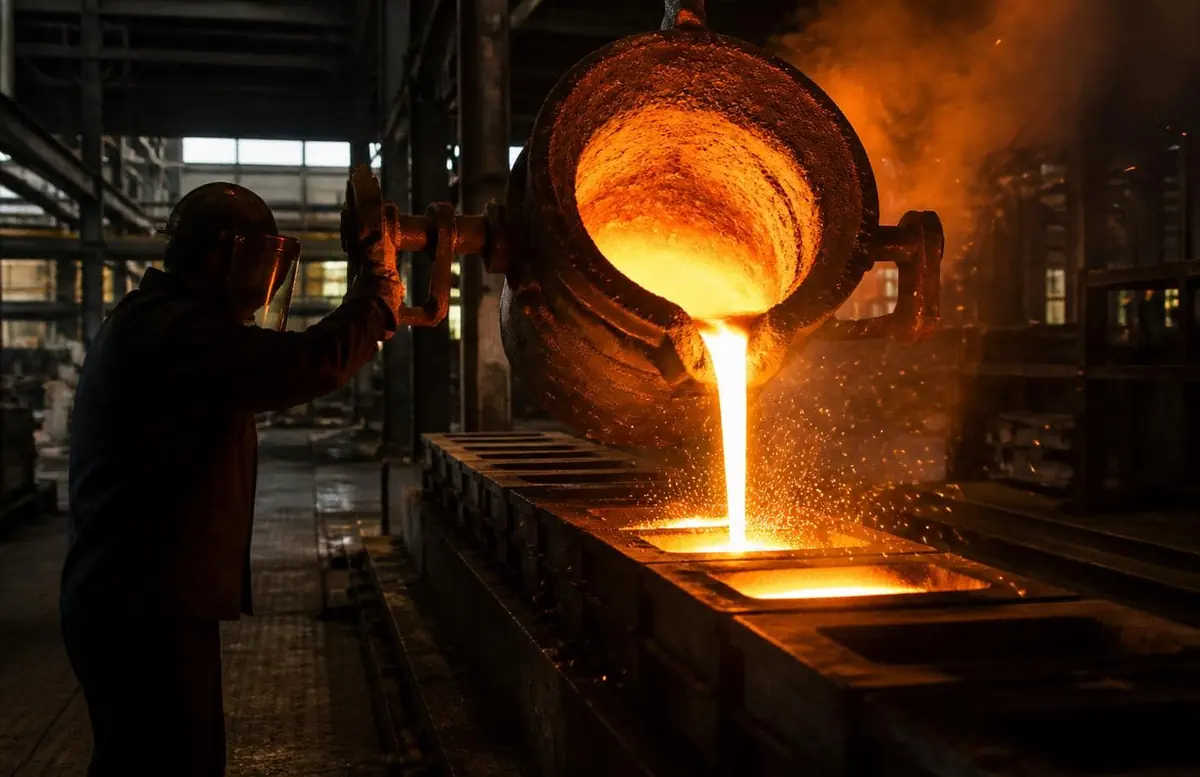
The bar arriving on the loading dock does not look like money. It looks like a dirty brick: pitted, grey-gold, stamped with a mine code and a weight in a hand-punched font. This is doré, the semi-refined alloy poured at the mine site, and depending on the geology behind it, somewhere between seventy and ninety per cent of its mass is gold. The rest is silver, copper, occasionally a trace of platinum, and whatever else the ore was carrying.
Turning that brick into a bar the wholesale market will accept without argument is an industrial process about a century and a half old in its essentials. It is also, increasingly, a documentation process. Refiners today spend as much effort proving where a bar's contents came from as they do removing the copper.
Weigh, sample, argue
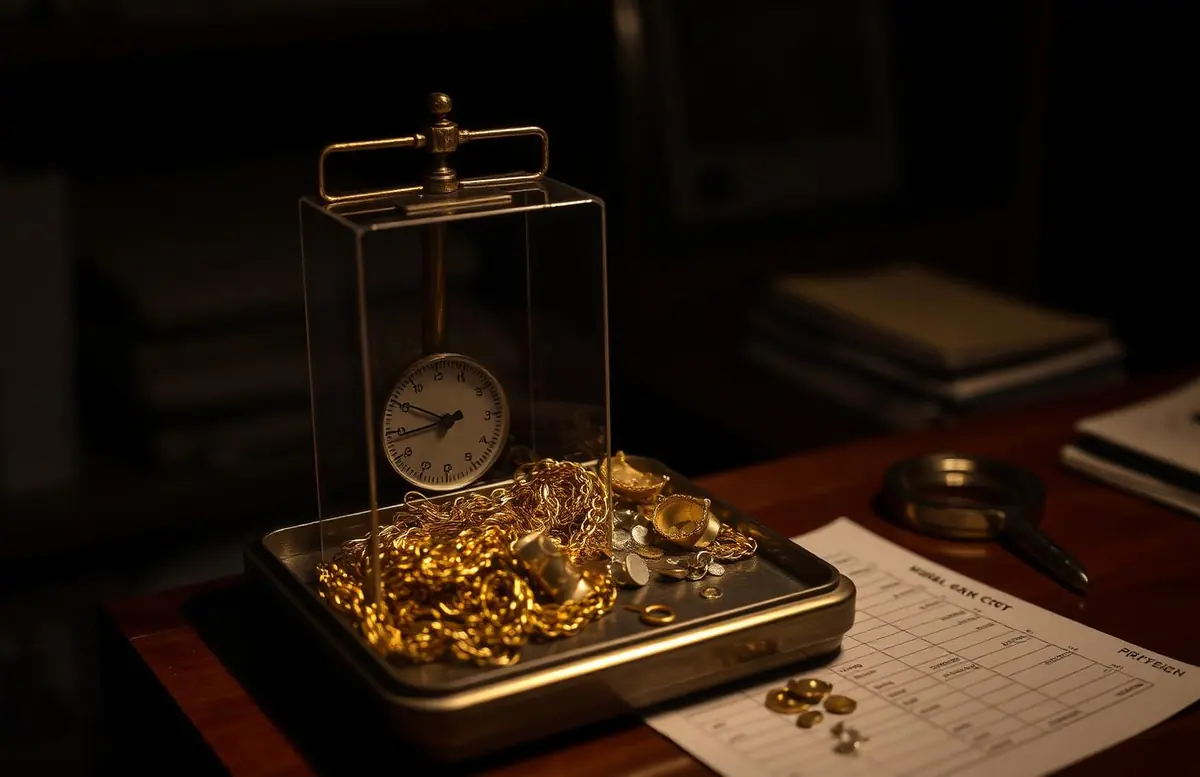
Nothing enters the plant unweighed. The doré is logged to the hundredth of a gram on scales calibrated daily against certified masses. Then it is melted, homogenised and sampled — because a bar's average composition tells you nothing if the gold has segregated during cooling.
The classic sampling method is the dip sample: a rod plunged into the melt, withdrawn fast, quenched. More common now is drilling the solidified bar at prescribed points, top and bottom, corner and centre, and combining the swarf. The resulting sample is split three ways — one for the refiner, one for the supplier, one sealed as an umpire sample in case the first two disagree. Disagreements over a tenth of a per cent on a four-hundred-ounce bar are worth arguing about.
Fire assay: the referee
The determination that settles disputes is fire assay, a technique that predates the periodic table by two thousand years and has never been bettered for accuracy on gold. The sample is wrapped in lead foil, fused in a crucible with litharge and flux, and poured. The lead collects the precious metals and sinks; the base metals dissolve into a glassy slag.
The lead button is then transferred to a cupel — a small porous dish of bone ash or magnesia — and heated in a stream of air. Lead oxidises and is absorbed into the cupel wall, wicking away like water into blotting paper. What remains is a bead of gold and silver, a couple of millimetres across, sitting in the dish like a drop of solder. Parting the bead in nitric acid dissolves the silver. The gold that survives is weighed on a microbalance.
“Every instrument in this building is calibrated, ultimately, against a bead of metal in a bone-ash cup. The technology is medieval and the tolerance is a part in ten thousand.”
Stage one: the Miller process
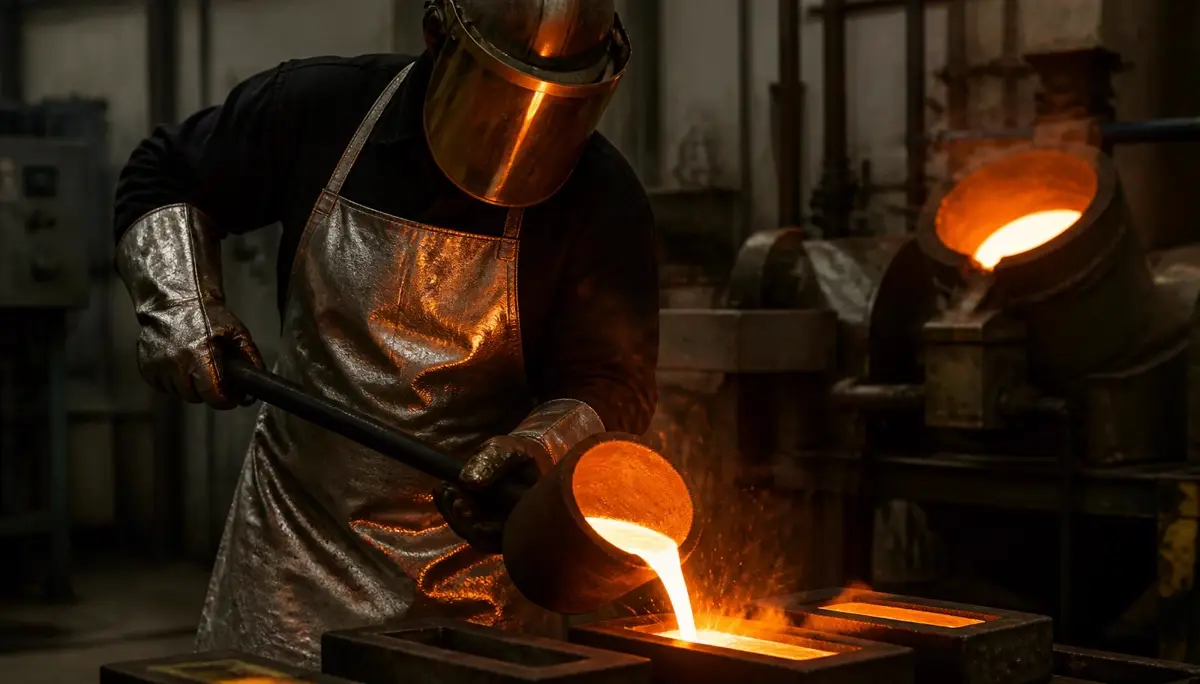
Francis Bowyer Miller patented his method in 1867, and it is still how most of the world's gold takes its first serious step towards purity. Molten doré is held at around 1,100°C and chlorine gas is bubbled through it via a ceramic lance.
The chemistry is a matter of preference. Chlorine bonds with base metals before it bonds with silver, and with silver before gold. Zinc, iron, copper and lead convert to chlorides that either volatilise off as fume or float to the surface as a molten salt layer that can be skimmed. Silver becomes silver chloride and joins the skim. Gold, being the least reactive thing in the crucible, is left behind.
The operator's signal that the reaction is complete is visual: the fume above the melt shifts colour as chlorine begins attacking gold itself, producing a reddish gold chloride vapour that means the run has gone one minute too far. Modern plants automate the endpoint with spectroscopy, but the older hands still watch the smoke.
- Speed: a Miller run takes roughly ninety minutes to two hours per charge.
- Ceiling: purity plateaus around 99.5 per cent — good, and not good enough.
- Limitation: platinum-group metals do not chlorinate usefully and remain in the gold.
- Byproduct: silver chloride skim is reduced and recovered separately, and is often the more voluminous product.
Stage two: Wohlwill electrolysis
To cross from 99.5 to 99.99, the metal goes into a cell. Emil Wohlwill's 1874 process casts the Miller output as anodes, suspends them in an electrolyte of gold chloride in hydrochloric acid, and applies a current. Gold dissolves from the anode and plates onto a cathode of thin pure gold sheet or titanium.
Selectivity comes from electrochemistry. At the cell's operating potential, gold deposits and the platinum-group contaminants stay in solution. Silver, awkwardly, precipitates as insoluble chloride and falls to the bottom of the tank as part of the anode slime — which is recovered, because anode slimes from a large refinery are among the richest precious-metal feedstocks in existence.
The cost of the Wohlwill process is time and inventory. A cell cycle takes days, and during those days a substantial quantity of gold is locked up in solution and in partially dissolved anodes. Refiners describe this as 'metal in process', and financing it is a real line on the balance sheet. The alternative, the Fizzer cell and related aqua regia routes, trades throughput for a smaller locked inventory and is favoured by smaller operations.
The cast, and what is stamped on it
Finished gold is remelted and cast to specification. For the wholesale market the format is the Good Delivery bar: nominally 400 troy ounces, actual weight between roughly 350 and 430 ounces, minimum fineness 995.0, surfaces free of cavities, edges that allow safe handling. Each bar carries a serial number, the refiner's mark, the fineness and the year of manufacture.
That set of marks is what allows a bar to move between vaults in the loco London system without being re-assayed at every transfer. Accreditation is not permanent; refiners submit to periodic proficiency testing and can be suspended. The list of accredited refiners is, in effect, the market's trust registry.
Recycling, which is most of the business
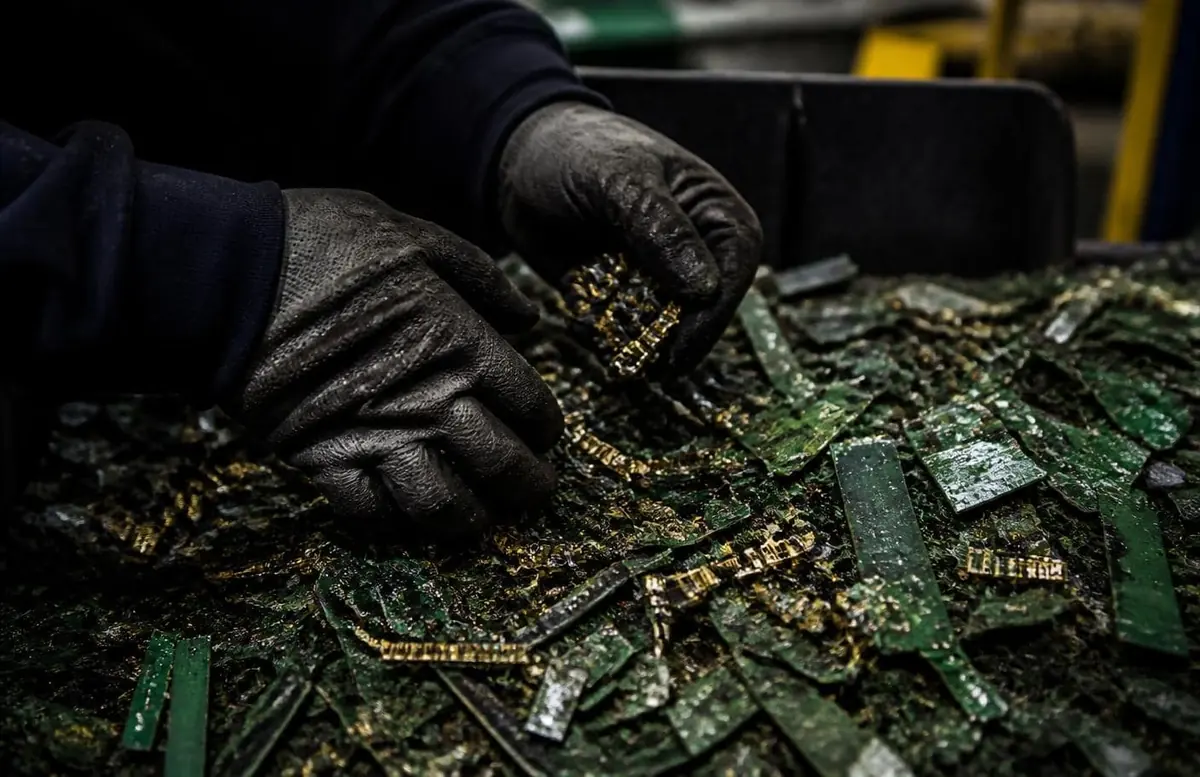
It surprises people that a large share of refinery throughput never came out of the ground that year. Scrap jewellery, industrial sweeps, spent catalysts and electronic waste all arrive in the same building, and the economics can be better than mined feed because the concentration is higher. A tonne of high-grade ore might carry a few grams of gold. A tonne of sorted circuit-board connectors carries orders of magnitude more.
Handling scrap is messier work. Feedstock arrives as everything from wedding rings to shredded phone housings, and the first task is not chemistry but sorting, incineration and homogenisation — turning a heterogeneous heap into something that can be sampled honestly. Only then does the metal join the same route the doré takes.
What the numbers mean
Investors treat four nines as a synonym for 'pure', but the last decimal points are earned at steeply rising cost. Going from 99.99 to 99.999 requires a second electrolytic pass or zone refining, and the market for five-nines metal is narrow: semiconductor bonding wire, certain optical coatings, scientific reference materials.
For everything else — coins, bars, jewellery alloys, central bank reserves — four nines is the end of the road, and it is close enough to the theoretical ideal that the remaining 0.01 per cent is mostly a rounding error in trace silver. The refinery's real product, in the end, is not purity. It is the credible assertion of purity, backed by an assay, a mark and an accreditation that can be taken away.
Where refineries actually sit in the supply chain
It is easy to picture a refinery as an isolated factory processing whatever arrives at the loading dock, but the plant sits at a genuine chokepoint. Mine output, recycled scrap and central bank bars converge on a small number of accredited refiners worldwide, and it is at that convergence point — not at the mine, not at the bank — that most due-diligence obligations are actually discharged.
This matters because a refinery cannot un-know what it has processed. Once doré from a dozen different mines and scrap from a hundred different jewellers is melted into a single homogenised pour, the resulting bar carries no chemical fingerprint of any single source. The compliance burden, in other words, has to be paid before the melt, not after — which is why refiners maintain sourcing questionnaires, site audits and supplier scorecards that look more like a bank's know-your-customer file than a metallurgist's logbook.
That same logic increasingly extends beyond gold-specific rules into broader corporate due-diligence law, as several jurisdictions have moved to impose supply-chain reporting obligations on companies dealing in conflict minerals and precious metals more generally. Refiners selling into those markets now have to demonstrate compliance not only with the accreditation bodies that govern bullion trading directly, but with a wider and still-evolving patchwork of national legislation, which has added yet another layer to the compliance workload described earlier without removing any of the older requirements it sits alongside.
Why so few refiners hold Good Delivery status
The list of refiners accredited to the London market's Good Delivery standard is short relative to the number of plants capable of producing four-nines gold. The gap is deliberate. Accreditation requires demonstrated financial strength, ongoing proficiency testing against umpire samples, and a sourcing and responsible-mining policy that is independently audited on a cycle of years, not once at entry. A refiner that cuts corners on any of the three loses the accreditation that makes its bars fungible across the wholesale market — and a bar from a delisted refiner instantly becomes harder to sell, whatever its actual fineness.
- Financial standing sufficient to bear the risk of holding large in-process inventories of unsold metal.
- Proficiency testing: refiners submit blind samples for assay and must stay within tight published tolerances.
- A documented, audited responsible-sourcing programme covering conflict-affected and high-risk areas.
- Physical and procedural security sufficient to satisfy insurers and counterparties handling bars worth tens of millions of dollars per shipment.
The economics of a refining business
Refining looks, from the outside, like a business built on chemistry, but the numbers that actually determine profitability are financial. A refiner earns a treatment charge — a fee, usually a small fraction of a per cent of the metal's value, plus a fixed handling cost — for converting doré or scrap into a saleable bar. Margins are thin by design, because the input, gold, is a fungible commodity priced continuously and the service being sold is essentially standardisation.
The real money sits in volume and in byproducts. A large refinery processing several hundred tonnes of throughput a year turns a modest fee into meaningful revenue, and the silver, platinum-group residues and base metals recovered alongside the gold are frequently a bigger margin contributor than the treatment charge itself. This is part of why the biggest refiners are often subsidiaries of larger metals or mining groups rather than standalone businesses: the economics reward scale and diversification into the byproduct stream.
“Ask any refinery director what keeps them up at night and it will not be a chlorination endpoint. It will be working capital tied up in metal that has not yet cleared assay.”
~5–7
Weeks a batch can spend as work-in-progress before final cast, in some plants
<1%
Typical treatment charge as a share of metal value
70–90%
Typical gold content of incoming doré bars
999.9
Standard four-nines fineness for wholesale bars
Safety, environment and the parts nobody photographs
The chlorine used in the Miller process is lethal in the concentrations a leak could produce, and the acids used in electrolytic and aqua regia routes are correspondingly hazardous. Modern plants are built around containment rather than heroics: sealed reaction vessels, scrubber towers that neutralise off-gas before it reaches a stack, continuous gas monitoring, and evacuation drills that are treated with the same seriousness as a chemical plant's, because that is functionally what a refinery is.
Effluent management is the less visible half of the environmental picture. Spent electrolyte, wash acids and scrubber liquor all carry trace metals that cannot simply be discharged, and a refinery's water-treatment capacity is sized to its throughput just as carefully as its furnaces are. Regulators in most jurisdictions now require closed-loop water systems for exactly this reason, and the older, more polluting plants that once operated on open discharge have largely been phased out or forced to retrofit.
A short history of the industry's consolidation
Refining was, for most of the twentieth century, a fragmented trade: national mints, jewellery-district assayers and a scattering of independent operators each handling relatively modest volumes for local markets. The industry's shape today looks nothing like that. A handful of large refining groups — several with roots in Swiss precision manufacturing, others built from mining-company captive refineries that were spun out or expanded — now handle a disproportionate share of global Good Delivery output, and the trend has been towards further concentration rather than fragmentation.
Three forces drove the consolidation. First, capital intensity: the effluent treatment, containment engineering and compliance infrastructure now expected of an accredited refiner costs tens of millions of dollars to build and maintain, a bar smaller operators increasingly could not clear. Second, accreditation itself became a competitive moat, since a refiner that loses Good Delivery status loses access to the wholesale market overnight, which pushed the industry towards operators with the balance sheets to absorb an audit failure without going under. Third, and most simply, economies of scale in a thin-margin, high-volume business reward the largest players disproportionately.
Switzerland's outsized role
A small number of Swiss refineries process a share of the world's mined gold that is wildly disproportionate to Switzerland's own mining output, which is essentially zero. The explanation lies in a confluence of historical banking secrecy, precision-engineering expertise inherited from the watchmaking and instrument trades, political stability, and decades of accumulated trust with mining companies and central banks who did not want to ship metal through less stable jurisdictions. That concentration has itself become a policy concern for some sourcing-conscious buyers, who now actively seek refiners outside the traditional Swiss cluster to diversify supply-chain risk.
The consolidation has a downside that critics of the industry raise consistently: fewer, larger refiners mean fewer, larger points of failure, and a scandal or accreditation suspension at one of the top handful of plants would ripple through the wholesale market far more than an equivalent failure would have a century ago, when volumes were spread across many smaller operators. The industry's own answer is that concentration among accredited, heavily audited players is safer than fragmentation among unaccredited ones — a genuinely contestable claim that depends entirely on how rigorously the accreditation is enforced.
When refining goes wrong: scandals and near-misses
The industry's reputation for quiet reliability obscures a real history of failures, most of them involving sourcing rather than metallurgy. Refiners have been implicated, at various points, in processing gold later traced to conflict-affected mining operations, illegally exported artisanal production, or metal laundered through falsified paperwork purporting to show a legitimate mine of origin. In several documented cases, gold smuggled across borders in West Africa and South America was blended into legitimate-looking shipments before reaching an accredited refiner whose due-diligence process failed to catch the substitution.
The regulatory response has been to push responsibility further upstream and to make refiners liable, in reputational and sometimes legal terms, for the provenance of what they melt — even though, as this piece has described, gold becomes chemically anonymous the moment it is poured. That mismatch between a physical process that destroys traceability and a compliance regime that depends on maintaining it is the industry's most persistent unsolved problem, and no refiner claims to have solved it completely.
A day in the compliance office
It is easy to picture a refinery as a floor of furnaces and cells, and to forget that a large modern plant increasingly employs as many people reading documents as pouring metal. A compliance officer's working day involves reconciling mine-of-origin certificates against shipping manifests, cross-checking supplier questionnaires against sanctions lists that update in real time, flagging shipments from jurisdictions the refiner has classified as higher-risk for enhanced due diligence, and preparing the paper trail that the refiner's own accreditation auditors will demand at the next review.
None of this touches the metal directly, and none of it is visible in the finished bar's stamp. But it is, in a real sense, the product a Good Delivery refiner is now selling: not merely 999.9 fine gold, which several dozen plants worldwide are technically capable of producing, but 999.9 fine gold that a bank, a fund or a central bank can accept without conducting its own investigation. That assurance is worth a premium, and it is why accredited refiners can charge a treatment fee that unaccredited competitors, however metallurgically competent, cannot.
What to watch next
Two developments are reshaping the refining sector's edges. The first is digital provenance: several refiners and industry bodies have piloted systems that attach a digital record — sometimes blockchain-based, sometimes a simpler centralised database — to a bar at the point of casting, intended to travel with it through every subsequent sale. The technology is not the hard part; getting mine sites, transporters, refiners and end buyers all to actually use the same system consistently is the part that has stalled most pilots so far.
The second is the growing share of recycled feedstock, driven by elevated gold prices that make scrap collection more economically attractive and by electronics recycling regulation that is slowly formalising what was once an informal scrap trade. A refinery's mix of mined versus recycled input is now a genuine strategic choice, not merely a function of whatever arrives at the loading dock, and the plants that have invested earliest in scrap-sorting capacity are positioned to benefit most as that share continues to grow.
Instrumentation: how a modern lab watches the melt
Behind every batch sits an analytical laboratory that has quietly become as sophisticated as the metallurgy it monitors. X-ray fluorescence spectrometers give a non-destructive fineness reading in minutes and are used constantly for in-process checks, but they are treated as a working tool rather than a final answer, because XRF measures only a thin surface layer and can be fooled by uneven plating or a poorly prepared sample. Inductively coupled plasma spectrometry goes further, dissolving a sample and reading trace elements down to parts per million, which is how a refiner proves not just that a bar is 999.9 fine but that the residual 0.01 per cent is silver and copper rather than something a buyer would object to.
None of these instruments has replaced fire assay for the figure that actually appears on a certificate. Instrumental methods are fast, cheap and useful for steering the process in real time, but when a shipment's value runs into tens of millions of dollars, the number that settles payment is still the one obtained by cupellation — a technique whose only real vulnerability is the skill of the person running it, which is precisely why umpire samples exist.
- X-ray fluorescence: fast, non-destructive, used for continuous in-process monitoring rather than final settlement.
- Inductively coupled plasma spectrometry: destructive but highly sensitive, used to characterise trace impurities.
- Fire assay: slow, manual, and still the referee method for any dispute over final fineness.
- Spectrographic endpoint detection: increasingly used to judge when a Miller chlorination run has gone far enough without over-chlorinating.
The people: a trade learned on the job
There is no undergraduate degree in gold refining. The furnace operators, chlorination technicians and cupellation assayers who keep a plant running mostly learn the trade through years of internal apprenticeship, working alongside someone more senior until judgement calls that look intuitive to an outsider — reading the colour of chlorine fume, sensing when a melt has homogenised, knowing which cupels are drying unevenly — become second nature. Refiners describe losing an experienced assayer to retirement as a bigger operational risk than losing a piece of capital equipment, because the equipment can be replaced from a catalogue and the judgement cannot.
“You can teach someone the chemistry of the Miller process in an afternoon. Teaching them to know, by the smell and the colour of the smoke, that a batch has ninety seconds left to run — that takes years, and it still cannot be fully written down.”
This is one reason the largest refining groups have begun formalising apprenticeship programmes and documenting institutional knowledge more deliberately than the trade historically required, aware that a workforce built entirely on tacit, person-to-person transmission is fragile in a way a fully automated process would not be. It also explains why acquisitions in the sector are often as much about buying an experienced workforce as about buying furnace capacity.
Beyond London: how other markets set their own rules
The Good Delivery system described earlier governs the London market specifically, but it is not the only standard in circulation. Refiners selling into Shanghai, Dubai or Zurich's own domestic bar markets must also satisfy accreditation regimes run by those exchanges and industry bodies, each with its own proficiency testing cycle, its own permissible bar weights and its own responsible-sourcing documentation requirements. In practice the major standards have converged substantially, since a refiner serving global clients has every incentive to meet the strictest overlapping requirements rather than maintain parallel production lines, but the paperwork obligations still multiply for a plant selling into several markets at once.
Smaller regional standards, particularly those emerging alongside growing domestic gold markets in Asia and the Gulf, have tended to model themselves closely on the London framework rather than inventing competing criteria, which has had the practical effect of making Good Delivery-style accreditation something close to a global default even outside London itself. Analysts who track the sector expect this convergence to continue, since fragmentation would raise costs for refiners and buyers alike without any obvious offsetting benefit.
Energy, cost pressure and the push to automate
Refining is not an especially energy-intensive process by the standards of heavy industry — nothing here approaches the furnace loads of steelmaking or aluminium smelting — but sustained high temperatures, continuous gas scrubbing and round-the-clock laboratory operation still make energy a meaningful line item, and rising industrial electricity and gas prices in several regions have pushed refiners to look harder at efficiency than they historically needed to. Heat recovery from furnace exhaust, more efficient scrubber fans and tighter control of idle furnace time have all become standard investments rather than optional upgrades.
Automation is advancing at the margins rather than replacing the core process outright. Robotic sample handling, automated crucible tilting for pours, and software that models chlorination endpoints from real-time gas analysis all reduce the number of times a human stands close to molten metal or chlorine gas, which matters for both safety and consistency. What automation has not yet displaced is the final sign-off on fineness, which remains a human assayer's judgement backed by fire assay, precisely because the cost of an undetected error at that stage is measured in tens of thousands of dollars per bar.
1,100°C
Typical operating temperature during Miller chlorination
days
Typical duration of a full Wohlwill electrolytic cycle
ppm
Sensitivity level at which ICP spectrometry reports trace impurities
A note on scale: what a mid-sized refinery actually looks like
It helps to picture the physical plant rather than the abstraction. A mid-sized accredited refinery typically occupies a site no larger than a modest industrial park unit, dominated visually not by furnaces — which are surprisingly compact — but by the scrubber stacks, effluent treatment tanks and secure vaulting that surround them. Security is layered rather than dramatic: perimeter fencing and cameras are the least of it, with the real controls sitting in dual-custody procedures for anything that moves metal between rooms, reconciled weight logs at every transfer point, and vault access lists that are audited as rigorously as the assay records.
Visitors expecting the romance of a foundry are usually struck instead by how quiet and procedural the floor feels. The drama, such as it is, happens in the paperwork: a mismatched sample weight, a supplier questionnaire with an inconsistency, a proficiency test result that comes back a fraction outside tolerance. Those are the events that actually occupy a modern refinery's management attention, far more than anything happening inside the crucible.
The long view: is refining a growth business?
It is tempting to assume that a mature, century-and-a-half-old industrial process has little room left to grow, but throughput at accredited refiners has generally tracked upward alongside both mined output and the expanding scrap stream, and industry participants expect that trajectory to continue rather than plateau. The constraint is not metallurgical capacity, which can be expanded with a further furnace line and additional electrolytic cells, but the slower-moving process of building the compliance infrastructure and earning the accreditation history that make a new entrant's bars fungible with everyone else's.
That asymmetry — capacity is buildable in months, trust is buildable only in years — is probably the single most important thing to understand about the economics of the sector, and it explains why incumbents have tended to expand existing accredited sites rather than see genuinely new entrants challenge their position. A greenfield refinery with excellent metallurgy and no operating history is, commercially, worth less than an established plant with a mediocre furnace but a clean decade of proficiency-test results behind it.
Frequently asked
Questions readers ask
- What is a doré bar?
- A doré bar is the semi-pure alloy poured at a mine site, typically 70–90 per cent gold with silver and base-metal impurities. It is the standard form in which mines ship output to refiners.
- What does 999.9 fine mean?
- It means 999.9 parts gold per thousand — 99.99 per cent pure, commonly called 'four nines'. Some refiners produce 999.99, or 'five nines', for specialist electronics and scientific applications.
- Why does the Miller process stop at about 99.5 per cent?
- Chlorination removes base metals and most silver efficiently, but the remaining platinum-group elements and residual silver will not separate as chlorides. Electrorefining is required to go further.
- How many refineries hold LBMA Good Delivery accreditation?
- A relatively short list worldwide, deliberately so. Accreditation requires demonstrated financial strength, passing blind proficiency testing on a regular cycle, and an independently audited responsible-sourcing programme, and refiners can be and have been suspended for failing any of the three. The scarcity of the list is what makes it function as a trust registry rather than a mere quality mark.
- Can gold be refined indefinitely, and is there a purity ceiling?
- In practice, yes there is a ceiling that is not worth crossing for most uses. Four nines (99.99 per cent) satisfies every wholesale, investment and most industrial specifications. Pushing further to five or six nines requires additional electrolytic passes or zone refining at sharply rising cost, and the market for that grade is narrow — chiefly semiconductor bonding wire and scientific reference standards.
- Is recycled gold treated any differently from newly mined gold once refined?
- Chemically, no — once both have passed through chlorination and electrolysis to the same fineness, a refined bar carries no trace of whether its gold came from a mine or a scrapped phone. Commercially, sourcing documentation differs: recycled feedstock brings its own due-diligence paper trail, covering where the scrap was collected and from whom, which refiners must reconcile just as carefully as mine-of-origin certificates for newly mined doré.
- How do fire assay, XRF and ICP spectrometry differ in practice?
- XRF gives a fast, non-destructive surface reading used mainly for in-process monitoring; ICP spectrometry dissolves a sample to quantify trace impurities down to parts per million; fire assay is slower and manual but remains the referee method used for final settlement figures, because its accuracy and long track record outweigh the convenience of instrumental alternatives.