Recovery
Urban Mining: The Richest Gold Ore on Earth Is in Your Old Phone
A tonne of good underground ore holds a few grams of gold. A tonne of discarded circuit boards can hold two hundred. So why is most of it still going into landfill?
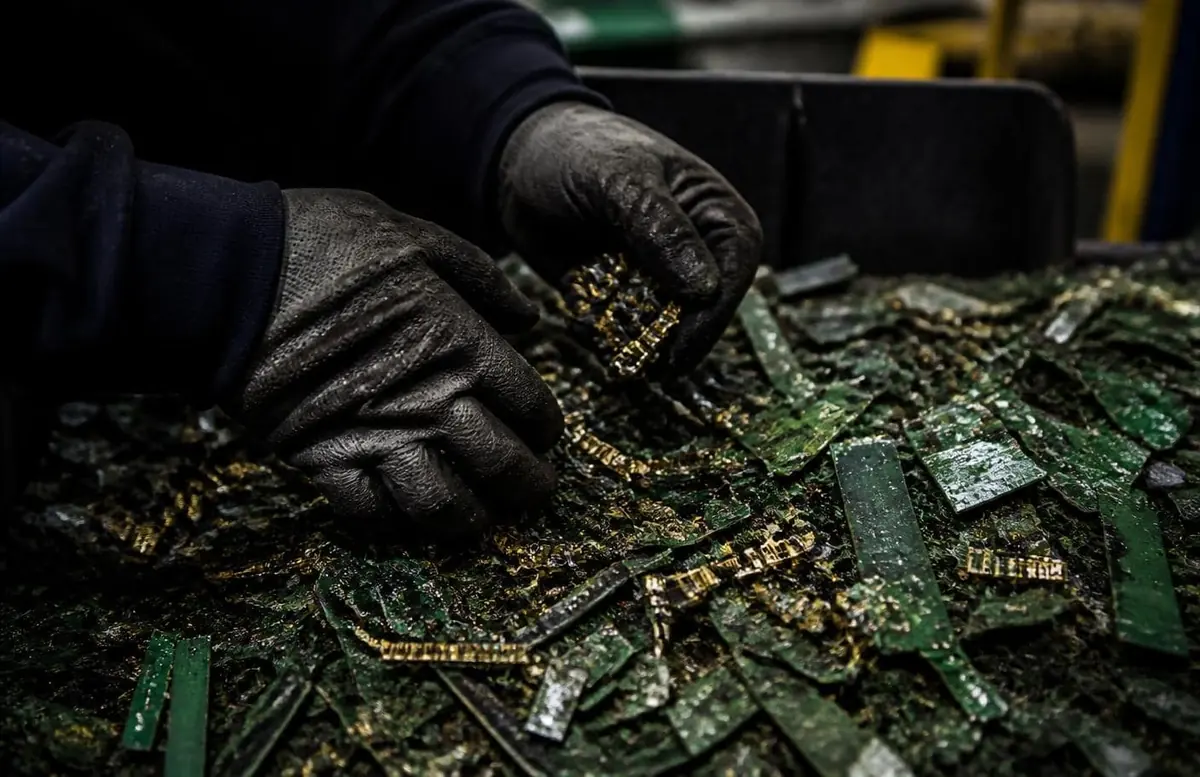
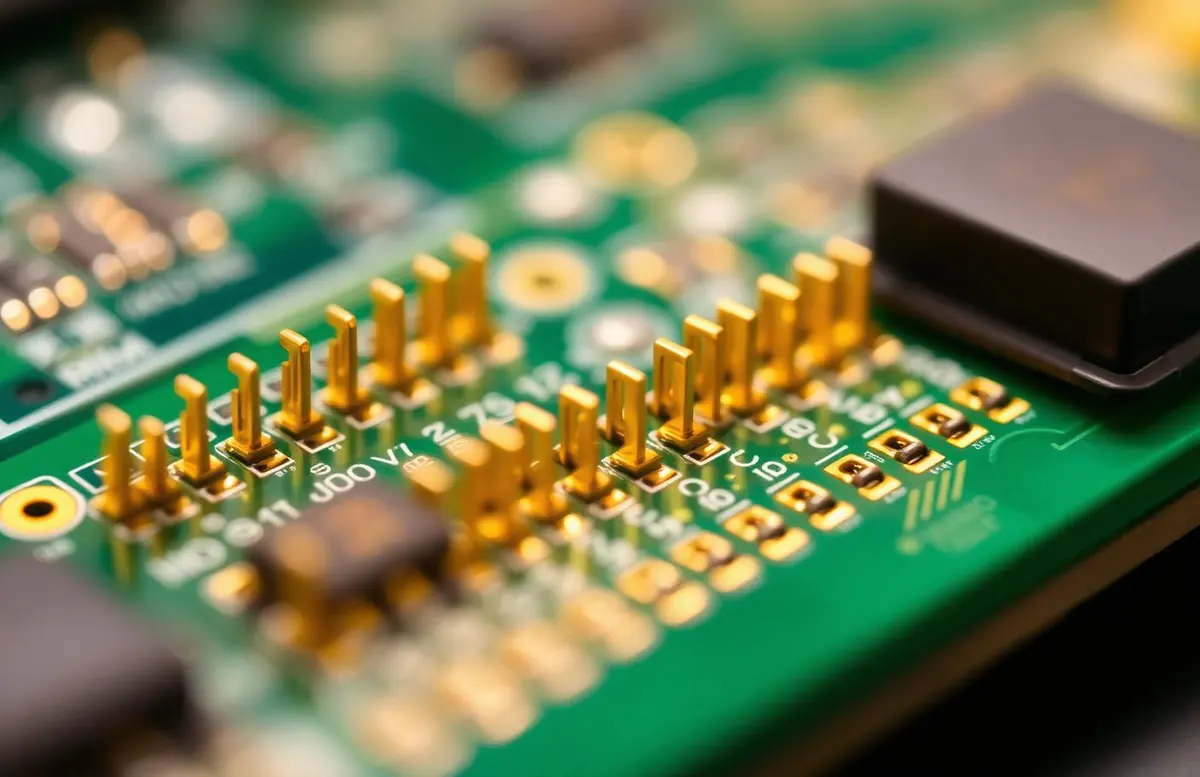
The word 'ore' has no romance in it. It is an accounting term. A rock is ore if the metal it contains can be extracted for less than the metal is worth, and it is waste if it cannot, and that boundary moves with the price, the exchange rate, the diesel bill and the depth of the shaft. Once you accept that definition, a strange conclusion follows almost immediately: the richest gold ore most people will ever hold is the connector strip on a discarded server board.
The comparison is not rhetorical. Underground gold mines routinely operate on ore that carries a handful of grams of gold per tonne of rock — a concentration of a few parts per million, invisible to the eye, recoverable only because the industry has spent a century industrialising the process of moving and grinding enormous volumes of stone. Sorted, high-grade printed circuit boards can carry gold at concentrations one or two orders of magnitude higher. On paper, it is the best deposit on the planet.
Why the best deposit on the planet is barely being mined
A mining company deals with one hole in the ground. It builds a road to it once, a plant beside it once, and then runs material from a known coordinate for twenty years. Urban mining inverts every one of those conditions. The deposit is a few grams at a time, in a drawer, in a garage, in an office refit skip, in a container heading to a port. The metallurgy was solved decades ago. The problem is that the ore has to be persuaded to arrive.
Collection economics are unforgiving. The gold in a single handset is worth a small fraction of what it costs to individually collect, transport, store and manually disassemble that handset. Value appears only at scale and only when the whole device is treated as a bundle of materials — copper, palladium, silver, tin, aluminium, rare earths, and gold — rather than a gold source with some packaging around it. Any recovery business that depends on gold alone fails; the ones that survive are copper and base-metal smelters that treat precious metals as the margin on top.
Three routes to the same metal
Industrial recovery narrows to a small number of established pathways, each with a distinct economic profile.
- Pyrometallurgy: boards are fed into a copper smelter, the organic fraction burns as fuel, and precious metals dissolve into the copper phase for later electrolytic separation. Highest throughput, highest capital cost, requires serious gas cleaning to be defensible environmentally.
- Hydrometallurgy: shredded material is leached in acid or cyanide solution, and gold is recovered from solution by carbon adsorption, precipitation or electrowinning. Lower capital cost, far more chemically demanding, generates effluent that must be treated rather than released.
- Bio-oxidation and emerging solvent chemistry: microbial and selective-solvent approaches that promise milder conditions and lower energy. Genuinely promising at pilot scale; still small next to the two established routes, and the honest reporting position is that scale-up is unproven rather than imminent.
Whichever route is used, the sequence is the same: liberate the metal from the substrate, concentrate it into a manageable stream, purify it to a form a refiner will accept. It is the same logic as a hard-rock mine, compressed into a shed and run against feedstock whose composition changes every truckload.
“We are not in the gold business. We are in the logistics business, and gold is what we find at the end of the logistics.”
The informal sector, and the part of this story that is not clever
A large volume of the world's end-of-life electronics is processed outside any permitted facility. The methods are simple and effective at capturing a fraction of the value: burn the plastics off to expose metal, dissolve the metal in acid mixtures in open containers, precipitate the gold, sell it locally. The technique is centuries old in outline. What is new is the feedstock, and the feedstock is full of brominated flame retardants, lead solder, mercury switches and beryllium.
The consequences are documented in the public-health literature rather than in industry reporting: elevated blood lead in children, dioxin exposure from open burning, contaminated soil and groundwater around processing clusters. Recovery rates in these operations are also poor — a large share of the gold is simply lost to the residue and the smoke. It is the worst combination available: maximum harm, minimum yield.
The policy answer usually offered is export control. The more honest answer, and the one people working in the field tend to give, is that formal capacity has to be cheaper and closer than the informal alternative, or material will keep going where the transaction is simplest. Regulation without accessible collection infrastructure moves the flow rather than stopping it.
ppm
Typical mined ore grade — parts per million
100s g/t
Grade of sorted high-value board fractions
~25%
Rough share of annual refinery feed from recycled sources
weeks
Lag between a price spike and a scrap inflow surge
Miniaturisation cuts both ways
It is tempting to assume the problem shrinks as engineers use less gold per device. Gold layers on connectors and bond wires have indeed become thinner, and substitution to palladium-coated copper wire in packaging has removed gold from applications that once consumed it steadily.
But recovery does not scale with content alone. Thinner deposits inside more tightly integrated, adhesive-bonded, multi-layer assemblies are harder to liberate, and harder liberation means lower recovery percentages and higher processing cost per gram. A device with half the gold and a quarter of the separability is a worse ore, not a better one. Design for disassembly — a phrase that has appeared in policy documents for two decades and in very few product specifications — remains the intervention with the largest untapped effect.
What recycling actually does to the market
Recycled gold occupies a specific structural position: it is the only significant supply source that reacts quickly to price. Mines cannot accelerate; scrap can. When the price moves sharply, jewellery scrap and industrial recovery flows rise within weeks, damping the move. That responsiveness is why refinery feedstock composition is a genuinely useful market indicator, and why refiners watch scrap arrivals the way a retailer watches footfall.
It also carries a claim that deserves care. Recycled gold is frequently marketed as a low-impact alternative to mined metal, and per gram at the point of recovery that comparison holds. What it does not do is reduce total demand, and it does not by itself reduce mining volumes while consumption grows. A supply chain that recycles more and mines the same amount has increased total supply, not cleaned up the existing one. That is an improvement worth having, described accurately.
The final irony of urban mining is that the deposit keeps improving in exactly the way a geologist would hate: it grows every year, it is distributed everywhere people live, and its grade is set by consumer electronics design cycles rather than by the last few hundred million years of hydrothermal activity. There is no exploration risk. There is only the far more mundane problem of getting the ore to the plant.
The collection problem is bigger than the chemistry problem
Metallurgically, recovering gold from circuit boards is a solved problem. Integrated smelters take mixed electronic scrap, use the copper matte as a collector for precious metals, and separate gold, silver, palladium and platinum in the refinery at recoveries that mined ore cannot approach. The technology is mature and the economics work at scale.
What does not work is getting the material there. A large majority of end-of-life electronics never reaches a formal recycler at all. Devices sit in drawers, go to landfill, or enter an informal export chain that ends with open burning and acid leaching in unregulated yards. The precious metal in that stream is not so much lost as scattered, and the fraction of it actually recovered is a small one.
- Hoarding — households retain old phones and laptops for years, delaying the feed and degrading batteries in the meantime.
- Leakage — material collected under a formal scheme that is resold into an informal chain before it reaches a smelter.
- Design — glued assemblies and integrated packages that make selective dismantling uneconomic at labour rates in high-income countries.
- Economics of distance — low-value bulk fractions make freight to a distant smelter marginal, so pre-processing has to happen near the source.
Why urban mining is a supplement, not a substitute
The comparison with a mine is flattering on grade and misleading on volume. Even at full recovery, gold in electronic waste is a small fraction of annual demand; there is simply not enough of it, spread across not enough devices, at a content per device that keeps falling. Recycling of all types — dominated by jewellery scrap, not electronics — supplies a substantial share of annual supply, but the electronics portion of that is modest.
What urban mining does offer is a much lower environmental cost per gram, no new land disturbance, no tailings facility and no perpetual water treatment. That is the honest case for it. It will not replace mining, and framing it that way sets it up to be judged against a target it cannot hit; it will meaningfully reduce the footprint of each incremental ounce, provided the collection rate improves faster than the gold content falls.
Inside a formal recovery plant: from shredder to bar
It is worth walking the physical path a batch of scrap takes through a compliant facility, because the sequence explains most of the cost structure the industry complains about. Incoming material is first manually triaged to pull out batteries, which must never enter a shredder because lithium cells can ignite on impact, and any items with obvious reuse value, which are diverted to refurbishment rather than destruction.
Shredding and liberation
What remains passes through a hammer mill or shear shredder that reduces devices to fist-sized fragments, then progressively finer stages bring the material down to a granulate. The point of shredding is liberation: breaking the mechanical bond between a gold-plated pin and the plastic housing around it, so that downstream separation equipment has a chance of telling the two apart.
Separation before smelting
Magnetic separation pulls out ferrous steel. Eddy-current separators, which induce a repulsive current in non-ferrous metal as it passes over a rapidly alternating magnetic field, fling aluminium and copper fragments clear of the plastic stream. Density-based sorting in air or water tables does further work on anything the magnets and eddy currents missed. None of this equipment sees the gold directly — it is far too finely distributed for any sorting machine to target — but it concentrates the precious-metal-bearing fraction into a smaller, richer stream before the expensive part of the process begins.
That concentrated fraction, still mostly copper by mass, goes to a smelter where it functions as feedstock alongside conventional copper concentrate. The precious metals collect preferentially into the copper matte during smelting, are separated at the anode stage of copper electrorefining as a sludge, and that sludge — now enriched many times over relative to the original scrap — is what finally goes through gold-specific refining: essentially the same chlorination and electrolytic steps used to refine mined doré.
The economics of collection, mapped against the informal sector
Formal recyclers do not lose to informal operators on chemistry. They lose, where they lose, on cost of compliance measured against a feedstock that is willing to go wherever the price is highest and the paperwork is lightest. A permitted smelter must fund gas cleaning, wastewater treatment, worker safety systems and licensing. An informal yard funds none of these, which is not a hidden subsidy so much as a directly transferred cost, paid by the health of the people living near it rather than by the price of the gold recovered.
- Formal collection typically pays less per kilogram of scrap than an informal buyer able to skip documentation and export controls.
- Informal operations can process material within days of collection; formal permitting and batching cycles are measured in weeks.
- Cross-border movement of e-waste is restricted under international agreements, but enforcement capacity at ports is uneven, and misdeclared shipments are a persistent problem rather than a solved one.
- Extended producer responsibility schemes, which require manufacturers to fund end-of-life collection, exist in a growing number of jurisdictions but rarely cover the full cost of formal processing.
The policy lesson, echoed by nearly everyone who has run a formal recovery operation, is that competing with the informal sector on price alone is a losing strategy, because the informal sector's price advantage comes from cost-shifting that a permitted operator is legally barred from replicating. The realistic lever is making formal collection more convenient than informal disposal — collection points inside retail chains, deposit schemes, manufacturer take-back — rather than trying to out-price an operation that has no compliance costs to recover.
What good policy has actually achieved, and where it has stalled
Extended producer responsibility regulation, first widely adopted in the European Union and since copied with variations elsewhere, shifted the legal obligation for end-of-life collection onto the companies that put the devices on the market in the first place. Where it has been enforced with real penalties, collection rates for large appliances have risen substantially, because a washing machine is too big to quietly bin and too easy to trace back to a compliance scheme.
Small, high-value electronics are the harder case. A phone is easy to keep in a drawer indefinitely, cheap enough to discard casually if it is finally thrown away, and light enough to disappear into general waste without anyone noticing. No jurisdiction has solved the small-device collection problem convincingly; the honest state of the field is a set of partial measures — retailer take-back requirements, postage-paid return schemes, municipal collection days — each of which recovers a modest fraction of what is theoretically available, and none of which has closed the gap to a level a mining engineer would recognise as a mature ore-supply chain.
A realistic ten-year outlook
None of the constraints described here are permanent in principle. Design-for-disassembly requirements are beginning to appear in procurement standards for public-sector electronics purchasing, which is a small market but a visible one that manufacturers watch when planning future product lines. Battery-recycling regulation, driven by cobalt and lithium supply concerns rather than gold, is dragging general electronics recycling infrastructure up with it, because much of the sorting and shredding capacity is shared.
The more likely trajectory is not a breakthrough but a slow, unglamorous tightening: better collection logistics, wider extended producer responsibility coverage, incremental gains in smelter recovery rates, and continued erosion of the informal sector's cost advantage as export controls improve. None of that produces a headline. All of it, compounded over a decade, is what actually moves the share of global gold supply that comes from a drawer rather than a drill rig.
The economics of a single tonne of scrap, worked through
It helps to follow one tonne of mixed consumer electronics through the numbers rather than talk about the industry in the abstract. A tonne of unsorted small appliances and old computing equipment might yield somewhere in the region of one to two hundred grams of gold once it reaches a smelter, alongside far larger quantities of copper, some silver, a trace of palladium and platinum from connectors and capacitors, and a great deal of plastic and glass that has to be dealt with rather than simply discarded. At current gold prices that gold fraction alone can be worth several thousand pounds, and it would be easy to conclude the tonne is straightforwardly profitable to process.
The conclusion does not survive contact with the cost side. Collecting a tonne of dispersed small devices from households and small businesses, rather than receiving it as an industrial lot, involves logistics costs that scale with the number of pickup points rather than the weight moved. Manual pre-sorting to remove batteries and reusable items is labour-intensive and cannot be meaningfully automated at current technology. Compliance costs — permits, gas cleaning, wastewater treatment, worker safety systems — are largely fixed regardless of volume, which is why formal recovery consolidates into a small number of large plants rather than proliferating into many small local operations the way, say, aluminium can recycling has.
Server farms, data centres and the highest-grade urban ore
If a mobile phone is a modest ore, a decommissioned data centre is closer to a bonanza. Server motherboards, network switches and telecom backplanes were historically built with gold-plated edge connectors, gold-flashed pins and gold bonding wire at densities far exceeding anything found in consumer electronics, because the reliability premium on enterprise and telecom hardware justified the material cost in a way a mass-market phone never could. As hyperscale data centres refresh hardware on short cycles — often three to five years — a steady, high-grade, well-documented stream of retired equipment enters the market, and it is disproportionately responsible for making formal electronic-waste recovery a viable business at all.
This stream also differs from consumer e-waste in a way that matters enormously for recovery economics: it typically comes from a single institutional source, arrives in bulk, is well described in inventory records, and carries no meaningful collection cost because the generator wants a clean, auditable disposal chain for data-security reasons as much as for environmental ones. Recovery specialists candidly describe consumer electronics recycling as subsidised, in commercial terms, by enterprise and telecom decommissioning — the high-grade, low-friction material funds the capacity that also processes the low-grade, high-friction material from households.
- Enterprise server and switch hardware: historically among the richest electronic scrap by gold content per kilogram, due to gold-plated connectors on high-reliability components.
- Telecom exchange equipment: legacy backplanes and connectors from wireline infrastructure being retired carry gold content well above consumer-grade equivalents.
- Consumer smartphones and laptops: modest gold content per unit, valuable only in large aggregated volumes.
- Aerospace and defence electronics: high gold content per unit but small overall volumes and often subject to security-driven destruction requirements that override recovery economics entirely.
The environmental accounting, done honestly
The case for urban mining is frequently stated in absolute terms — no land disturbance, no tailings, no new mine — that undersell how much the comparison depends on which route is being described. Formal, well-regulated electronic-waste recovery genuinely does avoid the land-use footprint, waste-rock volumes and long-term tailings liabilities associated with primary mining, and independent life-cycle assessments have consistently found lower energy use and lower greenhouse-gas emissions per gram of gold recovered through formal e-waste smelting compared with primary extraction from typical ore grades.
That comparison collapses, or reverses outright, once informal recovery is substituted for formal recovery. Open acid leaching and open burning release heavy metals, dioxins and other persistent pollutants directly into soil, air and water with essentially no containment, and the health and environmental costs of that route are large, well documented in affected communities, and not captured in any per-gram carbon comparison that only looks at energy inputs. The honest environmental case for urban mining is conditional: it is a genuine improvement over mining when it runs through a properly permitted facility, and it can be worse than doing nothing when it runs through an unregulated one.
“People want a single number: is recycled gold greener than mined gold. The true answer has three words hiding inside it — through which route.”
3–5 yrs
Typical hardware refresh cycle at hyperscale data centres
10–50×
Rough gold-content multiple of enterprise hardware over consumer devices, per kilogram
Lower
Typical life-cycle emissions per gram, formal e-waste recovery vs primary mining
Reversed
That comparison's direction once informal, unpermitted recovery is substituted
Frequently asked
Questions readers ask
- How much gold is in a mobile phone?
- On the order of a few tens of milligrams — worth a small amount individually. The economics only work in bulk: it takes thousands of handsets to accumulate a meaningful quantity, which is why collection logistics dominate the business model.
- Is e-waste really richer than gold ore?
- By concentration, frequently yes. Modern underground ore is often mined at grades measured in single-digit grams of gold per tonne, while sorted, high-grade circuit boards can run into the hundreds of grams per tonne. What e-waste lacks is a deposit: the material arrives in millions of small, geographically scattered, awkwardly assembled pieces.
- Can I recover gold from electronics at home?
- You should not attempt it. The established routes use strong acids, cyanide or high-temperature smelting, and the informal versions of these processes are responsible for severe heavy-metal and dioxin exposure in communities where they are practised. This article is reporting, not a procedure.
- Does recycling reduce the need for mining?
- It reduces it at the margin and makes total supply more responsive to price, but it cannot replace mining while total demand keeps growing and while a large share of end-of-life electronics is never collected in the first place.
- Which electronics contain the most gold?
- Old telecom and computing hardware — server boards, switchgear, mainframe-era backplanes — carry far more gold per kilogram than modern consumer devices, because miniaturisation and copper bonding wire have cut the metal content of newer equipment substantially.
- Can you extract gold from electronics at home?
- No, not safely or economically. The chemistry involves strong acids and produces toxic gases and residues, the yield from a household quantity of scrap is worth a few pounds, and informal processing is one of the more damaging sources of heavy-metal pollution worldwide.
- Why don't manufacturers just design devices to be recycled more easily?
- Because disassembly cost is a real cost and gold recovery is a marginal benefit compared with the priorities that actually drive product design: thinness, water resistance, structural rigidity and assembly speed on a production line. Adhesive bonding achieves all four more cheaply than screws and clips, and no regulation currently forces manufacturers to weigh recyclability against those goals at the design stage.
- How does urban mining compare with mining on cost per ounce?
- It varies hugely by feedstock quality and cannot be reduced to one figure. High-grade sorted server and telecom scrap can be cheaper to process per ounce than a marginal underground deposit; low-grade mixed consumer e-waste, once collection, sorting and environmental compliance are included, can be considerably more expensive. The comparison only makes sense feedstock by feedstock, not industry by industry.
- What happens to the plastics and other materials that aren't gold?
- In a formal smelter, the organic fraction is burned as fuel for the process itself, with emissions controlled by gas-cleaning equipment, and other metals — copper, palladium, tin, aluminium — are recovered in parallel streams. In informal operations, plastics are typically burned in the open, which is the single largest source of the toxic exposure associated with backyard e-waste processing.