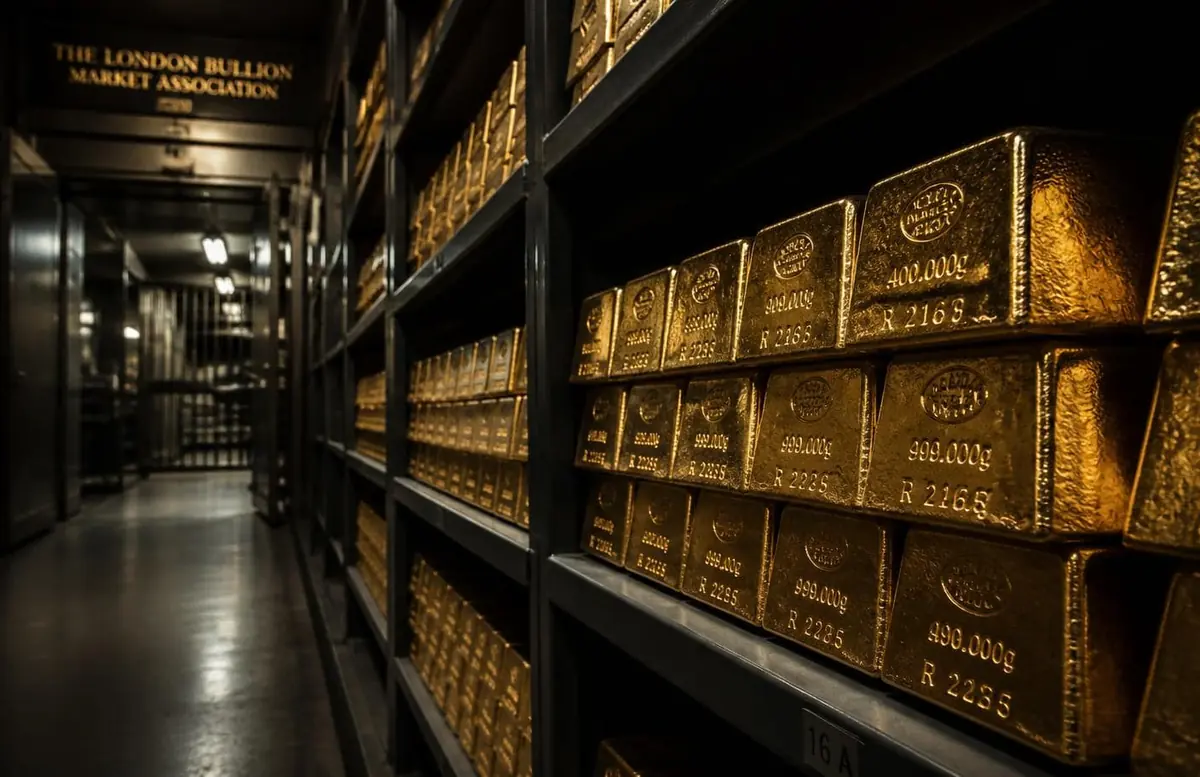
Origins
Where Gold Actually Comes From
Every gram of gold on Earth was manufactured in an astrophysical catastrophe, arrived here after the planet had already formed, and was then concentrated by hot water. Three separate accidents, none of them likely, all of them necessary.
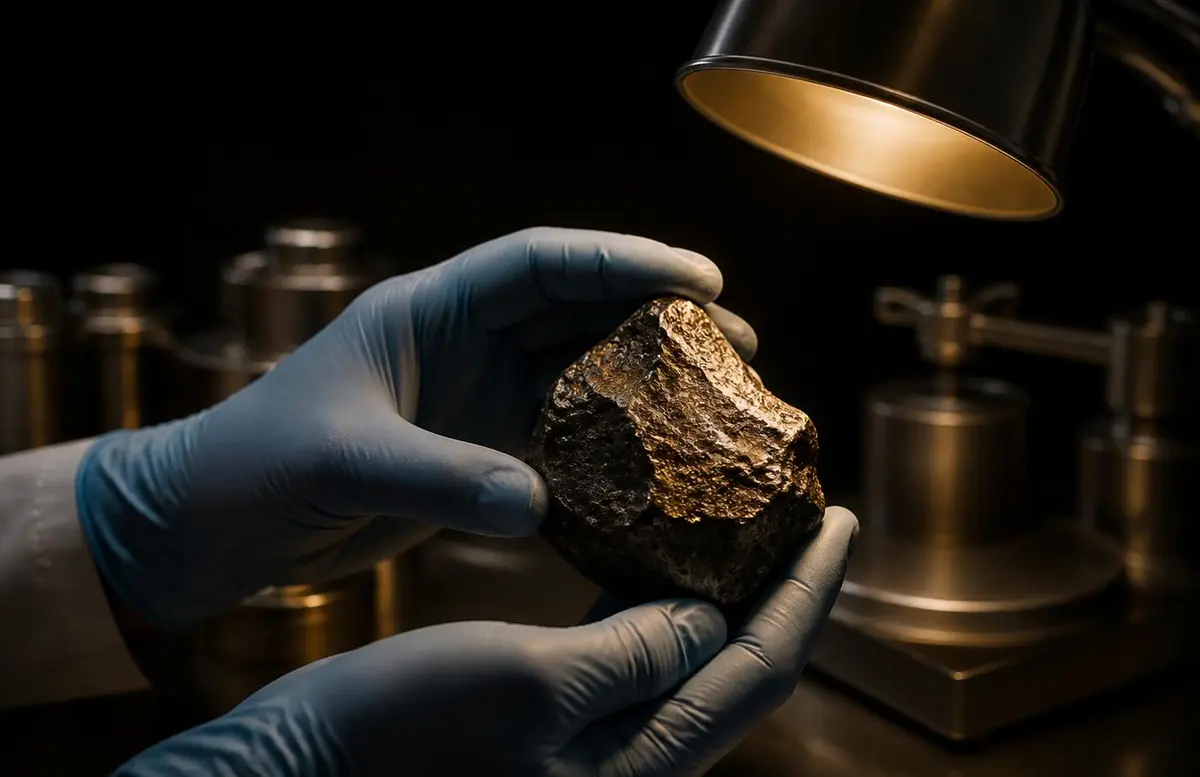
Start with a fact that sounds like a metaphor and is not: no process available to an ordinary star can make gold. Stellar fusion is profitable up to iron and then stops being profitable. Fusing light nuclei releases binding energy, which is what keeps a star inflated against its own weight; past iron-56, the arithmetic inverts and each further fusion costs energy rather than yielding it. A star that begins building gold in its core is a star that has begun switching itself off.
So the seventy-nine protons in a gold nucleus were assembled somewhere else, under conditions that no longer exist anywhere near us. The route to them runs through neutrons, not protons, and through a burst of them so intense that a nucleus can swallow dozens before it has time to decay. Astrophysicists call it the r-process — r for rapid — and the argument about where it happens has been running for seventy years.
The r-process, in plain terms
Neutrons are convenient raw material for nucleosynthesis because they carry no charge and are therefore not repelled by the nucleus they are approaching. A nucleus sitting in a neutron bath will absorb them until it becomes so neutron-heavy that it beta-decays, converting a neutron into a proton and climbing one step up the periodic table. Repeat this a few hundred times in the space of about a second and you can walk from iron to uranium.
The 'rapid' qualifier does the work. In the slow neutron capture process, the s-process, which operates in the interiors of ageing giant stars, captures are rare enough that unstable nuclei decay between them, and the reaction path hugs the valley of stability. That path can reach lead. It cannot efficiently reach the actinides, and it produces a distinctive abundance pattern that does not match what we measure for gold, platinum and the other heavy precious metals.
The 2017 event that settled part of the argument
For decades, the leading candidate site for the r-process was the core-collapse supernova, chiefly because supernovae were the most violent thing anyone could point to. The models never worked cleanly: simulations struggled to generate the neutron richness required, and the calculated yields fell short of the heavy-element inventory the galaxy actually contains.
On 17 August 2017, gravitational wave detectors recorded the inspiral and merger of two neutron stars in a galaxy roughly 130 million light years away. Within hours, telescopes across the spectrum found the optical counterpart, and over the following days its light reddened in a manner consistent with a cloud of freshly made, highly opaque heavy nuclei — a kilonova. The spectroscopy was not a receipt with 'gold' written on it, but the inferred mass of r-process material, several hundredths of a solar mass from a single merger, was in the right range to account for the galactic budget.
“Two dead stars collided, and the debris was a periodic table's worth of the elements we consider precious. That is the actual provenance of a wedding ring.”
The picture is not closed. Rare classes of magnetically driven supernovae, called magnetorotational or collapsar events, may contribute, and the observed abundance of heavy elements in some very old stars suggests r-process enrichment happened earlier in cosmic history than mergers alone comfortably explain. What has changed since 2017 is that the argument is now about relative contributions rather than about whether the mechanism has ever been observed.
Delivery: the metal that had to arrive twice
Suppose the galaxy has made its gold and dispersed it into the cloud from which the Sun and its planets condensed. There is a second problem, and it is the reason a geologist cares about any of the above.
Gold is siderophile: it prefers, chemically, to dissolve in molten iron rather than in silicate rock. When the young Earth differentiated and its iron sank to form a core, the gold that had been distributed through the bulk of the planet went with it. Run the partitioning coefficients measured in the laboratory and the mantle should have been stripped almost clean — depleted by two to three orders of magnitude below what we in fact measure in mantle-derived rocks.
~4.5 bn yr
Age of Earth's core formation
0.5%
Estimated late-veneer share of Earth's mass
1 ppb
Typical gold content of continental crust
1,000×
Concentration needed to make an ore body
The standard resolution is the late veneer. After the core had finished forming and the door had closed, Earth continued to accrete material — a final sliver of its mass, delivered by asteroidal and possibly cometary impactors over some hundreds of millions of years. That material never saw a core-forming event here, so it carried its full complement of gold and platinum-group metals into a mantle that had already been stripped. Every gram of gold in every vault, on this account, is a fragment of the last debris to hit the planet.
Concentration: what hot water does over a million years
The late veneer left continental crust with roughly one part gold per billion parts rock. At that concentration, a tonne of average rock contains about a milligram of gold, and nothing on Earth could economically extract it. Mining requires a further enrichment of a thousandfold or more, and geology performs that step with water.
In a hydrothermal system, groundwater heated by a cooling intrusion or by the geothermal gradient circulates through vast volumes of rock. Gold is not soluble in cold, clean water, but it is soluble as a complex — bound to reduced sulphur species, principally bisulphide, and at higher temperatures to chloride. The fluid strips gold at parts-per-billion concentrations from a rock volume measured in cubic kilometres and carries it in solution towards lower pressure.
Deposition happens where the chemistry of the fluid breaks. Boiling, which strips hydrogen sulphide into the vapour and destabilises the complex, is the classic trigger in epithermal systems; so is a sudden temperature drop, a reaction with iron-rich wall rock, or mixing with a chemically different water. What determines whether a deposit exists is not whether the gold was present but whether the fluid found a reason to let go of it in one narrow structural corridor.
- Orogenic deposits: gold in quartz veins along major crustal shear zones, formed during mountain building; the classic Californian and Western Australian lodes.
- Epithermal deposits: shallow, volcanically driven, often bonanza-grade in narrow veins where the fluid boiled.
- Porphyry systems: enormous, low-grade copper-gold bodies around a cooling intrusion; individually poor rock, collectively vast metal inventories.
- Carlin-type deposits: gold at microscopic scale locked in sulphide minerals within carbonate rock, invisible to the eye and undiscovered until the twentieth century.
- Placers: not a new concentration mechanism but a mechanical one — erosion frees gold from a hard-rock source and running water sorts it by density.
Why the geology explains the industry
The chain from neutron star to earring is a chain of improbabilities, and each link constrains what the modern industry can look like. Because the r-process is rare, gold is scarce in absolute terms. Because gold is siderophile, most of Earth's endowment is unreachable in the core. Because the crustal remainder sits at a part per billion, ore bodies exist only where a hydrothermal system happened to plumb a large rock volume into a small trap.
Those three facts produce an industry whose economics are dominated by moving material. Even a good open-pit orebody grades around one gram per tonne — one part per million, a thousand times enriched over average crust and still, in ordinary language, a rock with no visible gold in it. A miner does not find treasure; a miner finds a statistical anomaly and then spends a decade and several billion dollars processing it.
It is also why the recycling and refining desks matter as much as the exploration ones. The metal is not consumed. A late-veneer impactor delivered it, hot water concentrated it, and human beings have merely been moving the same inventory between vaults, necks and, latterly, circuit boards. The astrophysics finished four and a half billion years ago; everything since has been logistics.
How astronomers actually measure this
None of the r-process story rests on a single experiment. It is triangulated from three independent lines of evidence that happen to converge, which is the ordinary standard of proof in astrophysics, where controlled repetition of the event under study is never available.
Spectroscopy of old, metal-poor stars
Stars formed early in the galaxy's history, before generations of supernovae had enriched the interstellar medium, retain in their outer layers a near-fossil record of whatever heavy elements were present when they condensed. A subset of these ancient stars show a heavy-element abundance pattern that tracks the solar r-process curve almost exactly, while showing almost none of the lighter s-process elements that only accumulate after many stellar generations. That pattern is difficult to explain unless a genuinely rapid, high-neutron-flux event enriched the cloud those stars formed from, and it had to happen early and locally rather than as a slow galactic average.
Kilonova light curves
The second line is the direct observational one: the fading light of a neutron star merger's ejecta. Freshly synthesised heavy nuclei are extraordinarily opaque to blue light because their complex electron shells offer an enormous number of absorption lines, so the ejecta cloud reddens and dims on a specific, modellable timescale as it expands and cools. The 2017 event's light curve matched that prediction closely enough that most working astrophysicists now treat neutron star mergers as a confirmed, rather than merely proposed, r-process site.
Galactic chemical evolution modelling
The third line is bookkeeping. Given an estimated merger rate for the galaxy and an estimated ejecta mass per merger, does the arithmetic reproduce the actually observed inventory of gold, europium and platinum in the Milky Way today? Early models struggled because neutron star mergers are individually rare and might not happen often enough, especially in the galaxy's youth, to seed the very old stars discussed above. That tension is the live edge of the research, and it is why magnetorotational supernovae — a much rarer but far more violent alternative site — remain in contention as a secondary contributor.
The siderophile problem, in more detail
The late veneer hypothesis is elegant, but it had to survive a genuinely awkward piece of geochemistry before geologists accepted it, and understanding the objection clarifies why the theory has the shape it does.
Laboratory experiments that measure how gold partitions between molten iron and molten silicate at core-forming pressures and temperatures produce partition coefficients so extreme that, if the whole planet equilibrated during core formation, the mantle should be all but sterile of gold — depleted far beyond what is actually measured. For years this was treated as a serious problem for the story: either the partitioning experiments were wrong, or core formation was less efficient than assumed, or something else was topping up the mantle afterward.
The resolution that has held up is that core formation was never a single, complete equilibration event. It happened progressively, as the growing Earth accreted and iron periodically separated and sank in batches, meaning some iron-metal droplets never fully re-equilibrated with the whole silicate mantle before locking their gold away. Combined with a late veneer topping up whatever the core formation process missed, the two effects together reproduce the observed mantle abundances of gold, platinum and iridium far better than either explanation alone.
- The Moon shows a similarly gold-depleted mantle, consistent with its own core-forming history and a comparatively modest late veneer of its own.
- Mars, whose accretion finished earlier and whose late-accreted mass fraction is estimated to be smaller, shows a mantle signature consistent with less late-veneer enrichment than Earth's.
- Chondritic meteorites — undifferentiated leftovers from the solar system's formation that never had a core-forming event at all — preserve the full, unstripped abundance of siderophile elements and are the benchmark against which planetary depletion is measured.
- The near-constant ratio of gold to other highly siderophile elements across late-veneer-affected bodies is one of the strongest arguments that a single population of impactors, not a grab-bag of different objects, did the delivering.
What this means for exploration geology
It might seem that cosmic origin and ore-body discovery belong in different disciplines entirely, but the connection is closer than it looks. Understanding that gold's crustal abundance is a fixed, extremely low starting inventory — set once by accretion and never replenished — is what tells explorers that every discoverable ounce is the product of subsequent concentration, not of some deeper reservoir waiting to be tapped by drilling further.
That reframes the entire economics of mineral exploration. A company is never looking for a place where the Earth is unusually rich in gold in absolute terms; the crust is uniformly poor everywhere. It is looking for a place where a particular geological accident — a fault system, a boiling zone, a chemical trap — happened to run a large volume of that uniformly poor rock through a fluid system and drop its cargo in a small target. The rarity of gold is cosmic and fixed; the rarity of an ore body is geological and, crucially, discoverable with the right model.
“Exploration geologists do not search for gold. They search for the plumbing that once concentrated it, because the metal itself is everywhere and nowhere in equally useless quantities.”
~1 in 10¹²
Approximate atomic abundance of gold in bulk silicate Earth
3–4
Order-of-magnitude enrichment achieved by a hydrothermal system
130 million ly
Distance to the 2017 neutron star merger, GW170817
~13.8 bn yr
Age of the universe in which the r-process has been operating
Seen this way, the astrophysics and the industry are not separate stories loosely connected by trivia. They are the same story told at different timescales: an extremely rare nuclear event set a fixed, tiny inventory; planetary accretion delivered a fraction of it to a crust that could never make more; and everything the mining industry has done since is the very slow, very expensive business of finding the handful of places where geology performed the second concentration for free.
Gold on other worlds: the control-group evidence
The late-veneer story makes a testable prediction: bodies that finished forming their cores at different times, or that received different amounts of leftover bombardment afterwards, should show correspondingly different gold and platinum-group abundances in their outer layers. That prediction can be checked against samples that never sat in an Earth laboratory's back catalogue until spacecraft and telescopes went and found them.
What lunar samples show
The Apollo missions returned enough lunar material for geochemists to measure highly siderophile element abundances in mantle-derived basalts, and the numbers came back low, consistent with a Moon that underwent its own core-forming event and received a much smaller late veneer, proportionally, than Earth did. That is exactly what the giant-impact origin of the Moon would predict: a body formed largely from already-differentiated debris has less scope to receive a fresh, gold-bearing veneer afterwards.
What Martian meteorites show
Mars presents a middle case. Meteorites blasted off the Martian surface and recovered on Earth carry a highly siderophile element signature that sits between the Moon's depleted mantle and Earth's comparatively enriched one, consistent with a late veneer that arrived in smaller relative proportion, probably because Mars's accretion finished earlier, before as much leftover debris remained in the inner solar system to be swept up.
None of these comparisons are decisive on their own. Each planetary body has its own accretion history, its own core-formation pressure and temperature, and its own subsequent volcanic reworking that can locally concentrate or dilute a signal. What makes the comparison persuasive is that the ordering — Moon depleted, Mars intermediate, Earth comparatively enriched — falls out naturally from independently estimated accretion timelines, rather than being fitted after the fact to match the gold data.
Chondritic meteorites do a different job in this argument. Because they are fragments of bodies that never grew large enough to melt and differentiate, they preserve something close to the original solar nebula's proportions of siderophile elements, undisturbed by any core-forming event. Comparing planetary mantles against chondrites is how geochemists quantify depletion in the first place; without an undifferentiated benchmark, there would be no baseline against which to call any mantle 'stripped'.
“Every planet with a core is running the same experiment. The Moon, Mars and Earth are three data points on a single graph, and gold is the element that tells you where each point falls.”
The economics of an inventory that cannot grow
Because the crustal gold budget was fixed once, four and a half billion years ago, and has not been meaningfully added to since, the modern gold market is best understood as a closed loop rather than a conventional extractive industry. Mining does not create new supply in any absolute sense; it transfers gold from a form the market cannot use — trace concentrations locked in ordinary rock — into a form it can, at a rate set by how much ore-processing capacity exists and how much energy is worth spending on the transfer.
This is the structural reason gold behaves differently from most other commodities investors are used to analysing. Above-ground stock dwarfs annual mine production by a wide margin, which means the flow of newly mined metal can never move the price the way a supply shock moves the price of a commodity that is consumed and does not accumulate. A poor mining year barely dents an inventory built up over five millennia.
It also explains why recycling has become, in tonnage terms, comparable to primary mining in the annual supply figures published by industry bodies. Jewellery, electronics and dental scrap are not waste streams competing with mine output; they are re-entries of the same fixed cosmic inheritance, and the decision to recycle rather than mine turns on price and processing cost rather than on any difference in the underlying metal.
Seen against the astrophysics, this closed-loop character stops looking like an economic curiosity and starts looking like the only possible outcome. A rare nuclear event produced a fixed mass of the element; a narrow delivery window added a fixed fraction of it to a reachable crust; and every transaction since has been the redistribution of that one endowment among successive owners, forms and locations, with essentially nothing added and essentially nothing destroyed.
What could still overturn parts of the story
It is worth being precise about which parts of this account are settled and which remain live research questions, because popular science writing tends to flatten that distinction. That gold requires the r-process is essentially unchallenged; the nuclear physics of neutron-rich isotopes decaying up the periodic table is textbook material, not a hypothesis under test.
What is still argued over is the relative contribution of different astrophysical sites, and the timing problem is the sharpest version of that argument. Extremely old, metal-poor stars in the galaxy's halo already show r-process enrichment, and some population-synthesis models struggle to produce enough neutron star mergers early enough in cosmic history to account for it, because merger requires two neutron stars to form, spiral together and finally collide, a process that takes time even under optimistic assumptions about binary formation rates.
Magnetorotational supernovae — a rare subclass of core-collapse supernova with unusually strong magnetic fields and jet-driven ejecta — remain the leading alternative candidate for that early enrichment, precisely because a supernova can occur within a few million years of a massive star's birth, far faster than any merger channel. Current thinking treats both as real contributors operating on different timescales, rather than as competing explanations where one must be wrong.
None of this uncertainty touches the parts of the story that matter for a magazine about the metal itself: gold's rarity, its late-veneer delivery to Earth's crust, and the hydrothermal concentration that makes ore bodies possible. Those conclusions rest on planetary geochemistry and ore-deposit studies that do not depend on resolving exactly which stellar catastrophe contributed which fraction of the galactic total.
- The r-process mechanism itself: settled nuclear physics, not contested.
- Neutron star mergers as a confirmed r-process site: strongly evidenced since 2017, not merely theoretical.
- The precise split between merger and supernova contributions to the galactic inventory: an open research question.
- The late veneer as the source of crustal gold: the consensus model in planetary geochemistry, supported by cross-planet comparisons.
- Whether some very early r-process enrichment requires an additional, rarer site: unresolved and actively studied.
~100 million yr
Typical estimated delay before two neutron stars merge after forming
<10 million yr
Time from massive star formation to core-collapse supernova
2
Broad classes of candidate r-process site under active study
1957
Publication year of the B²FH paper that first outlined the r-process
Frequently asked
Questions readers ask
- Is it true that all gold comes from exploding stars?
- Broadly, yes — but not from ordinary supernovae alone. Gold forms through rapid neutron capture, the r-process, which needs an extreme flux of free neutrons. The 2017 detection of the neutron star merger GW170817, with a spectroscopic signature consistent with freshly synthesised heavy elements, gave the first direct observational support for that route.
- How much gold is in the Earth's core?
- Enough, by most estimates, to plate the entire planetary surface several metres deep — and utterly inaccessible. Gold is siderophile, meaning it dissolves preferentially into molten iron, so during core formation it followed the iron downwards and left the mantle depleted.
- If the core took the gold, why is there any in the crust?
- Because of what arrived afterwards. The late veneer hypothesis holds that a final few tenths of a percent of Earth's mass was delivered by impactors after the core had closed, seeding the mantle with gold and the other highly siderophile elements at concentrations far above what core formation should have left behind.
- Can gold be manufactured artificially?
- It has been done, atom by atom, by bombarding mercury and platinum in reactors and accelerators. The yields are measured in micrograms and the cost per gram exceeds the market price by orders of magnitude. Transmutation is a demonstration of physics, not a supply source.
- Will asteroid mining change the gold market?
- Not on any timescale a reserve manager needs to plan around. The metal-rich asteroids that get cited contain gold at concentrations comparable to good terrestrial ore, and the binding constraint is the cost of retrieving mass from orbit, not the grade.