Archaeology
The Hoard Problem: What Buried Gold Actually Tells Us
A field of gold torcs and coins is a spectacular find and a treacherous document. The people who buried it were not writing to us, and the reasons they had for putting it in the ground are exactly what the ground does not record.
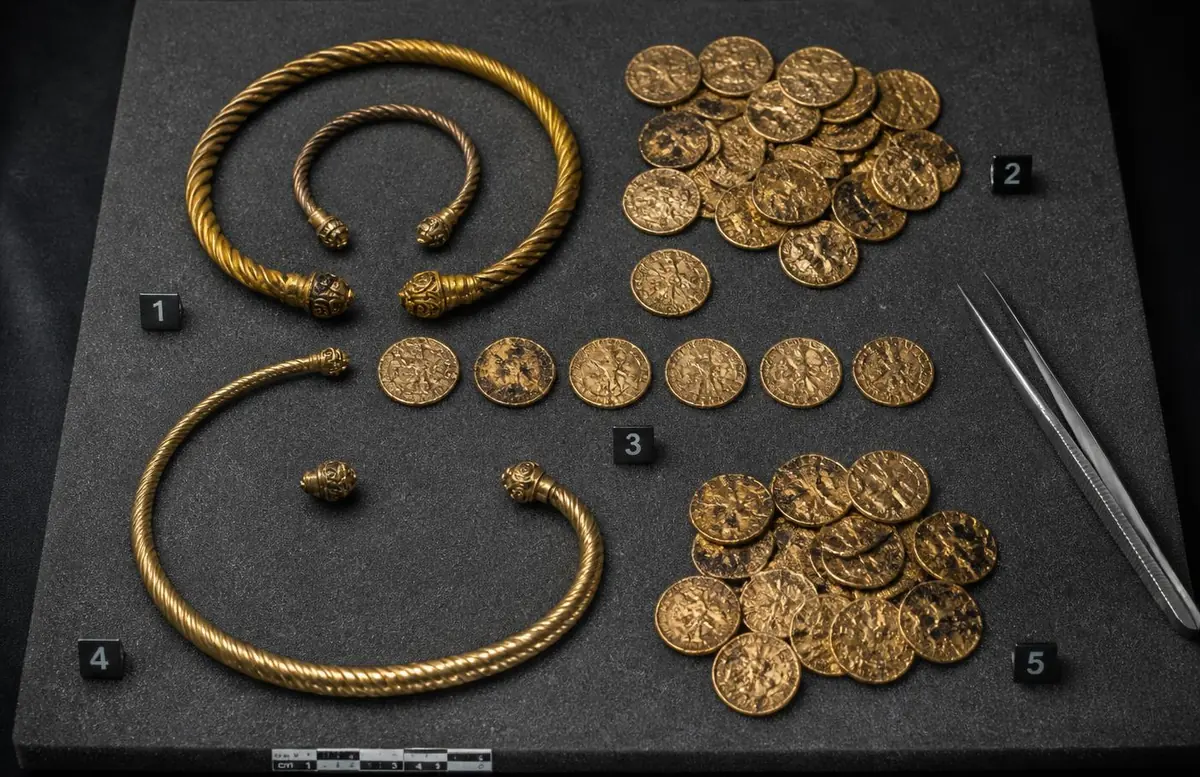
A hoard photographs beautifully. Torcs curved like question marks, coins in overlapping arcs, everything laid out on grey conservation foam with numbered markers and a scale bar. The image implies a story: someone hid this, in a hurry, because something was coming. That story is sometimes right. The difficulty is that the metal is silent on the point, and almost every popular account fills the silence with a battle.
Archaeologists have spent forty years disciplining that instinct, and the discipline is worth explaining, because it changes what a spectacular find is actually evidence of.
The survivorship problem
Consider what has to happen for a hoard to reach a museum. Someone puts valuables in the ground. Then that person fails to retrieve them — dies, is displaced, forgets the spot, or is prevented. Then the deposit survives ploughing, drainage, construction and centuries of casual scavenging. Then a modern finder recovers it and, crucially, reports it.
Each stage filters. The corpus we study is not a sample of ancient wealth or of ancient behaviour; it is a sample of ancient plans that went wrong, further filtered by modern legal incentives. When hoard counts rise in a given decade, the honest first hypothesis is not that more people buried gold but that more of them failed to come back.
“The archaeology of hoarding is the archaeology of unsuccessful hoarding. Every successful hoard was dug up by its owner and is invisible to us.”
Four reasons to put gold in the ground
Interpretation begins by enumerating the possibilities rather than reaching for the most cinematic one. In practice the field works with four broad categories, which overlap.
- Storage: routine wealth-keeping in a society without banks. Expect mixed denominations, wear consistent with circulation, and a findspot near a settlement or a memorable landmark.
- Emergency concealment: deposition under threat. Expect a tight date range, high-value objects, sometimes a container, and a findspot chosen for speed rather than for retrieval.
- Votive or ritual deposition: an offering never meant to return. Expect wet or liminal places, deliberate bending or breaking, and repeated deposition at the same site across generations.
- Founder's or scrap hoards: a metalworker's stock of recyclable material. Expect fragments, casting waste, ingots and mismatched pieces valued by weight rather than as objects.
Nothing in the gold decides between these. What decides is context: the soil profile, the container, whether the deposit was cut into a floor or dropped into standing water, what lay around it, whether the objects were intact. This is why an unrecorded findspot is so damaging. A looted hoard sold through the trade retains its market value in full and loses roughly everything that made it evidence.
What coins date, and what they do not
Coin hoards look like the most datable objects in archaeology, and in one narrow sense they are. The latest identifiable coin gives a terminus post quem: the deposit cannot have been made before that coin was struck. Combined with knowledge of circulation patterns, a numismatist can often place the burial within a decade or two.
The temptation is to convert that date into a cause, and to attach the hoard to whichever documented catastrophe happened nearby around that time. The logic is weak. Coins circulated for generations, the newest coin in a purse may predate its burial by years, and the events we know about are the ones that got written down — which biases attribution towards famous invasions and away from personal disasters, of which there were vastly more.
Provenancing the metal itself
Laboratory work has changed what a hoard can be asked. Trace elements — silver, copper, platinum-group inclusions, tin — carry a partial fingerprint of the ore and of the refining technology. Lead isotope ratios, measured by mass spectrometry on a sample far smaller than the eye can see, vary systematically between geological provinces and survive melting.
The limits are real. Ancient gold was recycled aggressively; a Roman aureus may contain metal from three earlier sources, and mixing pulls isotope ratios towards a meaningless average. Refining also fractionates: cupellation and cementation strip silver and base metals, moving the object's chemistry away from its parent ore. The technique is strongest when it excludes — showing that a group of objects cannot share a source — and weakest when asked to name a mine.
1996
Treasure Act (England & Wales) enacted
~1,500
Treasure cases reported in a typical recent year
96%
Share of reported finds made by metal detectorists
14 days
Reporting window after a finder believes a find is treasure
Law, incentives and the amateur record
Every state has to solve the same problem: the people most likely to find buried gold are not archaeologists, and the metal is worth more melted than reported unless the law makes reporting rational. Two broad approaches exist. One vests all archaeological material in the state and criminalises unlicensed searching. The other requires reporting and pays the finder a market-rate reward.
The English and Welsh model, built on the Treasure Act and the voluntary Portable Antiquities Scheme, has produced a dataset that would otherwise not exist: hundreds of thousands of recorded objects, the great majority reported by hobbyist detectorists, with findspots logged to a national database. It is an imperfect instrument — recording quality varies, and the reward structure attracts disputes — but it has demonstrably converted a looting problem into a data problem.
Prohibition regimes tend to produce the opposite result where enforcement is thin: material still leaves the ground, but it enters the trade with no findspot, and the archaeology is destroyed rather than recorded. The empirical case for incentive-based systems is not that they are morally tidier. It is that they recover more information.
Why any of this matters to a magazine about gold
Hoards are the deepest available data on how societies actually held bullion before there were institutions to hold it for them. Read carefully, they tell us about denomination structure, about how far coins travelled, about the relationship between object weight and account units, and about who had access to refined metal.
Read carelessly, they tell us a story we already believed. The metal is the least ambiguous thing in the trench — inert, unchanged, gleaming after two thousand years in clay — and that immaculate survival is precisely what makes it so easy to over-read. The gold is the evidence that lasted. It is not the evidence that mattered most.
What the metal itself can be made to say
A hoard is an archive of two kinds. The objects carry style, iconography and manufacture; the metal carries chemistry. Trace-element signatures and lead-isotope ratios can point toward the geological source of the gold, and platinum-group inclusions distinguish alluvial metal, recovered from river gravels, from metal won by mining a vein.
The complication is recycling. Gold has been remelted continuously for five thousand years, and every melt blends sources and blurs the signal. A coin struck in one century may contain metal mined in another and already reused twice, which is why isotope work on gold supports weaker conclusions than the equivalent analysis on copper or silver. What it can do reliably is exclude sources, and archaeology is often advanced more by ruling a hypothesis out than by proving one.
Why the findspot matters more than the object
An artefact removed from the ground without a record loses most of what made it evidence. The information is in the relationship: the depth, the soil layer, the associated pottery or charcoal that can be dated, whether items were placed in a container or scattered, whether the deposit sat in a boundary ditch or under a house floor. That context is what distinguishes emergency concealment from deliberate votive offering — two completely different stories told by an identical set of objects.
- Stratigraphy — the sequence of layers, which dates the deposit relative to everything around it.
- Association — what else was buried with the metal, often more datable than the gold itself.
- Container and arrangement — a pot, a bag, or a careful arrangement each imply different intent.
- Landscape setting — boundaries, watercourses and route networks that recur across votive deposits.
The survivorship problem
Everything known from hoards is filtered through one brutal selection: they survive because nobody came back for them. Gold that was recovered by its owner, spent, remelted or inherited leaves no trace at all. What the archaeological record preserves is disproportionately the product of catastrophe — invasion, plague, sudden death — and of ritual deposition that was never intended to be recovered.
That skews the picture in ways that are easy to forget when a spectacular find dominates a museum case. Hoards are not a sample of what people owned. They are a sample of what went wrong, which is a different and much narrower thing, and reading ancient wealth distribution straight off them overstates both the concentration of gold and the frequency of disaster.
Case studies: the same gold, three different readings
The hoard read as a savings account
A well-known category of late Roman and early medieval hoard consists of mixed coin denominations, spanning several decades of issue, showing the ordinary wear of circulation, buried near or beneath a domestic structure. Nothing about this pattern demands a crisis. It matches, far more naturally, an accumulated household reserve kept in the one storage medium available, and never recovered because its owner died, moved away, or simply forgot precisely where the pot sat under an earthen floor.
The hoard read as an emergency
Contrast that with assemblages where every coin clusters tightly around a single date, the objects are unusually high in value relative to the population that presumably owned them, and the container was clearly placed in haste — under a threshold, in a shallow pit dug through an existing floor, wrapped in cloth rather than stored in a proper vessel. That combination of features is the closest the discipline gets to confident crisis attribution, and even then the 'crisis' inferred is personal, not necessarily a documented historical event.
The hoard read as an offering
A third pattern recurs at watery or liminal sites: river crossings, bogs, spring heads, boundary ditches. Objects here are frequently intact but deliberately bent, snapped or otherwise 'killed' before deposition, and the same location often yields multiple episodes of deposition spanning generations, ruling out a single emergency. Archaeologists read this pattern as votive rather than economic — value given away, not value hidden — and it is one of the clearest examples of a case where the objects being valuable tells you almost nothing about why they were buried.
The market's role in destroying the evidence
Archaeology and the antiquities trade have an adversarial relationship that is easy to caricature and important to state precisely. A gold object's market value is barely affected by whether its findspot was ever recorded. Its scholarly value collapses to almost nothing without one. That asymmetry creates a structural incentive for anyone who wants to sell quickly and quietly to say as little as possible about where an object came from.
The consequence, well documented in the trade of unprovenanced antiquities more broadly, is a laundering pattern: objects surface with vague or fabricated collecting histories, pass through several hands and jurisdictions, and arrive at auction with a provenance that begins conveniently in the mid-twentieth century, before most source countries had export controls in force. Gold is especially vulnerable to this because, unlike a marble fragment, it can also simply be melted if a seller judges the metal value safer than the antiquity's.
- Melting destroys the object entirely but recovers full metal value with zero legal exposure in most jurisdictions — the single biggest threat to ancient gold, larger than looting itself.
- Vague provenance statements ('property of a European collector, acquired before 1970') are a recognised industry euphemism for 'we did not ask and do not want to know'.
- Export licensing gaps between source and market countries mean an object can be entirely legal at its point of sale while having left its country of origin illegally decades earlier.
- Museums and major auction houses have progressively tightened due-diligence standards, but enforcement still lags well behind the pace of the trade.
“A gold object with no findspot is not mysterious. It is a data point that someone, at some stage, found it more convenient to erase.”
What a well-recorded hoard can still tell us
None of this scepticism is an argument for despair about the evidence. Properly excavated hoards, recorded to modern standards, remain one of the richest sources archaeology has for economic history precisely because gold survives so well and travels so widely. A single well-contextualised hoard can establish the circulation range of a coinage, the point at which a denomination system changed, or the trade links between regions that left no other durable record.
The Staffordshire Hoard, recovered in a Warwickshire field in 2009 by a metal detectorist working with a permit and reported within days, is frequently cited as the model case: thousands of gold and garnet fragments, overwhelmingly military and martial in character, excavated under controlled conditions with full spatial recording. Because the context survived, researchers could argue seriously about whether the assemblage represented war trophies, a smith's stock, or a ritual deposit — a debate only possible because nothing was dug out by hand and sold piecemeal first.
2009
Year the Staffordshire Hoard was recovered
~4,600
Individual fragments recorded in the hoard
£3.285m
Valuation paid under the Treasure Act reward scheme
Days
Time between discovery and expert notification
The speed of that reporting is not incidental to the scholarship that followed. Every day a find sits unreported and unrecorded is a day in which soil layers can be disturbed, associated organic material can degrade beyond dating, and the spatial relationships that turn a pile of gold into a historical argument can be lost for good. The single most consequential variable in whether a hoard becomes evidence or merely becomes bullion is what its finder does in the first forty-eight hours.
What hoards reveal about ancient money itself
Set the drama aside and a well-recorded hoard is, above all, a dataset about weight. Long before coinage, gold circulated as ingots, rings and cut fragments valued by mass against a shared standard, and hoards are the primary evidence for what those standards actually were. Where a group of ring-money or hack-gold fragments clusters tightly around simple fractions of a common unit, that clustering is itself the discovery — it shows a society already thinking in an abstract unit of account well before it had struck coin to represent it.
Denomination and the birth of small change
Coin hoards do similar work for later periods. A hoard containing only high-value gold pieces suggests a savings function, held by people wealthy enough to store value in large units; a hoard mixing gold with worn silver and base-metal small change suggests an active household purse, accumulated from ordinary transactions rather than set aside deliberately. The denomination mix inside a single findspot is, in effect, a fossilised cross-section of a local economy's cash — a form of evidence no literary source records, because nobody thought a shopping basket of coins was worth writing down.
Wear, circulation and how far money travelled
Wear tells a related story. A coin struck with sharp relief and still legible has probably not circulated for long; one worn smooth has changed hands for years, possibly decades, before burial. Comparing wear across a hoard against the known issue dates of its coins lets numismatists estimate how long money typically stayed in circulation in a given period and region — evidence that feeds directly into models of ancient trade velocity and monetary supply that would otherwise rest entirely on documentary guesswork.
Findspots plotted across a wider region do the same job for geography. A coinage that turns up in hoards hundreds of miles from its mint tells archaeologists something a single inscription cannot: that the money itself, not just the goods it bought, moved along trade and tribute routes far beyond the polity that issued it. Mapping those distributions has done more to reconstruct the reach of some ancient trading networks than any surviving written itinerary.
Fakes, plants and the problem of a doctored find
The financial incentives around hoards are not confined to the ancient economy; they extend to the modern market for antiquities, and that market has produced its own category of fraud. A 'salted' find — genuine ancient objects deliberately buried recently, or a mixed lot assembled from several unrelated findspots and sold as a single coherent hoard — is far more common in the unregulated end of the trade than most buyers assume, because a documented, coherent hoard commands a substantial premium over the same objects sold individually.
Detecting a salted assemblage relies on exactly the contextual evidence that looting destroys, which is the central irony of the problem: soil residue analysis can show whether encrustation on different objects matches a single burial environment, corrosion patterns can reveal whether items spent the same length of time underground, and metallurgical dating can flag an object whose alloy or manufacture postdates the rest of the group. None of these checks is possible on a hoard that arrives at auction with no recorded findspot, which is precisely why the unprovenanced end of the market is also where fabricated hoards concentrate.
How museums decide what to acquire
A find reported under a Treasure Act-style process does not automatically end up in a museum; it goes through valuation, and national or regional museums are given the opportunity to acquire it at that price before it can be sold to a private buyer. The process exists precisely to keep exceptional finds in public collections without simply confiscating them, and it depends on independent valuation committees insulated from both the finder's expectations and the museum's budget constraints.
Museums weigh acquisition against more than price. A hoard with full excavation records, environmental samples and a secure findspot is worth pursuing even where the objects themselves are modest, because the context supports research for decades after acquisition. A spectacular but unprovenanced group is a harder case: curators increasingly decline such material altogether, not because it lacks aesthetic value but because acquiring it without a findspot rewards exactly the behaviour — quiet, undocumented extraction — that destroys the evidence museums exist to preserve.
Conservation: what happens after the trench
Recovery is only the first stage. Gold itself needs little chemical conservation, since it does not corrode, but the objects around it — organic containers, textile wrappings, iron fittings — degrade rapidly once exposed to air after centuries in a stable buried environment, and losing them destroys evidence as surely as looting does. A conservator's first job on site is often to stabilise everything except the gold, because the gold will still be there in a week and the waterlogged leather bag around it will not.
Block-lifting — removing a hoard still embedded in its surrounding soil as a single mass, for excavation later under laboratory conditions — has become the default approach for complex or fragile finds precisely because it preserves spatial relationships that would be destroyed by lifting objects individually in the field. The technique costs more and takes longer, but it converts a find into an excavation that can be repeated, reviewed and re-interpreted by later researchers using techniques that did not exist at the time of recovery.
Detecting responsibly: what changed in the hobby
Metal detecting has gone, over roughly two generations, from an activity archaeologists mostly regarded with suspicion to one that produces the majority of recorded small finds in several countries. That shift followed directly from the incentive structures described above: where reporting is rewarded and made simple, detectorists become collaborators rather than competitors, and schemes that log GPS findspots, photograph objects in situ before removal, and pair hobbyists with local finds liaison officers have produced research outcomes that professional survey alone could never have achieved at the same scale.
The remaining friction is mostly about land access and disturbed sites: material recovered from ploughsoil has already lost some of its original stratigraphic context before a detectorist ever arrives, which is why archaeologists increasingly ask for the precise plough-zone depth and surrounding find distribution rather than treating a single object's discovery as the whole event. A good detectorist report today looks less like 'I found a coin' and more like a mini excavation record, and that convergence between hobbyist practice and professional standards is arguably the most significant change in the field over the past thirty years.
Frequently asked
Questions readers ask
- Why did people bury gold instead of storing it?
- In societies with no deposit banking, the ground was the safe. Burial is a rational storage technology when the alternative is a wooden building that can burn or be robbed, and it appears throughout the ancient and medieval record as ordinary financial behaviour rather than as drama.
- Does a hoard prove there was a war or a crisis?
- Not by itself. Hoards do cluster around periods of disruption, but the correlation is contaminated: unrecovered hoards are the ones whose owner died or fled, so any period that killed or displaced people leaves more hoards regardless of whether burial itself increased.
- What is a votive deposit?
- A deliberate offering placed with no intention of recovery — into a bog, spring, river or shrine. Bent or deliberately damaged objects, waterlogged findspots and repeated deposition at one site are the usual indicators that a hoard was given rather than hidden.
- Can you tell where ancient gold was mined?
- Only approximately. Trace-element profiles and lead isotope ratios can be compared with ore-body signatures, and the technique works best on objects made from a single, freshly refined source. Because ancient goldsmiths melted down whatever they had, most artefacts are alloys of several generations of metal and produce a mixed signal.
- Who owns a hoard when it is found?
- It depends entirely on jurisdiction. Some states vest all antiquities in the nation; others, notably England and Wales under the Treasure Act, require finds to be reported and offer a reward at market valuation shared between finder and landowner, which has produced one of the world's richest datasets of amateur discoveries.
- How do archaeologists tell a votive deposit from a lost purse?
- Mainly through location and condition. Votive deposits cluster at recurring liminal sites — river crossings, springs, boundaries — often across multiple generations, and the objects are frequently deliberately damaged before burial. A lost or hidden purse is a one-off event at an ordinary domestic or route-side location, with intact objects and no pattern of repeated deposition at the same spot.
- What happened to the gold once the Staffordshire Hoard was reported?
- It was recorded in situ by professional archaeologists brought in immediately after the finder's report, then conserved, catalogued and valued under the Treasure Act process before acquisition by regional museums. The rapid, controlled recovery is why it remains the reference case for how a major hoard should be handled, rather than merely the reference case for its size.