Materials
The Metallurgy of Karat
Pure gold is too soft to hold a stone, too soft to hold an edge, and the wrong colour for half the world's taste. Almost everything you own that is gold is a designed alloy — and the design is where the engineering lives.
Hold a piece of chemically pure gold and the first surprise is not the colour but the compliance. Twenty-four karat sheet takes a thumbnail impression. A ring made of it will go oval in a pocket. The prongs holding a stone will open under nothing more violent than a coat sleeve. The metal that has carried human wealth for six thousand years is, in its unmixed state, almost useless as a material — and the entire jewellery trade is built on fixing that.
The fix is alloying, and the shorthand for how much fixing has been done is karat. It is worth being exact about the arithmetic, because a great deal of retail confusion lives here. Karat expresses gold content in twenty-fourths by mass. Eighteen karat is 18/24, or 75.0% gold. Fourteen karat is 58.3%. Nine karat is 37.5%. The number tells you nothing about the workmanship, the finish or the durability of the piece; it tells you the mass fraction of element 79 and nothing else.
What the other quarter is doing
In an 18k alloy, a quarter of the mass is not gold, and that quarter is engineered. It sets hardness, colour, melting range, casting behaviour, response to polishing and resistance to tarnish. Change it and you change everything about how the metal behaves on the bench, even though the assay result stays identical.
The three workhorse partners are copper, silver and zinc, with palladium and nickel entering when white is wanted. Copper is the hardener and the reddener. Silver softens the colour towards a greenish yellow and improves the alloy's behaviour under the torch. Zinc is added in small fractions as a deoxidiser during casting, scavenging oxygen that would otherwise leave porosity in the finished piece.
- 18k yellow, a common recipe: 75% gold, roughly 12.5% silver, 12.5% copper — the balanced colour most people picture when they picture gold.
- 18k rose: 75% gold with the balance weighted heavily to copper, typically 20% or more, which is what produces the pink cast.
- 18k palladium white: 75% gold with palladium as the primary bleaching agent, giving a grey-white alloy that is expensive but skin-friendly.
- 9k yellow: 37.5% gold, with the remaining 62.5% dominated by copper and silver — harder, paler, and far more prone to tarnish.
Colour is a solid-state physics problem
Gold is yellow for a reason that most metals are not, and the reason is relativistic. In a heavy atom, the innermost electrons move fast enough that relativistic effects contract their orbitals measurably, which in turn changes the energy gap between the filled 5d band and the partly filled 6s band. In gold that gap falls into the visible range, around 2.4 electronvolts, so blue light is absorbed and the reflected light skews yellow. Silver, one row up, has the same electronic architecture with a wider gap that sits in the ultraviolet — which is why silver reflects the whole visible spectrum and looks white.
Alloying shifts that gap. Adding copper narrows it further and moves the absorption edge, pushing the reflected colour towards red. Adding palladium or nickel disrupts the band structure enough to flatten the absorption across the visible range, producing a metal that reflects more evenly and reads as grey-white. Rose gold is not gold with a dye in it; it is a different electronic material that happens to contain the same mass fraction of gold.
The white gold compromise
No practical gold alloy is genuinely white. Even the best palladium formulations retain a faint warm or grey cast that reads as slightly off against a diamond. The trade's answer, standard since the mid-twentieth century, is to electroplate the finished piece with rhodium — a platinum-group metal that is genuinely white, extremely hard, and applied at thicknesses typically measured in fractions of a micron.
This is rarely explained at the point of sale, and it produces a predictable complaint two years later. A plated layer that thin is a consumable. It wears through first at the underside of a ring shank and at the shoulders, where the alloy beneath shows warm against the still-plated crown. Nothing has gone wrong; the finish has reached the end of its service life and needs redoing, at a cost that is modest but real and recurring.
What the bench actually cares about
Ask a goldsmith about alloys and the conversation will not be about colour for long. It will be about melting range, about how wide the gap is between the temperature at which the alloy starts to melt and the temperature at which it is fully liquid, because a wide gap means a sluggish, mushy casting that traps gas. It will be about whether the alloy work-hardens fast enough to need annealing three times during a single piece. It will be about fire scale, the dark copper-oxide layer that forms under the surface of copper-rich alloys during soldering and only reveals itself halfway through the final polish.
These are the properties that determine whether a design can be executed at all, and they are why workshops develop loyalties to particular alloy suppliers that outsiders find inexplicable. Two 18k yellows with identical assay results can behave like different metals.
Reading the marks
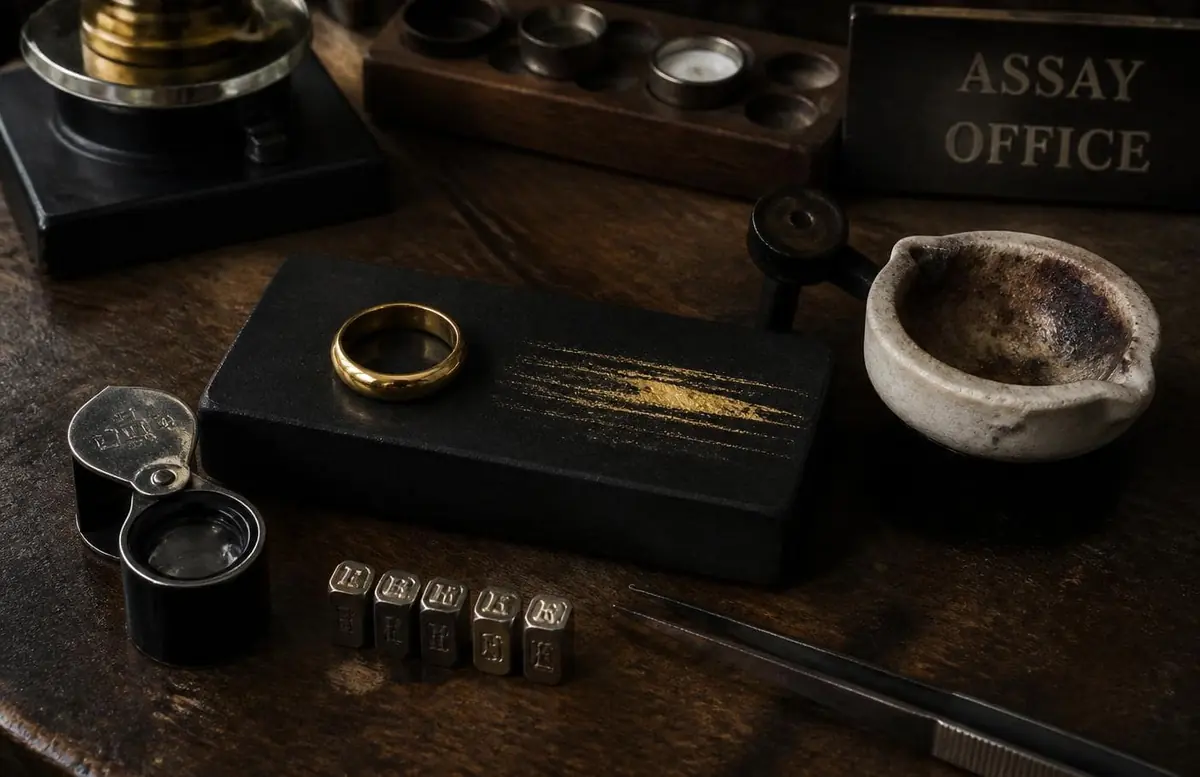
The millesimal number stamped inside a band — 750, 585, 375 — is the same statement as the karat figure, expressed as parts per thousand. It is the modern international convention and it is unambiguous in a way that '18k' printed on an unhallmarked import is not. In jurisdictions with a compulsory hallmarking regime, that number has been verified by an independent assay office rather than asserted by the manufacturer, which is the entire point of the system and the subject of a separate piece in this archive.
For the buyer, the practical hierarchy is short. Purity sets intrinsic value. The alloy design sets how the object survives being owned. And the finish, in the case of white gold, sets how often you will be back at the jeweller's counter. Those three facts are independent of one another, and only the first is printed on the metal.
Colour is an alloy decision, not a coating
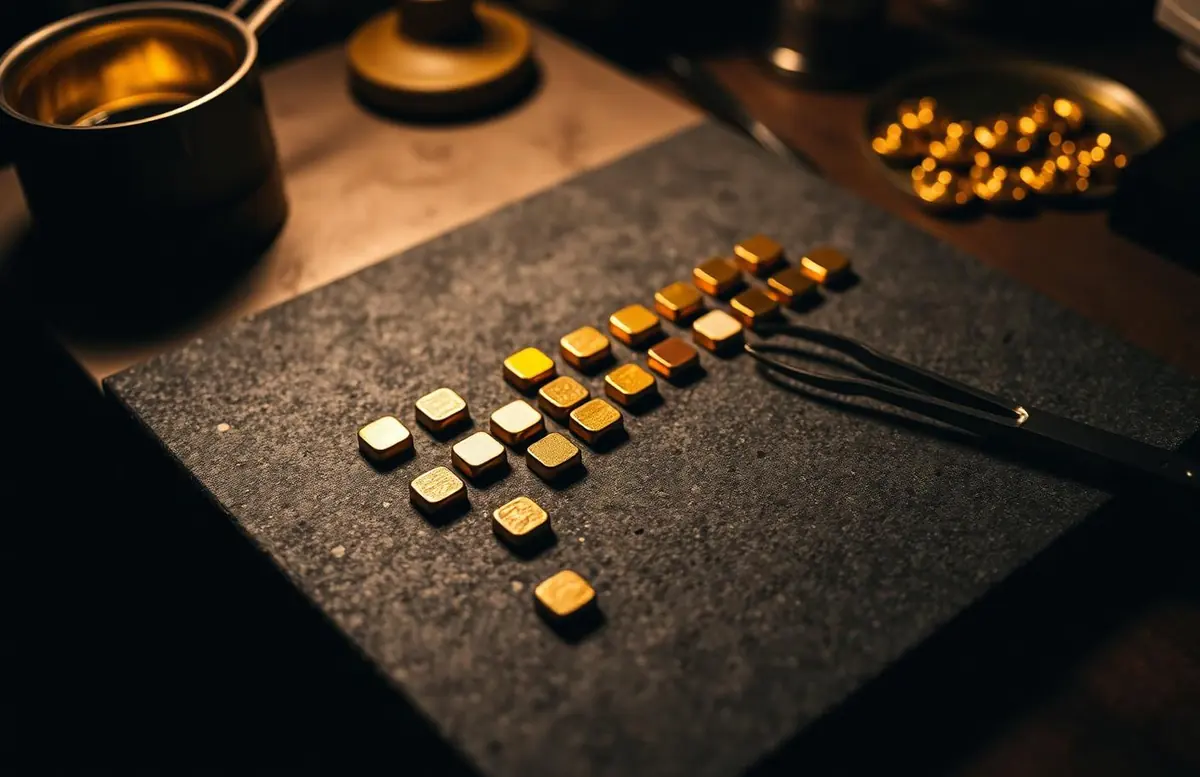
The three colours that dominate a jewellery window — yellow, white and rose — are not finishes applied to gold. They are different alloys of it, and in an 18-karat piece all three contain exactly the same 75 percent gold by weight. What changes is the quarter that is not gold. Copper pushes the colour toward red and hardens the metal; silver and zinc pull it back toward pale yellow and improve the way it flows when cast; palladium or nickel bleach it toward grey.
White gold is the alloy that most often disappoints buyers, because the greyish metal underneath is usually plated with rhodium to reach the bright, almost blue-white finish shown in the shop. Rhodium is a wear layer, typically under a micron thick, and it abrades from the high points of a ring within a few years of daily use. The piece has not been mis-sold and the gold content has not changed; the plating has simply worn through to the alloy. Replating is a routine bench job, and a jeweller who explains this at the point of sale saves a difficult conversation later.
Nickel-bleached white gold carries a second problem. Nickel is one of the most common contact allergens in the population, and prolonged skin contact with a released nickel ion produces the classic itching band under a ring. European rules cap the rate at which nickel may migrate out of an item worn against the skin, which is why palladium-bleached white golds — softer on the skin, harder on the price — became the default for higher-end work.
Why hardness and workability pull in opposite directions
A goldsmith wants two contradictory things from an alloy: it should be soft and forgiving on the bench, and hard and scratch-resistant on the finger. The metallurgy of the copper-silver-gold system offers a partial way out. Some 18-karat compositions can be age-hardened — held at a few hundred degrees for a defined time after working — so the metal is shaped soft and then stiffened in place. The same treatment on the wrong composition simply makes the piece brittle.
This is why karat alone is a poor predictor of how a piece will wear. A 22-karat Indian bangle and an 18-karat European band contain different amounts of gold, but the perceived durability gap is driven at least as much by alloy choice, work hardening from the making process, and the section thickness the designer chose. Thin, high-karat work deforms; thick, well-alloyed work of the same purity survives decades.
The final complication is solder. A repair or a joint uses a solder alloy of slightly lower melting point, which by definition is of slightly lower karat than the parent metal. On a piece with many joins the average fineness sits marginally below the stamped karat, which is precisely why hallmarking regimes set tolerances and why assay offices test the finished article rather than the stock it was made from.
Hallmarking around the world
The compulsory hallmark is a peculiarly British and Continental institution, and its absence elsewhere explains a great deal of cross-border confusion. The United Kingdom has required independent assay and marking since a medieval statute of 1300, administered today by four assay offices — London, Birmingham, Sheffield and Edinburgh — each stamping its own town mark alongside the fineness figure, the sponsor's mark and a date letter. France, Switzerland and much of the Gulf run comparable compulsory systems, though the marks and the minimum standards differ enough that an item legal for sale in Dubai at 21k may need re-marking to be sold as gold in a UK shop.
The United States has no compulsory third-party hallmarking system at all. Manufacturers stamp their own karat mark under the National Stamping Act, which makes the mark a legal representation rather than an independently verified fact, backed by the threat of prosecution for a false stamp rather than by prior testing. This is not a minor technicality: it means the entire evidentiary weight of an American gold stamp rests on the manufacturer's honesty and the buyer's recourse after the fact, where a British hallmark rests on inspection before the item ever reaches a shelf.
Reading a British hallmark
- Sponsor's mark — initials identifying the maker or the company that submitted the piece, registered with the assay office.
- Fineness mark — the millesimal number in a shield, such as 750 for 18ct or 375 for 9ct, the only mark that states purity.
- Assay office mark — a symbol identifying which of the four offices tested the piece, a leopard's head for London and an anchor for Birmingham among them.
- Date letter — a single letter in a defined typeface cycling on a multi-year schedule, letting a specialist date a piece to within that cycle.
Investment purity versus jewellery purity
The bullion market and the jewellery trade use the word 'gold' to mean two different design problems, and buyers frequently import the wrong intuition from one to the other. A 400-ounce Good Delivery bar or an investment coin is engineered purely for fineness and recognisability; it will typically be struck or cast at 999.9 fine and never has to survive being worn against skin, so none of the hardness trade-offs discussed above apply to it at all. It sits in a vault, is handled with gloves, and its value is almost entirely the metal content plus a small fabrication premium.
Bring that same 999.9 fine disc into a ring setting and it fails within a season — the prongs open, the shank distorts, the surface scuffs into a matte grey within weeks. This is why buyers who ask a jeweller for '24-karat quality' in an everyday piece are, without realising it, asking for an object engineered to fail. The honest answer is that investment gold and wearable gold optimise for opposite things, and the karat number that serves one purpose badly serves the other well.
“Nobody wears a bullion bar, and nobody stores an engagement ring in Zurich for its liquidity. The moment you ask what the gold is for, the correct karat chooses itself.”
Where alloy science is heading
The alloys described above are, in essentials, nineteenth-century chemistry executed with modern process control. The research frontier is more interesting than the shop floor suggests. Metallurgists have spent two decades chasing a genuinely white 18-karat gold that needs no rhodium plating at all — alloys incorporating manganese, or carefully balanced palladium-silver-copper systems, that reach an acceptable whiteness without the wear-item problem. None has yet displaced rhodium plating commercially, because the colour achievable without plating still reads slightly warmer than the market has been trained to expect by decades of freshly plated display pieces.
A second strand of work targets hardness directly, borrowing dispersion-hardening techniques from aerospace alloys to produce 18-karat compositions that resist scratching far better than traditional recipes without sacrificing castability. A handful of specialist manufacturers now market proprietary hardened 18-karat golds under trade names, aimed squarely at the watch case market, where scratch resistance sells at a premium most jewellery buyers never see reflected in a hallmark.
1300
Year compulsory UK hallmarking began
4
UK assay offices still operating today
1g
Minimum weight requiring UK gold hallmarking
999.9
Typical fineness of a Good Delivery bar
None of this changes the arithmetic a buyer needs at the counter. Karat states a fraction; the alloying partners state everything else; the finish states how much maintenance is coming. Whatever the metallurgists eventually manage in a laboratory, that division of labour between three separate facts is unlikely to disappear, because it reflects a real and permanent trade-off between purity, durability and appearance rather than a temporary limit of manufacturing.
How casting alloys differ from wrought alloys
A recipe that works beautifully rolled into sheet and drawn into wire can be a disaster poured into a mould, and the reverse is equally true. Casting alloys are formulated to flow while molten, to solidify without trapping gas, and to fill a thin, intricate mould before the metal cools past the point of movement. That means a wider freezing range is sometimes tolerated, more grain-refining additions are used, and the balance of silver to copper is tuned less for final hardness than for how forgivingly the metal behaves in the crucible.
Wrought alloys, worked by rolling, drawing and forging rather than cast to shape, are formulated the opposite way. They need to work-harden predictably under the hammer or the draw plate without cracking, and they need a narrow enough freezing range that ingots solidify cleanly for rolling. A goldsmith who orders casting grain for a chain-making job, or wrought stock for a lost-wax casting, will get a technically compliant 18-karat alloy that behaves badly in the process it was never meant for.
This is one of the least visible parts of the trade to an outside buyer, because both routes end up stamped with the same fineness mark and can look identical once polished. The difference only shows up as a manufacturing defect — porosity in a casting, cracking at a bend in a ring shank — that a retailer usually attributes to poor workmanship rather than to an alloy mismatch further up the supply chain.
Larger manufacturers manage the risk by keeping separate, clearly labelled stock for each route and by specifying alloy suppliers who guarantee a consistent grain structure lot to lot. Smaller workshops, buying grain or sheet in modest quantities, rely more on experience and on sourcing from suppliers whose reputation is built on exactly this kind of consistency rather than on the assay figure alone.
Grain refiners and trace additions
Beyond the headline copper-silver-zinc balance, commercial gold alloys often carry trace additions measured in parts per thousand rather than percent — small amounts of iridium, ruthenium or titanium used purely to refine the grain structure of the solidifying metal. A finer grain structure resists cracking during rolling and forging and takes a more even polish, and the addition is small enough that it barely registers against the karat figure while changing the working behaviour considerably.
- Iridium and ruthenium, added in trace amounts, act as nucleation sites that produce a finer as-cast grain and reduce hot-cracking during working.
- Titanium in very small fractions performs a similar grain-refining role in some proprietary casting alloys.
- Boron deoxidisers are used in some recipes as an alternative or supplement to zinc, particularly where a brighter as-cast surface is wanted.
- None of these trace elements are disclosed on a hallmark, which only ever states the gold fraction, not the alloy's full recipe.
The economics of alloy choice at scale
For a manufacturer producing tens of thousands of pieces a year, the alloy specification is a cost decision as much as a technical one, and the two pull against each other constantly. Palladium, the workhorse whitening agent for premium white gold, has at various points traded at a meaningful multiple of gold's own price, which means the non-gold three-quarters of a nominally 'cheaper' karat can still add real cost to a white-gold piece.
Manufacturers respond by trimming palladium content to the legal and practical minimum that still bleaches the alloy acceptably, then leaning more heavily on rhodium plating to finish the whiteness the alloy itself cannot quite deliver unaided. This is a defensible engineering trade-off, but it does mean that two rings sold as '18k white gold' at very different price points can contain meaningfully different palladium fractions beneath an identical-looking rhodium surface.
Nickel white gold remains cheaper again, and remains legal and common outside the EU's restricted markets, which is one reason imported white-gold jewellery bought abroad occasionally provokes a skin reaction that an equivalent European-made piece does not. A retailer who cannot say which whitening agent is in a white-gold item is not being evasive out of malice, usually; the information may simply not have travelled with the stock from the manufacturer.
At the very top of the market, cost stops being the constraint and durability becomes the entire brief. Fine watchmaking houses commission proprietary hardened golds specifically because a watch case is expected to survive decades of daily contact with desks, door frames and other watches, and the premium those brands charge over standard 18k reflects genuine metallurgical development rather than pure branding.
“Ask what an alloy is for before you ask what it is made of. A recipe that is perfect for a cast pendant will crack a drawn wire, and a recipe that resists scratching on a watch case will fight you the entire time you are trying to set a stone in it.”
Testing an alloy without destroying the piece
Retailers, pawnbrokers and buyers of second-hand jewellery need to establish fineness without melting the object in front of the customer, and the toolkit for doing so has changed considerably over the past two decades even though the underlying chemistry has not.
Acid testing on a touchstone remains the cheapest method: a streak of metal rubbed onto a fine stone is exposed to acids formulated to dissolve everything below a given fineness, leaving genuine gold of that karat or higher visibly intact. It is fast and nearly free per test, but it only reads the surface, which is exactly the layer a plated fake is designed to present.
Handheld X-ray fluorescence analysers have become the standard upgrade at any operation buying gold in volume, returning a full elemental breakdown in seconds without marking the item. They share the touchstone's blind spot, however: XRF reads only a few microns into the surface, so a heavily gold-plated base-metal item can return a reading indistinguishable from solid gold unless the operator knows to check density or file a hidden edge as well.
Where a dispute matters — a large lot, an insurance valuation, a legal claim — fire assay remains the referee method, unchanged in essentials for centuries. It is destructive to a small sample, slow, and more accurate than any instrument-based method, which is why assay offices and refiners fall back on it whenever a non-destructive reading is challenged.
150 HV
Approximate hardness of a well-formulated worked 18k yellow alloy
25 HV
Approximate hardness of annealed pure (24k) gold
~2 microns
Typical thickness of a fresh rhodium plating layer
4
Common bulk gold alloys used across a full jewellery range: yellow, white, rose, and green
Frequently asked
Questions readers ask
- Is 24k gold better than 18k?
- Purer, not better. 24k is the softest usable form of the metal and will deform under everyday handling, lose stone settings and scratch visibly within weeks of wear. For jewellery that must survive being worn, 18k is the usual compromise between colour, durability and intrinsic value.
- What is the difference between karat and carat?
- Karat (k or kt) measures the gold content of an alloy in twenty-fourths. Carat (ct) is a unit of mass for gemstones, equal to 0.2 grams. British usage writes both as 'carat', which is why UK jewellery is described as 9ct or 18ct gold.
- Why does white gold turn yellowish over time?
- Because you are seeing the alloy underneath. White gold is a bleached yellow alloy finished with a thin rhodium electroplate; as the plating wears through at knuckles and edges, the warmer base colour shows. Re-plating is routine maintenance, typically every one to three years for a ring worn daily.
- Does rose gold contain less gold?
- Not necessarily. 18k rose gold contains exactly the same 75% gold as 18k yellow; the remaining 25% is weighted towards copper rather than split with silver. Colour is a statement about the alloying partners, not about purity.
- Is 9k gold real gold?
- Yes, and it is legally hallmarkable as gold in the UK and much of the Commonwealth, though not in countries whose minimum standard is 14k or higher. At 37.5% gold it is harder and cheaper than 18k, with a paler colour and a greater tendency to tarnish because of its high base-metal content.
- Why do British hallmarks include a date letter?
- The date letter lets an assay office, a valuer or a specialist dealer establish roughly when a piece was submitted for testing, independent of any style or maker's mark. Each of the four UK offices cycles a defined alphabet in a distinctive typeface over a period of years, so a trained eye can date an unmarked-looking piece to within that cycle purely from the letter shape and case.
- Can you convert one karat of gold into another at home?
- Not safely or legally in the way some online guides suggest. Diluting an 18k alloy towards 9k by adding base metal at home changes the composition unevenly, will not pass assay, and destroys any hallmark already on the piece. Karat conversion is a refiner's job, done by melting, assaying and re-alloying from scratch, then resubmitting for a fresh hallmark.
- Does higher karat gold always cost more per gram?
- In terms of pure metal content, yes — an 18k item contains more gold per gram than a 9k item of the same weight, and that difference is reflected in scrap or intrinsic value. Retail price per gram is a weaker guide, because workmanship, brand and stone value can dominate the ticket price regardless of the underlying karat.