Standards
Hallmarks and Assay: How Anyone Proves Gold Is Gold
A hallmark is one of the oldest consumer protection technologies in continuous use. It is also, on close inspection, a small masterpiece of institutional design — and it is being quietly eroded.
Gold has one commercial weakness, and everything in this article exists to address it: you cannot tell how much gold is in an object by looking at it. Colour can be alloyed. Weight can be faked with tungsten, which is inconveniently close to gold in density. Ring, feel and polish can all be reproduced. A buyer standing in front of a bracelet has, unaided, almost no way to distinguish 750 fineness from 375 with a good finish.
Societies that traded gold seriously worked this out early and built an institution rather than a gadget. The hallmark — a set of small punched symbols applied by a body with no stake in the sale — is one of the oldest continuously operating consumer protection systems in existence, predating trademark law, product labelling and every modern certification scheme by centuries.
What the marks say
A full traditional hallmark is a compact record. It typically carries a sponsor or maker's mark identifying who submitted the article; a fineness mark stating gold content in parts per thousand or karats; an assay office mark showing which office tested it; and, in some regimes, a date letter identifying the year of marking. Read together they answer four questions: who made it, how pure it is, who verified that, and when.
The date letter is the detail that reveals the design philosophy. A system that only certified purity would not need one. A system built to be auditable after the fact — to allow a piece to be traced to an office and a year decades later, when the maker is dead and the shop is gone — does. The hallmark is not a label. It is a record kept in the object itself.
Karat, fineness, and why 24ct is a fiction in practice
Karat divides gold content into twenty-fourths; fineness states it in parts per thousand. They are the same measurement in different clothing. Eighteen karat is 750 fineness, fourteen karat is 585, nine karat is 375. Investment bars are marked 995, 999 or 999.9 — the last of these, four nines, is the practical ceiling of industrial refining rather than a claim of literal chemical purity.
Alloying is not adulteration. Pure gold is too soft for most objects that get worn: a 24ct ring deforms, scratches and loses detail within months of daily use. Copper hardens and reddens; silver softens the colour toward green; palladium and nickel produce white golds with very different working properties and, in the case of nickel, a well-documented contact allergy problem that drove regulation across Europe. The alloy is an engineering decision, and the fineness mark is the honest disclosure of it.
999.9
Four-nines fineness — refining's practical ceiling
750
18 karat — the standard fine jewellery alloy
585
14 karat — the durable everyday standard
375
9 karat — legal as gold in some markets, not in others
Fire assay: destroying the sample to tell the truth
The referee method has barely changed in principle since the sixteenth century. A precisely weighed sample is wrapped with silver and lead and heated in a porous cupel. The lead oxidises and, along with base metals, is absorbed into the cupel wall, leaving a bead of gold and silver. The bead is treated with nitric acid to dissolve the silver — the step traditionally called parting — and the remaining gold is weighed. Fineness is the ratio of the final weight to the original.
Its authority comes from what it does not assume. It measures the entire sample, not a surface. It does not need calibration against reference standards of similar composition. It is slow, destructive, requires a skilled analyst, and consumes the material tested — and it is still what everything else is checked against.
“The instrument tells you what the surface is. The cupel tells you what the object is. Most disputes are the difference between those two sentences.”
XRF, and the honest limits of instant answers
X-ray fluorescence spectrometry is the workhorse of modern testing. Irradiate a sample, read the characteristic secondary X-rays each element emits, infer composition in seconds without damaging the piece. For a dealer processing a queue of walk-in sellers, it is transformative.
Its limitation is physical and unavoidable: XRF reads a shallow surface layer. A gold-plated base-metal item, a gold-filled item with a thick bonded layer, or a piece deliberately depletion-gilded so that its outer skin is richer than its core will all read high. Skilled operators know this and combine XRF with density checks, magnetism, ultrasonic thickness measurement, or a scratch through the surface before touch-testing with acids. An unskilled operator with the same instrument produces a fast, confident, wrong number.
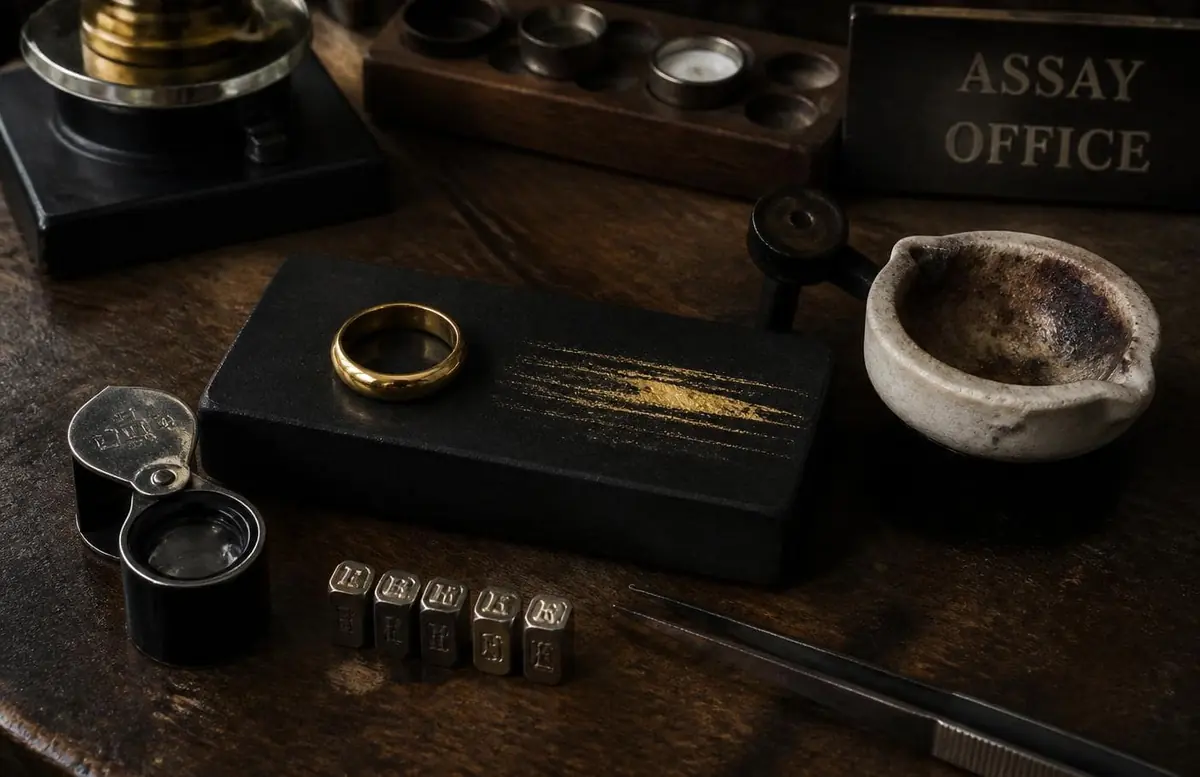
- Touchstone and acid: a streak of the item on a basalt stone, compared with streaks from known needles under graded acids. Cheap, quick, surface-limited, still in daily use.
- Density by displacement: catches tungsten poorly and hollow fill well; useful as a cross-check, never conclusive alone.
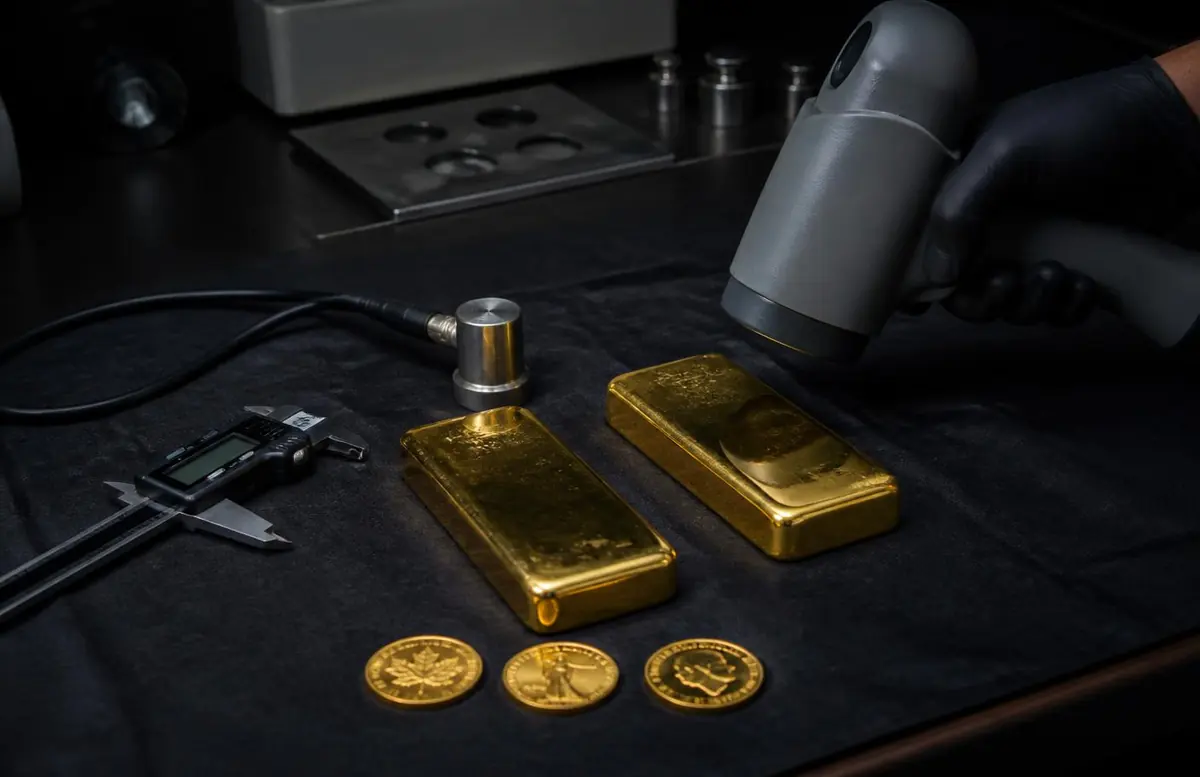
- Ultrasonic thickness: detects internal voids and inserts in bars, which is why serious bullion desks own one.
- Fire assay: destructive, definitive, and the only method that ends an argument.
The erosion nobody advertises
Hallmarking's authority depends on a chain: compulsory submission, independent testing, and enforcement against unmarked or falsely marked goods. Each link is under pressure. Cross-border online sales route around jurisdictional requirements. Counterfeit punch sets circulate. Very light articles are exempt from marking in many regimes, and a great deal of contemporary jewellery is very light. Where enforcement funding falls, the mark degrades from a verified statement into a decorative convention.
That erosion is gradual and largely invisible to buyers, which is precisely the danger. A system like this works because it is boringly reliable; it stops working the moment the average buyer starts assuming a mark might be decorative. Nothing about the mark itself changes at that point. Only the belief does, and the belief was the product.
There is something clarifying about a technology that has survived five centuries of financial innovation without needing to be reinvented. The hallmark solved a specific, permanent problem — an object whose value cannot be observed — with an independent third party, a physical record and a standing threat of prosecution. Every digital provenance scheme now proposed for the gold supply chain is attempting the same trick with different tooling. The old system's advantage is that its record is punched into the metal, and the metal does not need a server.
How an assay office actually tests
An assay office does not test the piece it is shown; it tests a sample taken from it. A tiny scraping is removed from an inconspicuous point on the article, and for high-value or disputed work the referee method remains fire assay: the sample is wrapped in lead, cupelled in a furnace so the base metals oxidise into the cupel, and the remaining precious bead is parted in acid and weighed. The result is accurate to a few parts per ten thousand and it destroys the sample.
Routine work is done faster. X-ray fluorescence gives a non-destructive surface reading in seconds and screens the bulk of submissions; ICP spectrometry handles trace analysis where the alloy composition matters as well as the fineness. The offices reserve fire assay for cases where the answer must survive a legal challenge, which is the point of having a referee method at all.
Tolerances, solder and the negative-tolerance principle
A finished article is not a homogeneous ingot. It has solder joints of lower fineness, plating, and sometimes a hollow section filled with cement or wax. Hallmarking regimes deal with this in two ways: they define which components are exempt from the fineness requirement, and they apply a negative tolerance rule, under which no part tested may fall below the marked standard rather than merely averaging to it.
That rule is stricter than it sounds and it is why makers alloy slightly above the nominal. An 18-karat piece submitted at exactly 750 parts per thousand risks a sample coming back at 748 and being refused; the trade works to 752 or 753 and treats the difference as a cost of doing business.
Where hallmarking is heading
Two pressures are reshaping a system designed for the bench and the punch. The first is laser marking, which places a mark without deforming thin or delicate work and can encode a machine-readable identifier alongside the traditional symbols. The second is provenance: buyers increasingly want to know not only the fineness but the origin of the metal, and an assay office is a natural place to attach that record because it already handles the article and already has statutory standing.
Neither changes what the mark fundamentally is. A hallmark is a third party, with no interest in the sale, putting its own reputation behind a statement about a piece of metal. Every substitute proposed over three centuries has come back to that same structure.
A short global tour of how countries actually do this
Hallmarking is not a single international system with local branding. It is a patchwork of national regimes with genuinely different legal foundations, and the differences matter enormously to a buyer who assumes a mark means the same thing everywhere.
The convention states
A group of mostly European countries operate under the International Hallmarking Convention, sometimes called the Vienna Convention, under which an assay office in one member state applies a Common Control Mark that other members agree to accept without retesting. This is one of the older functioning examples of mutual regulatory recognition in any industry, predating equivalent arrangements in food safety or pharmaceuticals by decades, and it exists purely because gold assay is a solved, stable, low-dispute technical problem — exactly the kind of regulation that mutual recognition works best for.
Mandatory national systems outside the convention
The United Kingdom operates one of the strictest mandatory systems in the world: articles above a small weight threshold must be hallmarked by one of four assay offices before sale, and trading standards bodies actively prosecute non-compliance. India moved to mandatory hallmarking for gold jewellery in stages through the early 2020s, a huge undertaking given the scale of its informal jewellery trade, administered through a national hallmarking centre network rather than a small number of historic assay offices.
Voluntary and maker's-mark systems
The United States has no compulsory third-party hallmarking system in the UK or Indian sense. Federal law requires accurate quality marking and makes underkarating a form of fraud subject to enforcement, but the testing is typically the manufacturer's own responsibility rather than routed through an independent assay office before sale reaches the shop floor. This is a maker's-mark model, and studies commissioned by industry bodies have periodically found meaningfully higher rates of underkarated stock in spot testing than in mandatory third-party regimes — not because American manufacturers are less honest, but because the verification step that catches errors and fraud in other systems is largely absent.
4
UK assay offices with statutory hallmarking authority
1999
Year the UK made the date letter optional rather than compulsory
1972
Vienna Convention on the Control and Marking of Articles of Precious Metals
1g
Approximate UK weight threshold below which gold articles are exempt from compulsory hallmarking
“Ask a buyer which country's hallmark they trust most and they will usually name whichever one they grew up with. Ask an assay chemist and you get a much shorter, much less sentimental answer: the ones with criminal penalties attached and inspectors who actually turn up.”
The provenance layer: a different question wearing the same infrastructure
Fineness and origin are separate facts about a piece of gold, and the recent push to attach mine-to-market provenance records to jewellery and bars has, understandably, gotten tangled up with hallmarking in public discussion because both are handled by institutions the buyer is asked to trust. They are not the same claim. A hallmark says: this metal is at least this pure, verified by a named independent office. A provenance record says: this metal can be traced back through a documented chain of custody to a stated origin, which speaks to questions of conflict financing, labour conditions and environmental standards rather than to the metal's chemistry at all.
Why assay offices are a natural home for provenance data
Assay offices already have physical custody of the article at a trusted moment in its life, already carry statutory authority, and already maintain permanent records tied to a punched mark. Attaching a machine-readable provenance reference at the same point in the process is a logical extension of existing infrastructure rather than a new system built from nothing, which is why several national offices have begun piloting exactly that.
The risk is conflation. A laser-etched code that looks authoritative can encourage a buyer to stop asking about fineness because the piece already looks thoroughly verified, when the two questions have entirely separate evidentiary standards behind them. A responsible retailer discloses both, clearly separated; a careless one lets one halo cover the other.
What this means at the counter, practically
For most buyers the working advice has not changed in decades, and everything above simply explains why it holds. Buy from a jeweller who will show you the hallmark and explain it, keep the receipt and any accompanying certificate, and treat an unusually large discount on an apparently well-marked piece as a reason to ask for independent testing rather than a reason to celebrate. None of that requires understanding cupellation or eddy-current sorting. It requires knowing that a small punched mark on a ring is doing more institutional work than almost anything else you will buy this year, and that the work is worth respecting rather than assuming.
- Ask which assay office applied the mark and, if unfamiliar, look it up — legitimate offices are public bodies or long-established institutions with verifiable records.
- Treat an absent hallmark on a high-value piece as a request for independent testing before purchase, not an automatic red flag.
- Keep original documentation; a piece re-sold years later benefits enormously from a traceable paper trail back to the point of sale.
- Remember that a hallmark's silence on gemstones, workmanship and design means those elements need their own separate scrutiny.
What happens when a piece fails assay
Failure is not dramatic in practice, though it can be expensive for the submitter. An assay office that finds an article below the marked or claimed fineness does not quietly return it; hallmarking law in mandatory regimes typically requires the office either to break, deface or retain the piece rather than release it back into commerce unmarked and unremarked upon, precisely so a failed item cannot simply be resubmitted elsewhere or sold as though nothing had happened. The submitter bears the loss, which is a strong incentive to alloy comfortably above the nominal standard rather than shave costs by working right at the boundary.
Persistent or serious under-karating by a manufacturer is treated as a trading-standards or consumer-fraud matter in jurisdictions with compulsory hallmarking, with penalties that can include prosecution, not merely a returned batch. That enforcement backbone is what gives the mark its commercial weight: a hallmark is credible not because gold assay is hard to fake convincingly, but because the cost of being caught faking it is deliberately made to exceed any plausible saving.
Antique and estate pieces: reading marks across centuries
Valuers working with estate jewellery face a version of this problem that a modern retail buyer rarely encounters: marks that were correct and standard in their era but look unfamiliar or even suspicious to an untrained eye today. Hallmarking symbols, sponsor mark formats and even which metals were subject to compulsory marking have all changed over the centuries within a single country's own system, and a mark that looks crude or non-standard by contemporary conventions may simply be authentic to a period before certain refinements were introduced.
- Date letter cycles restart with a new typeface or shield shape roughly every twenty to thirty years in the UK system, so identical letters recur across history and must be read together with the shield style to date a piece correctly.
- Some historic assay offices have closed entirely — Glasgow's marks stopped being applied in the 1960s — leaving pieces bearing marks from institutions that no longer exist to consult.
- Import marks, distinct from marks applied to domestically made goods, were historically used to flag foreign-made items assayed on arrival, and their presence or absence carries its own dating information.
- A worn or partially struck mark on a genuinely old piece is common and is not, by itself, evidence of tampering; heavy circulation and repeated polishing both erode a shallow punch mark over decades.
This is specialist work, and the trade's answer to it is exactly the same institutional structure discussed throughout this piece: a valuer uncertain about an old mark refers it to the relevant assay office or a recognised specialist reference, rather than guessing from a chart. The system's records outlive the individuals who made the pieces, which is the entire design intention behind punching a permanent mark into durable metal in the first place.
What a hallmark cannot tell you, restated with examples
It is worth being concrete about the limits of the mark, because the gap between what buyers assume it certifies and what it actually certifies is where most retail disappointment originates. A hallmark on a ring says nothing about whether the diamond mounted in it is natural or lab-grown, nothing about whether the stone has been treated to improve its colour or clarity, nothing about the manufacturing quality of the setting, and nothing about whether the price charged represents fair value for the workmanship involved.
Buyers who understand this distinction ask two separate sets of questions at the counter: one about the metal, answered by the hallmark and confirmable by independent testing, and one about everything else — stones, craftsmanship, design, brand — answered by entirely different forms of expertise and documentation that a hallmark was never designed to provide.
1300
Year of the English statute establishing compulsory gold and silver assay
20–30 yrs
Typical length of a UK assay office date-letter cycle
1960s
Decade the historic Glasgow assay office ceased striking marks
0
Information a hallmark provides about gemstones or workmanship
Frequently asked
Questions readers ask
- What does a hallmark actually guarantee?
- That an independent assay office tested the article and found its gold content to be at least the marked fineness. It says nothing about weight, gemstones, workmanship, resale value or the honesty of the price you were quoted.
- What is the difference between karat and fineness?
- They are two scales for one measurement. Karat expresses gold content in twenty-fourths, so 24ct is nominally pure and 18ct is eighteen parts in twenty-four. Fineness expresses the same proportion in parts per thousand: 18ct is 750, 14ct is 585, 9ct is 375.
- Is fire assay still used when instruments exist?
- Yes. Fire assay is destructive, slow and skilled, and it remains the reference method against which instrumental techniques are calibrated, because it measures the whole sample rather than inferring composition from a surface response.
- Does no hallmark mean the piece is fake?
- Not necessarily. Compulsory hallmarking exists in some jurisdictions and not others, and many legitimate pieces — antique, imported, or made where marking is voluntary — carry no mark. It does mean the fineness has not been independently verified, which is a different and weaker position for a buyer.
- Does a hallmark guarantee the value of a piece?
- It guarantees the fineness of the metal and nothing else. Craftsmanship, brand, gemstones, design and condition are all outside the mark's scope, and a hallmark on a poorly made piece certifies only that its gold content is what it claims.
- What is the difference between a hallmark and a maker's stamp?
- A hallmark is applied by an independent assay office after testing; a maker's stamp is the manufacturer's own claim about its own product. Jurisdictions that rely solely on maker's marks report materially higher rates of underkarating for exactly that reason.
- Can a hallmark be forged?
- Counterfeit punch sets exist and have been seized in enforcement actions, though forging a convincing full set of marks — sponsor, fineness, office and date letter, correctly matched to a plausible date and office — is harder than simply underkarating a piece and hoping nobody checks. A buyer relying on a mark alone rather than an independent test is trusting the enforcement regime as much as the metal.
- Do bullion bars carry the same kind of hallmark as jewellery?
- Not exactly. Good Delivery bars carry a refiner's stamp, a serial number, fineness and weight, verified through the refiner's own accreditation and periodic audit rather than a separate assay office punch on each bar. The underlying principle — an independent standard, a traceable mark, and accountability if it is wrong — is the same, but the institutional mechanism differs from retail jewellery hallmarking.