Craft & Culture
The Alchemy of Craft: What Goldsmiths Know That Machines Don't
Gold's working properties are so extreme they border on the absurd — one gram drawn into three kilometres of wire. Inside a trade where the tools have barely changed and the hands are irreplaceable.
Begin with a number that sounds like a misprint. A single gram of gold — a piece smaller than a match head — can be drawn into a wire roughly three kilometres long. Beaten instead of drawn, that same gram covers most of a square metre as leaf so thin that light passes through it green. No other metal comes close. Gold is the most malleable and most ductile substance we know, and everything about the goldsmith's trade descends from that fact.
It descends, too, from the inconvenient corollary: a metal that yields that easily to a hammer also yields to a doorframe, a car key and forty years of a wedding ring rubbing against a steering wheel. The craft's entire technical vocabulary exists to negotiate between workability and durability.
Karat is a fraction, not a grade
The karat system divides by twenty-four. Twenty-four karat is pure gold; eighteen karat is eighteen parts gold in twenty-four, or 75 per cent by mass, stamped 750 in the millesimal system that most of the world now uses on hallmarks. Fourteen karat is 585. Nine karat, common in Britain, is 375 — more alloy than gold, and a source of long-standing argument about what may honestly be called a gold ring.
The alloying metals are not filler. They are the specification. Copper hardens and pulls the colour towards red. Silver softens the tone towards green-yellow. Zinc scavenges oxygen during casting and improves flow. Palladium and nickel bleach the yellow out entirely to produce white gold. Change the ratio and you change the hardness, the melting range, the colour and the way the metal behaves under a graver.
- Yellow 18k: typically ~75% gold, with copper and silver in near-balance for a warm neutral tone.
- Rose 18k: copper-dominant alloy; harder than yellow and less forgiving under the hammer.
- White 18k: palladium- or nickel-alloyed; usually rhodium-plated, and the plating needs renewing.
- Green gold: silver-heavy, historically used for foliage in enamelled work.
Annealing, and the memory of metal
Work gold and it fights back. Hammering, bending and drawing distort the crystal grains and the metal work-hardens — it becomes stiffer, springier, and eventually cracks. The remedy is annealing: heating the piece to a dull red, holding it, then letting the grain structure recrystallise.
Judging that temperature is the first real skill an apprentice acquires, and it is judged by eye, ideally in a dimmed workshop, because a thermocouple cannot tell you about the specific corner of a specific piece. Underheat and the metal stays brittle. Overheat and the surface begins to melt, leaving a pitted skin no amount of polishing will remove. Every experienced goldsmith has a ruined piece from the year they learned this.
Techniques that survived the industrial revolution
Granulation
Etruscan goldsmiths in the seventh century BCE fused thousands of gold spheres, some smaller than a tenth of a millimetre, onto sheet gold in dense decorative fields. They did it without visible solder — the joint is formed by a copper-based diffusion bond that briefly lowers the melting point at the point of contact and then, as the copper diffuses away into the surrounding gold, raises it again, locking the sphere in place.
The technique was effectively lost and reconstructed in the twentieth century through analysis of surviving pieces and patient experiment. It remains the sternest test of temperature control in the trade: the window between a sound bond and a puddle of collapsed granules is measured in seconds.
Repoussé and chasing
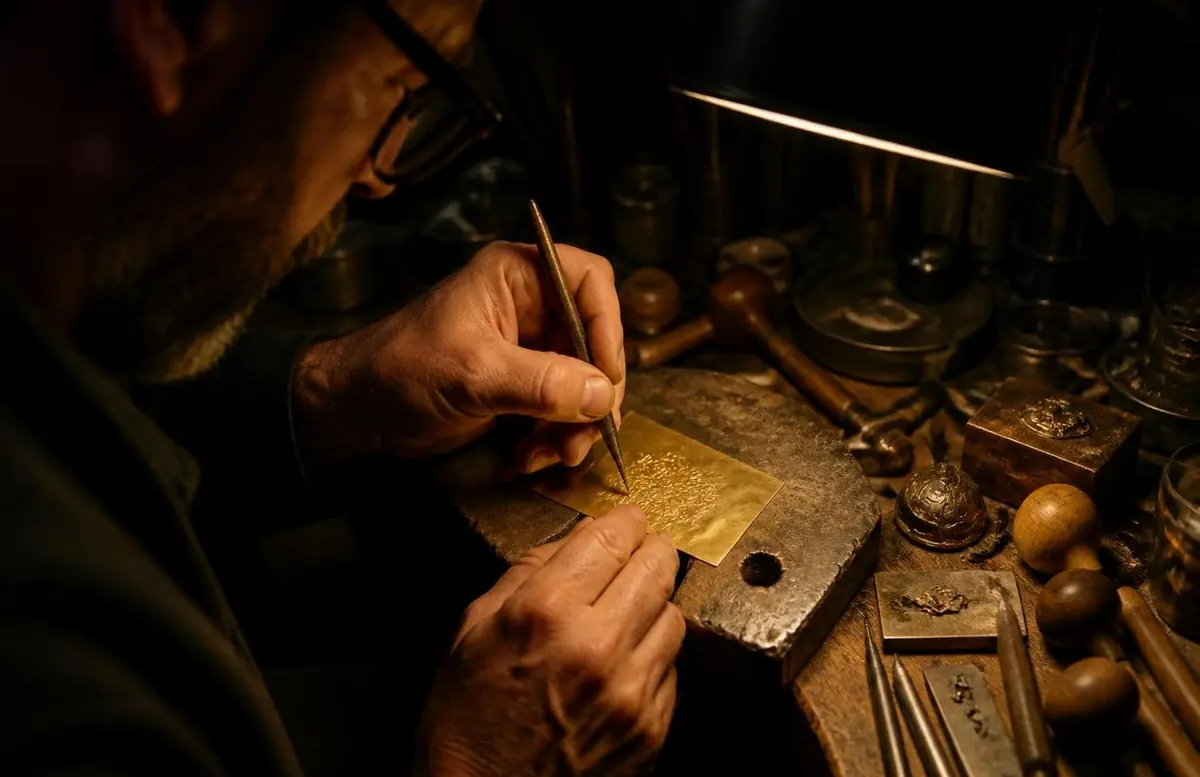
Raising a relief from behind the sheet is repoussé; refining the detail from the front is chasing. Both are done with blunt punches against a yielding support — traditionally pitch, a tar-based compound that holds the work firmly, gives under the punch, and can be warmed to release the piece without stressing it.
There is no machine equivalent for the good version of this. Stamping produces relief; it does not produce the accumulated evidence of decision-making that makes a chased surface read as alive rather than reproduced.
“The machine makes the same thing a thousand times. That is its virtue and it is why the thousandth one is worth less than the first thing I make badly.”
Where the machines did win
It would be sentimental to pretend the trade has been untouched. Volume jewellery production has been transformed by computer-aided design and investment casting. A designer models a ring on screen, prints it in castable resin, invests it in plaster, burns out the resin and pours metal into the void. Ring sizes scale parametrically. Stone settings are placed to tolerances a hand could not repeat reliably.
For a market that wants a specific design in eleven sizes with consistent stone spacing, this is straightforwardly better. Casting also wastes less metal than fabrication from sheet and wire — and when the raw material costs what gold costs, scrap recovery rates are a line item that decides whether a workshop is profitable.
What the process cannot do is originate. Casting reproduces a master. Someone must still make the master, and at the top of the trade that person is at a bench with a graver, a torch and a lamp, doing work whose value lies precisely in the fact that it cannot be run again.
Reading a hallmark
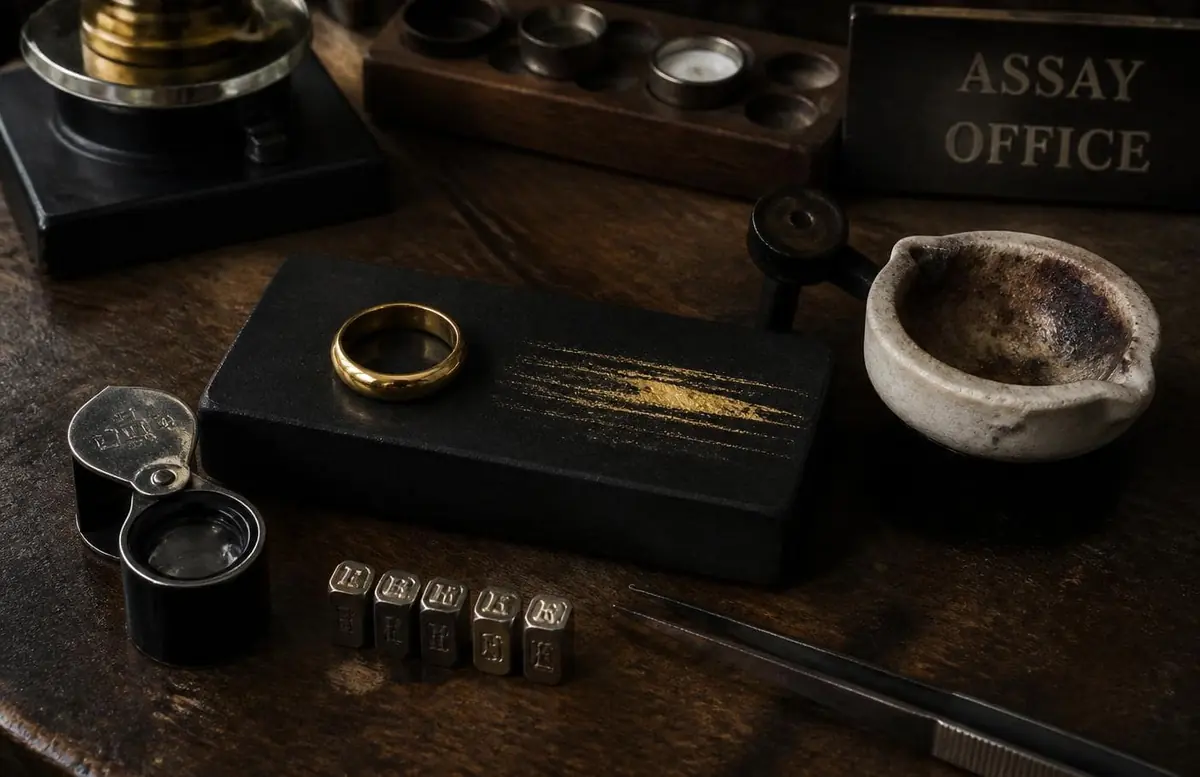
In assay-office jurisdictions, the marks struck into a finished piece are a compressed provenance record: the sponsor's mark identifying the maker, the fineness in millesimal form, the assay office town mark, and in some systems a date letter. It is the oldest continuously operating consumer protection scheme in existence, running in Britain since the fourteenth century.
The marks matter more now, not less. As casting and plating make surface appearance easy to fake, the physical stamp of an independent assay office remains one of the few claims about a piece that was verified by destructive testing rather than asserted by the seller.
The long apprenticeship problem
Every workshop tells the same story about succession. The skills take a decade to build, cannot be transmitted by video, and compete for young people against careers that pay better sooner. Bench training is intrinsically inefficient — one master, one or two apprentices, thousands of hours — and inefficiency is hard to fund.
The counterweight is demand. As mass production drives the floor of the market down, the ceiling has held: buyers who can distinguish a hand-raised bowl from a spun one continue to pay for the difference. That is a thin market and a fragile transmission mechanism, but it has been thin and fragile for four hundred years and the granulation still gets made.
Which returns us to the number we started with. A gram of gold contains three kilometres of possible wire, and every one of those kilometres is a decision somebody has to make. Machines are excellent at executing decisions. The trade persists because gold, uniquely among materials, rewards the making of them.
What the bench still does that a machine cannot
CAD and lost-wax casting have absorbed most of the volume trade, and the results are good — geometrically precise, endlessly repeatable, and cheaper than a skilled hand at every step. What they have not absorbed is the work that begins after the casting comes out of the flask.
Stone setting is the clearest example. A setter reads the individual stone, the individual seat and the way the metal behaves under the burnisher, correcting for tolerances no model anticipated. Finishing is another: the difference between a competent piece and a fine one is usually hours of filing, emery and polishing on surfaces a machine cannot reach. And repair, resizing and restoration are by definition bespoke, which is why the bench survives in workshops that otherwise cast everything.
“The machine gives me a shape. It does not give me a piece of jewellery. That still takes the same number of hours it took my teacher.”
Why work hardening matters to the wearer
A cast component and a forged one of identical alloy and dimensions do not behave identically. Casting produces a coarse dendritic grain structure with the possibility of porosity; hammering, rolling and drawing deform the grains and raise the metal's hardness and fatigue resistance. A hand-raised bangle is measurably stiffer than a cast one of the same weight, and a drawn wire shank outlasts a cast one under daily flexing.
This is why the better volume manufacturers combine the two: cast the complex head, fabricate the shank from drawn stock, and join them. The buyer sees a single object; the failure statistics see two very different components.
The skills pipeline
The constraint on fine goldsmithing is not demand or metal. It is people. Training a setter or a raiser takes years of supervised bench time, the apprenticeship structures that funded it have thinned in most European centres, and the workshops that remain are competing for the same small cohort. Where the trade has held up — parts of Italy, India, Turkey, a handful of city workshops elsewhere — it has usually been because a formal training route survived alongside the commercial one.
The optimistic reading is that scarcity has raised the value of the work. Bench-made pieces command premiums that would have looked implausible when the skills were common, and the maker's name has become part of the price in a way it was not two generations ago. The pessimistic reading is that a premium paid to the last practitioners is not the same thing as a pipeline.
Setting stones: the craft inside the craft
Stone setting is often treated as an adjacent trade, and in large workshops it is a separate specialism entirely — but it is where the goldsmith's material knowledge is tested hardest, because the metal must be moved without moving the stone, and the margin for error is measured in fractions of a millimetre against a material that, unlike gold, does not forgive a mistake by being reworked.
Bezel, prong, pavé and channel
A bezel setting encircles a stone with a strip of metal burnished over its edge, offering maximum protection at the cost of light entering from the sides — the choice for opals, pearls and other stones sensitive to knocks. Prong settings hold a stone at a few contact points and let light flood in from every angle, at the cost of catching on fabric and requiring periodic inspection for wear. Pavé sets stones so densely that the metal nearly disappears beneath them, each one held by shared tiny beads raised from the surrounding surface with a graver — a technique that punishes any inconsistency in bead height with a visibly uneven field of stones. Channel setting runs stones in a groove with no visible metal between them, which demands that every stone in the run be cut to a tolerance the setter, not the manufacturer, is usually the one who catches when it is missed.
- Bezel: maximum protection, least light, favoured for softer or more fragile stones.
- Prong: maximum brilliance, most exposure, needs periodic re-tightening as metal wears.
- Pavé: dense coverage, unforgiving of inconsistent bead height, labour-intensive per carat set.
- Channel: seamless run of stones, entirely dependent on precise, matched stone-cutting.
None of this is decorative vocabulary for its own sake. Each choice trades off durability, light performance and repairability, and an experienced setter reads a client's actual life — a manual job, small children, a ring worn daily rather than for occasions — before recommending one over another. A prong setting is wrong for someone who works with their hands regardless of how well it showcases the stone.
Colour, patina and the chemistry of finish
Gold's surface can be manipulated almost as much as its bulk composition. A high polish reflects specularly and shows every subsequent scratch; a satin or brushed finish scatters light and hides the same scratches almost entirely, which is why wedding bands — worn daily against a lifetime of small abrasions — are so often finished this way rather than mirror-bright. Matte and sandblasted finishes go further still, deliberately roughening the surface at a microscopic scale to produce a flat, non-reflective field that reads as modern and, practically, ages more gracefully under daily wear than a polish that will inevitably dull.
Colouring gold chemically, rather than by alloying, is an older and less discussed tradition. Depletion gilding — used by pre-Columbian Andean and Central American goldsmiths on gold-copper alloys — involves etching the surface with a mild acid that dissolves copper preferentially, leaving a thin, enriched layer of near-pure gold at the surface of a piece that is, underneath, a lower-karat alloy. The effect is a piece that reads as far purer than its bulk composition, achieved with vinegar-strength acids and patience rather than a furnace.
“You can tell a good finisher from a good setter by what they apologise for. The setter apologises for a loose stone. The finisher apologises for a fingerprint left in the polish two steps before the end.”
The economics of a bespoke commission
Clients frequently assume the price of a commissioned piece tracks the gold price closely, and are surprised to learn how small a share of the final invoice the metal often represents once design, modelling, casting, setting and finishing are added. On an intricate hand-finished piece, making charges can exceed the value of the metal several times over — a ratio that inverts entirely for a plain heavy band, where the metal dominates and the making charge is comparatively small.
~1 g → 3 km
Wire drawable from a single gram of pure gold
750
Millesimal fineness mark for 18 karat gold
375
Millesimal fineness mark for 9 karat gold
14th c.
Approximate origin of the British hallmarking system
That inversion is worth understanding before commissioning anything, because it explains why two rings of identical weight and karat can carry wildly different prices, and why asking only 'how much gold is in it' is the wrong question for anything beyond the plainest band. The right question is how many hours of decision-making — the setter's, the finisher's, the maker of the original model — the piece actually required, because that, far more than the spot price on the day of purchase, is what the invoice is paying for.
The chemistry behind the hand skill
Gold's malleability is only half the reason it rewards a skilled hand. The other half is chemical inertness. Gold does not oxidise at room temperature, does not react with sulphur compounds in the air, and resists all but the most aggressive acids — which is precisely why aqua regia, a mixture that dissolves almost nothing else usefully, was named for its ability to dissolve 'royal' gold. That inertness means a goldsmith can leave a piece half-finished on the bench overnight without a protective coating, anneal it repeatedly without a scale forming that would need to be pickled away in quantity, and polish a decade-old piece back to a fresh surface without first stripping accumulated corrosion, because there generally isn't any.
This is not a minor convenience. Silver, by contrast, tarnishes visibly within weeks in most urban atmospheres because it reacts with trace sulphur compounds, and silversmiths build their entire finishing sequence around anticipating and managing that reaction. Gold's alloys inherit some of the alloying metal's reactivity — a high-copper rose gold will pick up a faint patina over years that a pure yellow alloy will not — but even the least stable common gold alloys are dramatically more stable than almost anything else on the bench. The craft's techniques exist largely to work around gold's mechanical softness precisely because its chemical behaviour causes so few problems by comparison.
That stability also explains why ancient gold survives in a condition that ancient silver, bronze and iron almost never do. Etruscan granulation recovered from tombs after two and a half thousand years in damp soil often needs nothing more than a careful clean to reveal joints as crisp as the day they were fused. Archaeologists studying gold artefacts are, in a very literal sense, looking at surfaces closer to their original state than any other metal from the same period offers — which is part of why so much of what is known about ancient goldsmithing technique comes from gold objects specifically, rather than from the far more numerous but far more degraded objects made from other metals.
Recycled metal and the modern workshop
A significant and growing share of the gold that reaches a bench today has been refined from scrap rather than freshly mined ore — old jewellery, industrial swarf, electronic waste and dental gold, melted down, assayed and returned to 999.9 fine bullion that is chemically indistinguishable from any other source. For the goldsmith this changes almost nothing about how the metal behaves under a hammer or a torch; refined gold has no memory of its previous life once it has been through a proper refinery.
It changes a great deal about how workshops present themselves to clients, however. Recycled content has become a genuine point of commercial differentiation, particularly among younger buyers who ask about it unprompted in a way that would have been unusual a decade ago. Workshops that can document a recycled or responsibly sourced supply chain increasingly treat that documentation as part of the product rather than an afterthought, alongside the hallmark and the maker's mark.
The practical mechanics are unglamorous: a workshop's own filings, polishing dust and failed castings are collected, weighed and sent to a refiner alongside any client's old gold brought in for reworking, and the resulting bullion is credited against future metal purchases. Very little genuinely disappears in a well-run workshop — recovery rates from swept floors and used polishing compounds are high enough that scrap recovery is treated as a routine part of the cost structure rather than an environmental gesture, even where it is also marketed as one.
Where the craft still concentrates
Fine goldsmithing has never been evenly distributed, and it remains concentrated today in a handful of centres where training pipelines, dense supplier networks and a critical mass of skilled setters and finishers reinforce one another. Northern Italy's Arezzo and Vicenza districts retain an unusually complete manufacturing ecosystem, from casting houses to chain-making specialists to finishers, built up over generations of family workshops feeding both domestic brands and export contracts. India's jewellery manufacturing hubs, particularly around Mumbai and Surat, combine an enormous skilled workforce with hand-finishing traditions — filigree, kundan setting, meenakari enamel work — that have no close equivalent elsewhere and that supply both a vast domestic market and a growing export trade.
Istanbul's Grand Bazaar district and the wider Turkish trade retain one of the highest concentrations of working goldsmiths per capita anywhere, serving both a domestic culture in which gold jewellery is a conventional store of value and gift, and international wholesale buyers. Smaller specialist pockets persist elsewhere for particular reasons: Birmingham's Jewellery Quarter as a legacy of Britain's industrial-era manufacturing base and its own assay office, Los Angeles's jewellery district built around the entertainment industry's demand for bespoke pieces, and a scattering of individual master workshops in cities with no obvious industrial reason to host them beyond the presence of one exceptional teacher and the apprentices who gathered around them.
What these centres share is density rather than any single institutional structure — enough workshops in close proximity that a setter can specialise in setting alone and still find enough work to fill a week, enough casting houses competing on quality that a small workshop need not own its own furnace, enough finishers that a maker can hand off polishing without losing control of the final result. Break up that density, as has happened in cities where property costs have pushed workshops out of central districts, and the trade does not relocate cleanly — it thins, because the ecosystem that made specialisation viable does not travel with any single workshop that moves.
Frequently asked
Questions readers ask
- What does 18k gold mean?
- Eighteen parts gold in twenty-four by mass — 75 per cent gold, marked 750. The remaining quarter is alloying metal, usually copper and silver, which determines hardness and colour.
- Why is pure gold rarely used in jewellery?
- At 24k gold is soft enough to be marked by a fingernail's pressure over time and deforms out of shape in daily wear. Alloying dramatically increases hardness at modest cost to purity.
- Is white gold really gold?
- Yes — it is gold alloyed with white metals such as palladium or nickel to neutralise the yellow, and it is often rhodium-plated for a brighter finish that requires periodic renewal.
- Is handmade jewellery better than cast?
- Neither is inherently better. Hand-raised and fabricated work has denser, work-hardened metal and no porosity; good casting is consistent, efficient and capable of forms that cannot be fabricated. Poor examples of each are easy to find, and the maker matters more than the method.
- Why does the same weight of gold cost so differently between pieces?
- Because making charges vary enormously. Metal is a commodity priced by the gram; labour, design, finishing and setting are not, and on intricate handwork they can exceed the value of the gold in the piece.
- Why doesn't gold tarnish like silver or copper?
- Gold is chemically inert to oxygen and most acids at room temperature, so it does not form the surface oxide or sulphide layers that dull silver and copper. Its alloys can still discolour slightly if the added metal — usually copper — reacts, which is one reason higher-karat gold tarnishes less than low-karat gold.
- Is recycled gold as good as newly mined gold?
- Chemically, yes — refined gold is refined gold regardless of origin, and once alloyed there is no test that reveals where the metal came from. Many workshops now use recycled stock by default, both because refining recovers it to the same purity and because it reduces reliance on newly mined supply.
- How long does it take to train as a goldsmith?
- Basic bench competence takes one to two years, but the skills that distinguish a fine goldsmith — stone setting, granulation, chasing at a professional standard — typically take closer to a decade of supervised practice, which is why experienced setters and engravers are in persistent short supply.