Physical Demand
The Wedding-Season Bid: How Jewellery Demand Sets the Floor
Half the world's gold is worn, not stored. In India and China that distinction barely exists — and the buying behaviour it produces is the most reliably contrarian force in the entire market.
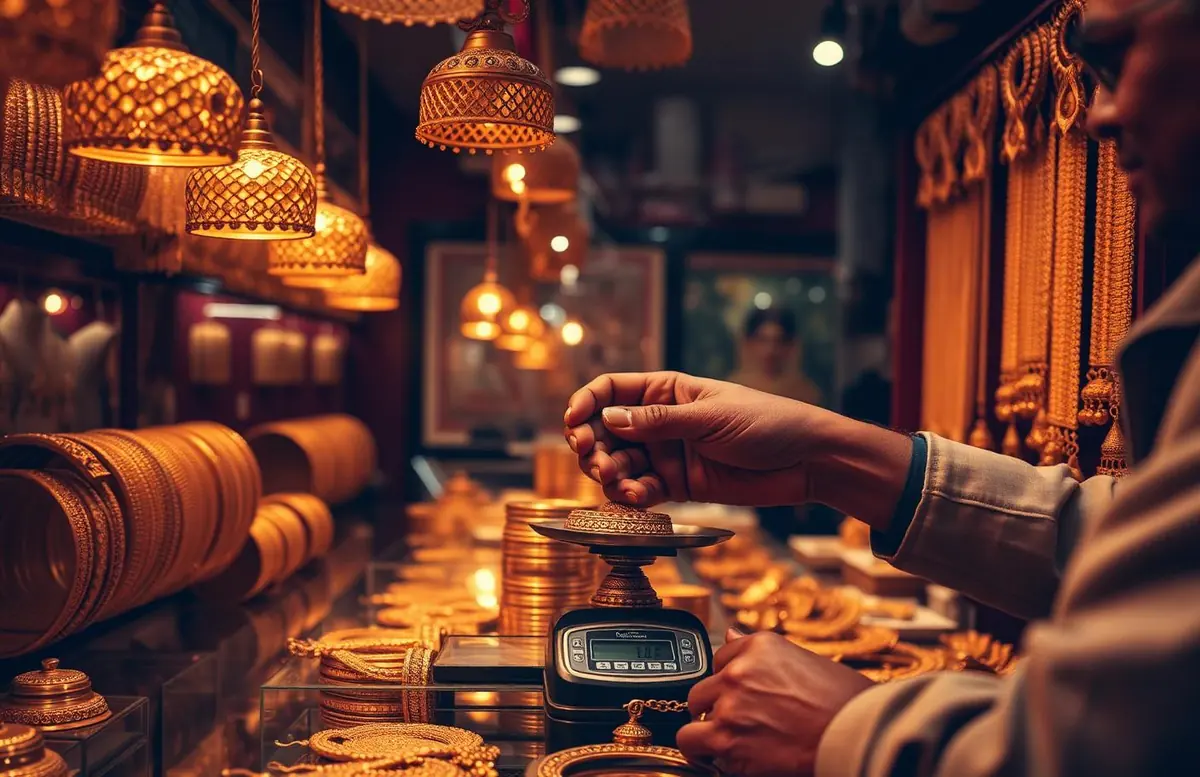
In the financial press, gold is a chart. In the two markets that consume most of it, gold is an object that someone weighs in front of you, quotes against today's rate, and wraps in tissue paper. The transaction is entirely explicit about what is being bought: the shopkeeper states the rate per gram, the weight of the piece, the making charge and the tax, and the buyer adds it up. Nobody in that exchange is confused about whether they are purchasing an ornament or a store of value. They are purchasing both, and the ratio is negotiable.
That transaction, repeated across tens of thousands of counters, constitutes roughly half of world gold demand. It is also the least well understood half, because it behaves in the opposite direction to everything a market participant is trained to expect.
Savings you can wear
The karat number is the tell. A Western jewellery market built around adornment gravitates to 14 and 18 karat: harder alloys, better for setting stones, less metal per piece, lower price point. The Indian and Chinese trades are built around 22 and 24 karat — 91.6 percent gold and effectively pure — which are softer, scratch more easily, and are chosen anyway because the point of the object is the metal.
This makes jewellery a savings vehicle in economies where formal financial access has historically been uneven, inflation has periodically eroded cash, and a household asset that can be liquidated in an afternoon at a shop within walking distance has obvious appeal. It is also, unlike a bank deposit, an asset a woman may hold in her own name in family structures where other property is not hers. That is not a sentimental observation; it is a substantial part of why the demand is durable.
“The customer is not asking me whether gold will go up. She is asking me what the rate is today and whether I will reduce the making charge. She has already decided the metal is the safe part.”
The calendar is the demand curve
Physical buying is seasonal in a way that no investment flow is. Indian demand concentrates around the wedding season and around auspicious dates — Akshaya Tritiya, Dhanteras during Diwali — when purchasing gold is customary rather than optional. Chinese demand clusters ahead of Lunar New Year, when fabricators stock up weeks in advance and the trade's buying shows up in import data before any of it reaches a customer.
The seasonality is legible enough that it is traded. Refiners in Switzerland and the Emirates schedule kilobar production around it; logistics capacity into the subcontinent is booked against it; and a monsoon that determines the rural harvest determines, with a lag of a few months, how much of the wedding-season buying actually materialises in the villages where a large share of it happens.
~50%
Share of annual gold demand consumed as jewellery
91.6%
Gold content of 22-karat, the Indian retail standard
1 kg
Kilobar size refined specifically for the Asian trade
99.99%
Fineness Asian buyers expect on an investment kilobar
The digitisation of the bazaar
The traditional gold jewellery market is undergoing a digital transformation as retailers seek to reach a younger, more tech-savvy generation. In India and China, major jewellery brands have launched sophisticated online platforms and mobile apps that allow customers to browse designs, check real-time gold rates, and even make purchases from their phones. This shift is breaking down the geographic barriers that once limited a local jeweller's reach.
Furthermore, the rise of 'digital gold' products allows consumers to buy gold in tiny increments — sometimes for as little as one rupee or yuan — which is then stored in a secure vault on their behalf. These products provide a gateway for younger savers to build up a gold balance that can later be converted into physical jewellery at a retail outlet. It is a modern twist on the traditional gold-savings schemes that have underpinned the market for generations.
This digitisation also brings greater transparency to a sector that has historically been opaque. Real-time price tracking and digital certificates of authenticity provide reassurance to consumers, particularly in the face of concerns about purity and hallmarking. As the digital and physical retail worlds continue to converge, the 'bazaar' is becoming a global and 24-hour marketplace.
“A wedding without gold is like a sky without stars in our tradition; the metal is the light that secures the family's future.”
Ethical sourcing and the young consumer
A new generation of jewellery buyers in Asia is increasingly concerned with the ethical and environmental footprint of their purchases. While the metal's purity and price remain paramount, there is a growing demand for 'responsible' gold that can be traced back to mines with high labour and environmental standards. This shift is prompting major retailers to audit their supply chains and offer 'certified ethical' collections.
The challenge for the industry is that the gold supply chain is notoriously complex, with metal from multiple sources often blended during refining. However, the adoption of blockchain technology and other tracking systems is making it easier to provide the 'provenance' that modern consumers demand. Retailers who can prove their commitment to sustainability are finding a receptive audience among younger, urban professionals.
This trend is not just about ethics; it is about brand-building in a competitive market. As the traditional drivers of demand — weddings and festivals — are joined by a desire for conscious consumption, the ability to tell a positive story about a piece of jewellery is becoming a key differentiator. Ethical sourcing is moving from a niche concern to a mainstream requirement for the modern jewellery trade.
The regional variations in purity preference
While 22 and 24-karat gold dominate the Asian markets, there are significant regional variations in purity preferences that reflect local traditions and economic conditions. In South India, for instance, there is a strong and persistent preference for 22-karat plain gold jewellery, which is seen as the ultimate store of value. In contrast, urban centres in North India and parts of East China are seeing a growing appetite for 18-karat diamond-set jewellery among the burgeoning middle class.
These variations are also influenced by local tax and duty regimes. In regions where the informal trade is more prevalent, higher-purity metal is often preferred because it is easier to value and resell without formal documentation. In more formalised retail environments, the design and brand value associated with lower-karat pieces can be more effectively marketed.
Understanding these regional nuances is essential for any international brand looking to enter the Asian market. A one-size-fits-all approach rarely works in a region where gold is so deeply woven into the local cultural and financial fabric. The 'gold market' in Asia is, in reality, a collection of dozens of distinct regional markets, each with its own rules and rhythms.
Contrarian by construction
Here is the behaviour that confounds people who model gold as a financial asset. When the price rallies hard, Asian physical demand does not chase it. It stops. Retail buyers postpone, jewellers destock rather than reorder, and — critically — households begin selling old pieces back into the trade, which raises domestic scrap supply exactly when imports are least attractive. Local prices slip to a discount against London.
When the price falls sharply, the reverse happens with equal reliability. Queues form. Wedding purchases that were deferred get executed. Importers pay a premium over London to secure metal, and the flow of bars turns eastward. The physical market, in other words, supplies into strength and absorbs into weakness — the exact opposite of momentum-driven fund flows.
Reading the premium
Because of this, the domestic premium or discount to the London price is one of the most useful real-time indicators in the market, and one of the least reported. It is a physical measurement: what someone will pay, today, in a specific city, to have a bar in their hands rather than a claim on one in a vault four thousand miles away.
- Sustained premium — importers competing for scarce bars; retail demand is live and inventories are thin.
- Sustained discount — domestic surplus, usually a rally that killed retail buying and pulled scrap out of households.
- Premium spiking around a policy change — duty adjustment or import restriction creating scarcity in the formal channel rather than genuine consumption.
- Divergence between India and China — a good early signal that one market's move is local policy rather than a global change in appetite.
Duty, hallmarking and the informal channel
Governments that see large gold imports on the trade balance are tempted to tax them, and both major markets have experimented with duty and restriction. The consistent finding is that these measures change which channel the metal moves through far more than they change how much moves. Raise the duty sharply and the differential between the domestic and international price widens until it exceeds the cost and risk of carrying metal across a border unofficially — at which point it is carried.
Mandatory hallmarking has been the more effective intervention, and for a different reason. By requiring an assayed purity mark, it attacks the oldest problem in the retail trade: pieces sold as 22 karat that assay at 19 or 20. That fraud is a tax on exactly the households least able to verify what they are buying, and eliminating it does more for the integrity of the market than any tariff. It also, incidentally, pushes trade toward larger formal retailers with the capacity to comply, which is a real consolidation cost borne by small family jewellers.
The jewellery trade is routinely patronised in financial coverage as sentimental demand, the implication being that it is less rational than a position taken through a fund. The evidence points the other way. The household buying 22-karat bangles on a dip, negotiating the labour charge, and checking the hallmark is making a more clear-eyed assessment of price, cost and counterparty than most of the people trading the same metal on a screen.
Making charges: the part of the price nobody quotes
A jewellery bill has three components: metal, making, and tax. Metal is transparent and tracks the local rate. Making charges — the labour and wastage margin — are the negotiable part and range from a few percent on plain machine-made chain to a third or more on intricate handwork. On resale, only the metal comes back.
This is what makes the same purchase savings in one market and consumption in another. A buyer of plain 22-karat bangles at a five percent making charge recovers most of what they paid; a buyer of an elaborate branded design at thirty percent has bought jewellery in the Western sense, whatever the karat. Households that treat gold as a store of value know this precisely, which is why the plainest work moves fastest when the metal is being bought for the metal.
Premiums and discounts as a demand gauge
The most useful real-time read on Asian physical appetite is not a survey but a spread: the local price versus the London benchmark, quoted per ounce, as a premium or a discount. Positive means importers are competing for metal; negative means the domestic market is oversupplied and is being cleared by recycled scrap and unofficial inflows.
- Sustained premiums — genuine demand, typically ahead of a festival or wedding season, and a signal that imports will follow.
- Persistent discounts — weak demand or heavy scrap flow, and in duty-heavy markets an indicator that unofficial supply is undercutting the formal trade.
- Sharp swings — usually policy: a duty change, an import-licence adjustment or a hallmarking deadline pulling purchases forward.
Why physical buyers stabilise the market
Investment flows are momentum-following: money enters funds when the price is rising and leaves when it falls. Asian physical demand does the reverse. A price fall brings buyers into shops because the same budget buys more grams, and a rally empties them because families defer or trade down to a lighter piece. Aggregate the two and you get a market with a soft floor underneath it, built from millions of small, price-sensitive, non-speculative decisions.
That behaviour is also why jewellery demand is a poor predictor of price direction and an excellent explanation of price resilience. It does not push the market anywhere. It absorbs the metal that other people are selling.
The workshop behind the counter
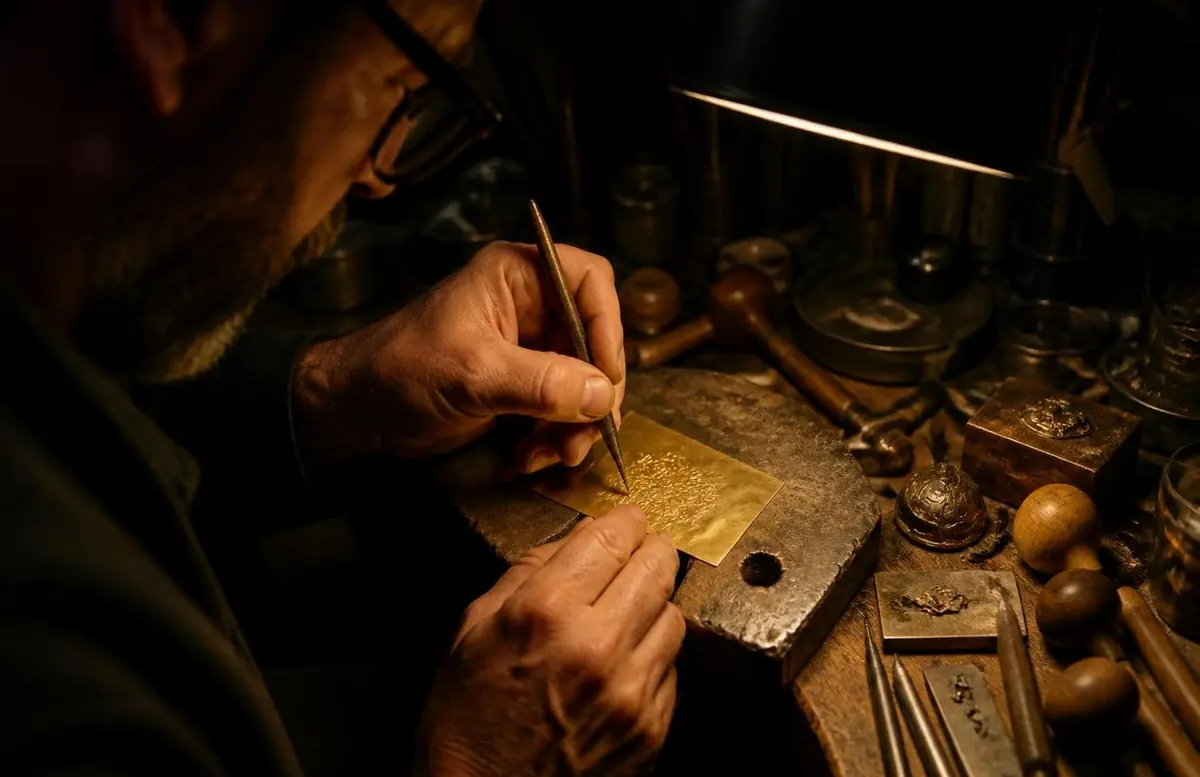
Almost none of the jewellery sold across South Asia is made by the shop that sells it. Behind the glass counters of a bazaar sits a supply chain of small karigars — artisan workshops, often family businesses of five to fifteen people, working in back-street units a short walk from the retail strip. A retailer takes an order, specifies weight and design, and the piece is cast, set and finished within days by a workshop the customer never sees and the brand rarely credits.
Piece rates and the economics of handwork
Karigars are paid by weight of finished work and by design complexity, not by the hour, which means the trade's famous intricacy is also a wage-suppression mechanism: a filigree necklace that takes four days pays a fixed making rate regardless of how long it actually took, and competition among workshops for a retailer's order has historically pushed those rates down rather than up. Efforts to formalise minimum piece rates have made slow progress precisely because the workshops themselves compete on price to retailers who compete on price to customers, and gold is the one line item nobody will negotiate downward.
Mechanisation has changed this only partially. Chain-making and plain bangles have moved substantially to machine production in organised factories, which pushed down making charges on plain work and pushed the remaining artisan workshops toward the ornate, hand-finished pieces that machines still cannot replicate economically. The result is a bifurcated trade: cheap, thin-margin machine work for the mass market, and a shrinking population of skilled hand-workers producing the bridal-heavy pieces that carry the highest making charges and the highest margins.
Recycling: the market's second mine
India and China are not only the world's largest jewellery consumers; they are two of its largest sources of recycled gold, and the same household that buys a bangle on a dip is often the household selling an older one back a decade later to fund a different life event — a daughter's wedding, a medical bill, a business that needs capital fast. Old-gold exchange, where a customer trades in existing jewellery against a new piece and pays only the difference, is one of the most common transactions at any Indian jeweller and rarely appears in headline demand figures at all.
This recycling flow is itself price-responsive, and in the opposite direction to fresh buying: a sharp rally that discourages new purchases simultaneously encourages households sitting on old jewellery to realise the gain, which is why scrap supply and new demand can move against each other within the same city in the same month. A market model that only counts imports and mine supply misses roughly this entire channel, and it is one reason official demand statistics for these two countries are treated by traders as directional rather than precise.
5–15
Typical workforce size of an artisan karigar workshop
3–4 days
Common turnaround for a mid-complexity bridal piece
Old-gold exchange
The most common transaction type at an Indian jewellery counter after new sales
Bridal gold and the household balance sheet
In much of South Asia a wedding is still, functionally, a balance-sheet event. Gold given to a bride is understood by every party in the room as dowry, insurance and display simultaneously — a store of value transferred at the one point in a woman's life when a lump-sum transfer is culturally uncontroversial, and an asset she may retain some independent claim over even where other household property is titled to her husband or his family. Anthropologists studying South Asian households have repeatedly found that bridal gold is treated differently in intra-household bargaining than other jointly held assets, precisely because it is portable, sellable without anyone else's signature, and worn rather than banked.
“Ask a mother how much gold her daughter needs for the wedding and she will not describe fashion. She will describe a number of grams, built up over years of small purchases, because she has done this arithmetic since the daughter was born.”
That arithmetic explains a buying pattern financial models struggle with: purchases that begin years before the event they fund, in small increments, through recurring gold-savings schemes that some jewellers now formalise as instalment plans with the final month's value in metal rather than cash. It is, in effect, a dollar-cost-averaging programme invented independently by households with no exposure to the phrase, running for a specific liability rather than a general investment goal, and it smooths the seasonal spike a headline wedding-season narrative implies is more sudden than it actually is.
China's parallel but distinct market
It is a common error to treat Indian and Chinese gold demand as the same story told twice. China's jewellery trade is younger, more urban, and more retail-brand-driven — dominated by national chains with standardised pricing and hallmarking rather than the family-jeweller model that still defines much of India — and it sits alongside a far larger domestic bar and coin investment market than India's, reflecting decades of state encouragement of household gold saving as an alternative to a historically shallow domestic capital market.
- Retail structure — large branded chains dominate urban China; family-run jewellers and regional wholesalers dominate the Indian trade.
- Investment overlay — Chinese demand includes a substantial bar-and-coin component absent from India's overwhelmingly ornamental market.
- Purity convention — 24-karat is the default retail expectation in China; 22-karat dominates Indian retail, with 24-karat reserved mostly for coins and investment bars.
- Policy lever — India manages demand mainly through import duty; China manages it mainly through the state-linked Shanghai Gold Exchange and periodic import-quota administration.
What the counter transaction says about the whole market
Step back from the bazaar and the through-line is this: the two largest gold-consuming populations on earth have built, without coordination or financial engineering, a decentralised savings system denominated in a metal that needs no bank, no credit history and no maturity date. It is inefficient by the standards of a modern portfolio — the making charge is a real cost with no offsetting return, and a bangle earns nothing while it sits in a locker — and it has nonetheless proved durable across currency crises, wars and generations of financial-sector reform precisely because its unit of account cannot be devalued by any domestic authority.
That durability is the reason analysts who dismiss jewellery demand as sentimental keep being surprised by it. It is not sentiment. It is a parallel financial system operating in plain sight, with its own instruments — the bangle instead of the bond, the making charge instead of the management fee, the hallmark instead of the credit rating — settling the same underlying question every other part of the gold market is trying to answer: what do you hold when you do not fully trust anyone else's promise.
Frequently asked
Questions readers ask
- Why is Indian jewellery usually 22 karat?
- Because it is bought partly as stored value. Twenty-two karat is 91.6 percent gold — high enough that the piece is close to a savings instrument, while retaining enough alloy for the metal to survive being worn. Western markets favour 14 and 18 karat, which are harder and cheaper but hold far less metal.
- What are making charges?
- The fabrication cost a jeweller adds to the metal value: labour, wastage during working, design and margin. They typically run from single-digit percentages on plain machine-made chain to well over twenty percent on intricate handwork, and they are the part of the price a buyer can negotiate.
- Does jewellery demand actually move the gold price?
- It shapes the floor more than the ceiling. Because Asian buyers step back on rallies and step in on dips, physical demand tends to damp both directions. Sharp price moves are usually driven by investment and futures flows; the absorption that ends a sell-off is often physical.
- What does a local premium or discount tell you?
- It tells you whether physical metal is scarce or surplus in that market right now. A premium over the London price means importers are competing for bars; a discount means the domestic market is oversupplied, often because scrap selling has surged or a rally has killed retail demand.
- How does the Chinese 'heritage gold' trend affect demand?
- The 'heritage gold' or 'gu-fa' gold trend in China involves traditional matte finishes and heavier, solid designs. It has appealed strongly to younger consumers who see it as both a fashion statement and a reliable store of value, helping to sustain demand even as other luxury sectors have slowed.
- Is there a tax on gold in India?
- Yes, India applies both an import duty and a Goods and Services Tax (GST) on gold. The combined tax rate can be significant, which often leads to a wide gap between international and domestic prices and creates incentives for unofficial inflows of metal.
- What is the significance of 'Akshaya Tritiya' for gold buying?
- Akshaya Tritiya is a spring festival considered one of the most auspicious days in the Hindu calendar to start new ventures or make major purchases. Buying gold on this day is believed to bring eternal prosperity and good fortune, leading to one of the largest single-day surges in physical gold demand annually.