
Topic hub
Goldsmithing and craft
Alloys, the bench, and why almost nothing you wear is pure gold.
Pure gold is too soft to hold a stone or survive a decade on a hand. Every wearable object is an alloy, and the choice of alloying metals decides colour, hardness, solderability and how the piece ages. The bench trade that makes those choices is old, small and unusually well documented.
Our craft coverage runs from karat metallurgy to hallmarking to the working practices of contemporary goldsmiths.
Start here
Science · 17 min read
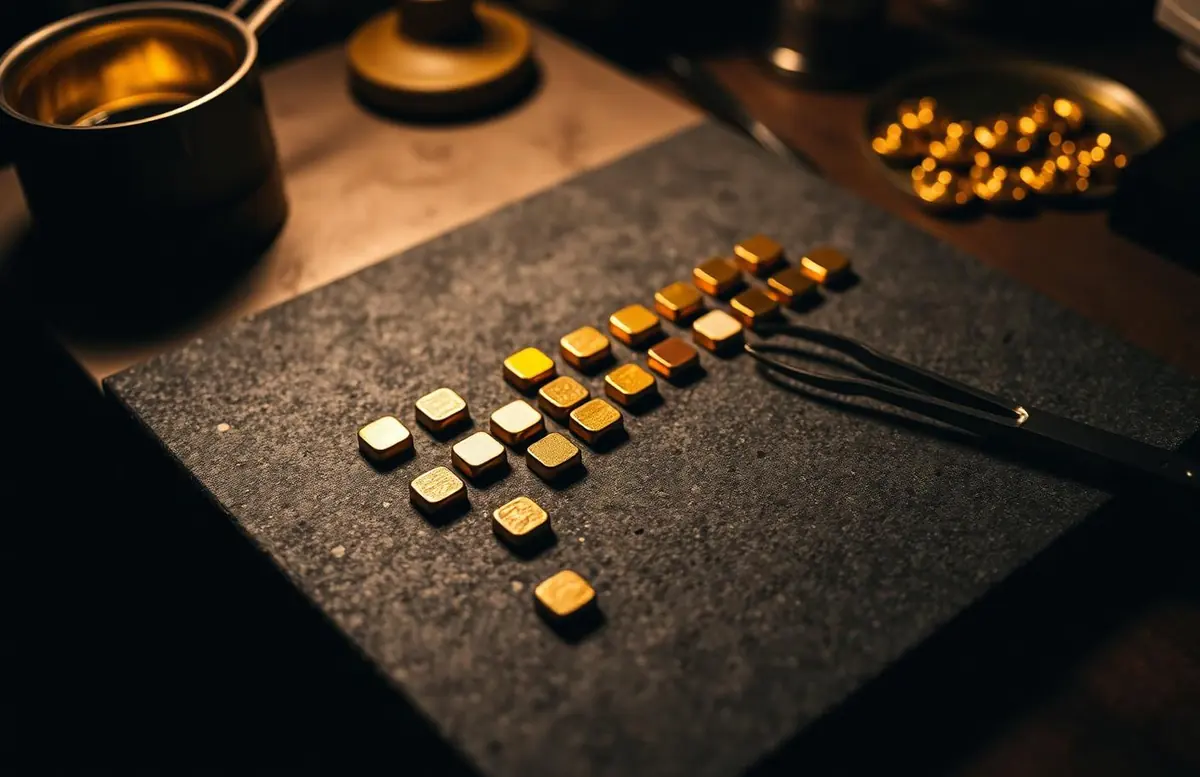
The Metallurgy of Karat
Pure gold is too soft to hold a stone, too soft to hold an edge, and the wrong colour for half the world's taste. Almost everything you own that is gold is a designed alloy — and the design is where the engineering lives.
Tomas Herrera · 9 August 2026
More on goldsmithing and craft
Craft
The Wedding-Season Bid: How Jewellery Demand Sets the Floor
Half the world's gold is worn, not stored. In India and China that distinction barely exists — and the buying behaviour it produces is the most reliably contrarian force in the entire market.
3 August 2026 · 15 min read
Markets
Who Actually Sets the Gold Price
There is no single gold price. There is a London settlement number, a New York futures curve, a Shanghai premium and a jeweller's counter in Dubai — and the distance between them is where the market lives.
2 August 2026 · 16 min read
Craft
Hallmarks and Assay: How Anyone Proves Gold Is Gold
A hallmark is one of the oldest consumer protection technologies in continuous use. It is also, on close inspection, a small masterpiece of institutional design — and it is being quietly eroded.
22 July 2026 · 15 min read
Markets
Bring It Home: Central Banks and the Great Gold Repatriation
For half a century it was rational to store your gold in someone else's basement. Then the calculus of counterparty risk changed, and reserve managers started chartering aircraft.
20 June 2026 · 14 min read
Craft
The Alchemy of Craft: What Goldsmiths Know That Machines Don't
Gold's working properties are so extreme they border on the absurd — one gram drawn into three kilometres of wire. Inside a trade where the tools have barely changed and the hands are irreplaceable.
5 June 2026 · 16 min read
Terms used in this topic
- Karat
- A twenty-fourths scale for gold content in an alloy: 24k is pure gold, 18k is 750 parts per thousand, 14k is 583, 9k is 375. Karat measures only how much gold is present, not which metals make up the rest — and the balance determines colour, hardness and tarnish behaviour. Pure gold is too soft for most settings, which is why almost all worn jewellery is alloyed.
- Hallmark
- A set of marks struck by an independent assay office certifying that an article's gold content has been tested and meets the declared standard. A full hallmark typically records the sponsor, the fineness, the assay office and a date letter. In jurisdictions with compulsory hallmarking it is a legal guarantee rather than a maker's claim, which is why hallmarked antique pieces can be dated and attributed so precisely.
- White gold
- A gold alloy whitened with palladium, nickel or silver, then almost always plated with rhodium for a bright neutral finish. The underlying alloy is generally faintly warm rather than truly white, so the visible colour of a worn ring is often the plating rather than the metal. Rhodium wears off over years of contact, which is why re-plating is routine maintenance rather than a repair.
- Rose gold
- Gold alloyed with a high proportion of copper, which supplies both the pink colour and a notable increase in hardness. The depth of colour tracks the copper fraction, so 18k rose is subtler than 14k rose at the same nominal karat family. Higher-copper alloys can develop a surface patina over time and are less forgiving under the torch, which affects how a piece is sized and repaired.
- Vermeil
- Sterling silver plated with a defined minimum thickness of gold — typically 2.5 microns at 10k or finer under US rules. It is a regulated term, not a marketing one, which distinguishes it from ordinary gold plating where the layer may be a fraction of a micron. The distinction matters in wear: a thin flash plate can rub through in months, while true vermeil survives years of regular use.
- Lost-wax casting
- The oldest method still used to make gold jewellery. A wax model is encased in a refractory investment, the wax is burned out, and molten gold is drawn into the resulting cavity by vacuum or centrifuge. Almost every mass-produced ring passes through it. Its limits set the vocabulary of design: wall thickness, sprue placement and shrinkage all constrain what a caster will accept from a drawing.
- Gold filled
- A mechanically bonded layer of karat gold making up at least 1/20 of an article's total weight, pressure-bonded to a base-metal core rather than deposited electrically. It is orders of magnitude thicker than plating and can last decades in normal wear. It is not solid gold and has little refining value, but it is the reason well-made early twentieth-century costume pieces still look intact today.
Questions readers ask
- Why is jewellery not pure gold?
- Because 24ct gold is soft enough to deform in normal wear. Alloying with copper, silver, palladium or nickel raises hardness and sets colour at the cost of fineness.
- What is the difference between 18ct and 14ct?
- 18ct is 75 percent gold by mass, 14ct is 58.5 percent. The lower karat is harder and cheaper; the higher karat holds colour better and is the norm in European fine jewellery.
Other topics
- The gold standard
- Central-bank reserves
- Refining and assay
- Mining economics
- Recycling and recovery
- Price and market structure
- The science of gold
Reported from the Science desk.