
Topic hub
The science of gold
Where element 79 comes from, why it is inert, and what it does in medicine and electronics.
Gold's monetary career is a consequence of its chemistry. It does not oxidise, it conducts well, it is the most ductile metal known, and relativistic effects on its electron shells are why it is yellow rather than silver. Its cosmic origin — neutron-star mergers and the late veneer delivered to Earth's crust — is still an active research question.
This hub gathers the physical-science reporting: nucleosynthesis, colloidal gold in diagnostics, and the industrial uses that depend on the metal's inertness.
Start here
Science · 17 min read
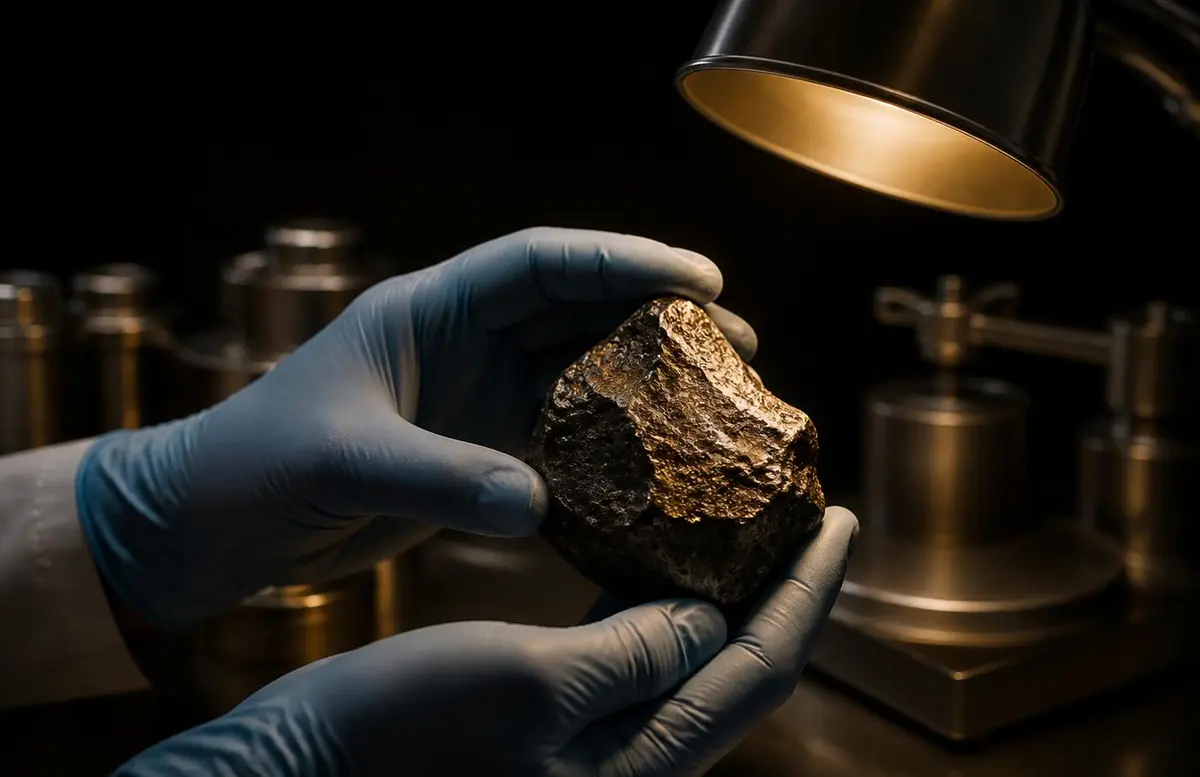
Where Gold Actually Comes From
Every gram of gold on Earth was manufactured in an astrophysical catastrophe, arrived here after the planet had already formed, and was then concentrated by hot water. Three separate accidents, none of them likely, all of them necessary.
Tomas Herrera · 10 August 2026
More on the science of gold
History
The Hoard Problem: What Buried Gold Actually Tells Us
A field of gold torcs and coins is a spectacular find and a treacherous document. The people who buried it were not writing to us, and the reasons they had for putting it in the ground are exactly what the ground does not record.
9 August 2026 · 16 min read
Science
The Metallurgy of Karat
Pure gold is too soft to hold a stone, too soft to hold an edge, and the wrong colour for half the world's taste. Almost everything you own that is gold is a designed alloy — and the design is where the engineering lives.
9 August 2026 · 17 min read
Science
The Metal That Went Medical
Divide gold finely enough and it stops being gold-coloured, stops being inert in the way you expect, and starts doing work in places no bullion bar could reach — including the test strip that told you whether you had a virus.
8 August 2026 · 19 min read
History
The Gold Standard: How a Soft Yellow Metal Became Money
For roughly five thousand years, humanity kept returning to the same element to settle its debts. The story is less about greed than about the unusually boring chemistry of atomic number 79.
14 July 2026 · 14 min read
Terms used in this topic
- Fineness
- Gold purity expressed in parts per thousand. 999.9 fineness — 'four nines' — is 99.99 percent gold, the standard for investment bars and coins. 995 is the London Good Delivery minimum. Fineness is the wholesale market's language because it is a direct mass fraction, unlike karat, which expresses the same idea in twenty-fourths and is used in jewellery.
- Fire assay
- The reference method for determining gold content, unchanged in principle for centuries. A weighed sample is fused with lead and fluxes, then heated in a porous cupel where the lead oxidises and is absorbed, leaving a bead of precious metal. The bead is parted in acid to remove silver and the remaining gold is weighed. It is slow and destructive, but it remains the arbiter when a result is disputed.
- Urban mining
- Recovering gold from discarded electronics rather than ore. A tonne of circuit boards can carry a hundred times the gold of a tonne of typical ore, concentrated in connectors, bonding wire and plating. The constraint is not chemistry but logistics and safety: collecting, sorting and de-soldering mixed waste without releasing brominated flame retardants or heavy metals is what determines whether recovery is economic.
Questions readers ask
- Where does gold come from?
- From nucleosynthesis in extreme astrophysical events — principally neutron-star mergers. Earth's accessible gold was largely delivered to the crust by the late veneer of impacts after the core had already formed.
- Why does gold not tarnish?
- Its electron configuration makes oxidation thermodynamically unfavourable under normal conditions. It resists nearly every single acid; dissolving it takes aqua regia or a cyanide complex.
Other topics
- The gold standard
- Central-bank reserves
- Refining and assay
- Mining economics
- Recycling and recovery
- Price and market structure
- Goldsmithing and craft
Reported from the Science desk.