Nanoscience
The Metal That Went Medical
Divide gold finely enough and it stops being gold-coloured, stops being inert in the way you expect, and starts doing work in places no bullion bar could reach — including the test strip that told you whether you had a virus.
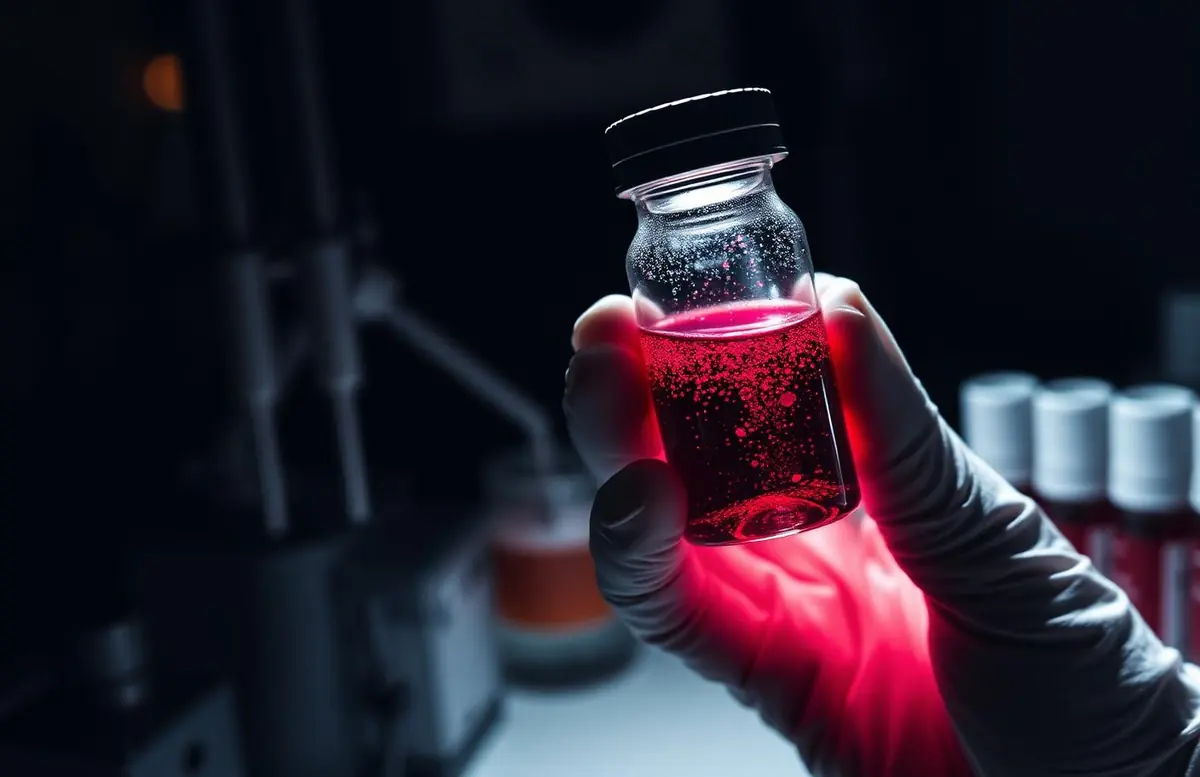
In 1857 Michael Faraday made a liquid the colour of a garnet by reducing a gold chloride solution with phosphorus, and then spent considerable effort defending the claim that the ruby colour came from gold itself. His contemporaries assumed a dissolved compound. Faraday argued the metal was still metal, merely divided into particles too small to see, and that their smallness was the whole explanation. He was right, roughly a century before anyone could image the particles and confirm it.
That divided gold is now in more laboratories, hospitals and pharmacy shelves than bullion is in most vaults, and the reason is not scarcity or value. It is that gold at the nanometre scale does something no other convenient material does as reliably: it announces its own state, in colour, to the naked eye.
Why small gold is red
A bulk gold surface reflects. A gold particle twenty nanometres across — smaller than the wavelength of visible light — cannot behave that way. Instead, the incoming light field drives the particle's conduction electrons back and forth as a single coherent cloud. At a particular frequency the oscillation resonates, and the particle absorbs that colour strongly. For twenty-nanometre spheres in water, that resonance falls near 520 nanometres, in the green. Remove green from white light and what remains reads as red.
The important part is that the resonant frequency depends on the particle's size, its shape and — crucially — its distance from its neighbours. Grow the spheres and the peak shifts towards longer wavelengths. Stretch them into rods and they acquire a second resonance, tunable well into the near-infrared. Let them clump together and the coupled plasmons of adjacent particles shift the absorption dramatically towards the red end, at which point the suspension turns from wine-red to slate blue in seconds.
The line on the test strip
Almost everyone has now used colloidal gold without knowing it. In a lateral flow immunoassay — the format of the home pregnancy test and of the rapid antigen tests that became universal in the 2020s — the coloured line is gold.
The mechanism is worth spelling out because it explains the format's limits as well as its strengths. A pad near the sample well holds dried gold nanoparticles, each coated with antibodies against the target. Sample fluid rehydrates them and carries them along the nitrocellulose membrane by capillary action. If the target is present, it binds to the antibodies on the particles. Further along the strip, a fixed line of a second antibody captures that complex, immobilising the gold. Enough particles trapped in a narrow band become visible as a red line. A control line downstream captures particles regardless, proving the fluid ran.
- No enzyme, no substrate, no incubation step — the label is already coloured, so nothing has to be developed.
- No refrigeration — dried gold conjugates are stable at ambient temperature for long shelf lives.
- No reader — which is what makes the format viable in a bathroom or a rural clinic.
- The trade-off is sensitivity: a visible line needs a large number of particles, so lateral flow is far less sensitive than laboratory PCR.
Why gold and not something cheaper
Coloured latex beads and carbon particles both work as labels and both are cheaper per unit. Gold persists because of surface chemistry. The bond between sulphur and a gold surface is strong, forms spontaneously from solution, and orients molecules predictably — which means any biological molecule that can be given a thiol group can be attached to a gold particle in a single step, in water, at room temperature, without destroying its function.
Add gold's near-total chemical inertness — it will not oxidise on the shelf, will not leach reactive ions into a biological sample, and will not degrade under the light it is being read by — and the material earns its price. Reproducibility is worth more than raw cost in a diagnostic supply chain.
Beyond the strip
Immunogold labelling has been standard in electron microscopy since the 1970s: attach gold particles of a defined size to an antibody, and their electron density makes them appear as unmistakable black dots on the micrograph, marking exactly where the target protein sits inside a cell. Use two particle sizes and you can label two targets in one image.
The frontier work is therapeutic and remains genuinely experimental. Gold nanorods tuned to absorb near-infrared light — which penetrates tissue relatively well — convert that light into localised heat, an approach explored for ablating tumours. Gold's high atomic number makes it a candidate radiosensitiser, concentrating the effect of a radiotherapy dose where the particles have accumulated. Others use the particle purely as a scaffold for delivering a drug payload. Several of these have entered clinical trials; none should be described to a reader as a treatment they can obtain.
What it means for the metal
None of this moves the gold price. The total mass of gold in the world's diagnostic and research nanoparticle supply would not fill a modest vault shelf, and the market for it is priced on manufacturing precision rather than on metal content. The significance is different in kind: it is the clearest available demonstration that gold's industrial value has never really been about how much of it you have, and always about the properties that make it behave predictably when nothing else will.
Why the particles have to be exactly the size they are
The behaviour that makes colloidal gold useful is not chemical but optical, and it is exquisitely size-dependent. Conduction electrons at the surface of a nanoparticle oscillate together when light of the right wavelength hits them — a surface plasmon resonance — and absorb strongly at that wavelength. For spheres around forty nanometres across the resonance sits in the green, so the transmitted light is red. Grow the particles and the resonance shifts toward the red, and the suspension turns purple and then grey-blue.
Manufacturing a diagnostic therefore means manufacturing a size distribution, not just a material. A batch whose particles run ten percent large produces a test line of a visibly different shade, which matters when the readout is a human eye deciding whether a faint band is present. This is why nanogold production is dominated by a small number of suppliers with tight process control, and why a lateral-flow test that works in a laboratory can fail validation when the conjugate is sourced elsewhere.
From the test strip to the clinic
The lateral-flow strip is the mature application, and the pandemic turned it into one of the largest single uses of nanoscale gold in history. The newer work is therapeutic, and it is slower, because a diagnostic only has to be read while a therapeutic has to be tolerated.
- Photothermal therapy — gold shells and rods tuned to absorb near-infrared light, which passes through tissue, then convert it to heat inside a tumour.
- Targeted delivery — particles surface-functionalised with antibodies or nucleic acids, using gold as an inert, easily conjugated scaffold rather than as an active agent.
- Imaging contrast — gold's high atomic number makes it strongly X-ray attenuating, giving CT contrast at concentrations conventional agents cannot reach.
- Radiosensitisation — particles concentrated in a tumour that increase local dose from an external radiation beam.
Every one of these has to clear the same obstacle: what the body does with a metal particle it cannot dissolve. Gold is not metabolised. Particles above a threshold size are cleared by the liver and spleen and can be retained for months, which regulators reasonably treat as a long-term safety question rather than a formality. Much of the current design effort goes into particles small enough to be cleared by the kidney, or into constructs assembled from small units that disassemble after they have done their work.
The quantities involved keep this out of the demand statistics entirely. A single test strip carries something in the order of nanograms of metal, and global diagnostic output does not register against a market measured in tonnes. Its significance is not volumetric. It is that a metal chosen for millennia because it does not react found a modern career for precisely the same reason.
Manufacturing gold at the nanoscale
Making colloidal gold in a research lab is almost embarrassingly simple, which is part of why Faraday could do it with Victorian equipment. The Turkevich method, formalised in the 1950s and still the workhorse recipe, reduces a boiling solution of chloroauric acid with sodium citrate. The citrate does two jobs at once: it donates electrons to reduce the gold ions to metal, and the citrate ions left adsorbed on the particle surface carry a negative charge that keeps the growing particles from clumping together as they form. Vary the ratio of citrate to gold and the final particle size shifts predictably, which is the entire basis of size-controlled manufacture.
Scaling that chemistry from a beaker to a pharmaceutical-grade production line is where the real engineering sits. Batch-to-batch consistency in size distribution has to be verified by dynamic light scattering and electron microscopy before a lot is released, because a diagnostic manufacturer cannot tolerate a shipment whose particles run five per cent large and shift the test line towards purple. A small number of specialist suppliers dominate the diagnostic-grade nanogold market for exactly this reason: the chemistry is old and cheap, but the quality control is not, and reputational trust built over years of consistent batches is difficult for a new entrant to buy quickly.
Surface functionalisation
- Passive adsorption — antibodies stick to the bare gold surface through a mix of electrostatic and hydrophobic forces, cheap but prone to reorienting or detaching under stress.
- Thiol linkage — molecules bearing a sulphur group form a strong, self-orienting bond directly to gold atoms, the basis of most modern conjugates.
- PEGylation — polyethylene glycol chains coat the particle to reduce non-specific binding and extend circulation time in the body, standard for anything intended to be injected.
- Layer-by-layer coating — successive charged polymer layers build a shell that can carry a drug payload separately from the targeting molecule on the outer surface.
The safety and regulatory picture
Diagnostic-grade colloidal gold sits in a different regulatory lane from anything intended to enter the body. A lateral flow strip never crosses a biological barrier — the gold stays on a nitrocellulose membrane and is discarded with the device — so it is regulated as a medical device component, tested for consistency rather than for systemic toxicity. Injectable or ingestible gold nanoparticle products face an entirely different bar, because the body's inability to metabolise gold becomes the central safety question rather than a footnote.
Regulators have pushed hard on particle clearance data as a result. Below roughly 5–6 nanometres, gold particles are small enough to pass through the kidney and be excreted in urine within days. Above that threshold, particles accumulate in the liver and spleen and can remain detectable for months, which is treated as a long-term retention question requiring extended toxicology studies rather than an automatic disqualifier — several larger-particle formulations have still progressed through early clinical trials under monitored protocols.
“The strip in your bathroom and the particle in a phase-one oncology trial share an element and almost nothing else — one never enters a cell, the other is designed to.”
What the next decade looks like
The diagnostic side of this story is largely settled technology waiting for cheaper, more sensitive variants — combining gold nanoparticles with fluorescent or magnetic reporters to push lateral flow sensitivity closer to laboratory methods without sacrificing the format's defining simplicity. Several manufacturers are already shipping hybrid strips that pair the familiar visible line with a smartphone-read fluorescent signal for a quantitative result, aimed at applications such as home monitoring of chronic conditions where a positive-or-negative readout is not precise enough.
The therapeutic side remains a longer and more uncertain road, constrained less by the chemistry than by the same trial infrastructure and regulatory caution that governs every experimental cancer therapy. What is not in doubt is the direction of travel: as biology increasingly needs materials that can be seen, targeted and functionalised at a scale smaller than a cell, an element first prized for refusing to react with anything is being redeployed for exactly that quality, just at a billion times smaller a scale than a coin.
1857
Year Faraday first characterised stable gold colloids
~20nm
Typical particle size for the classic ruby-red colloid
~520nm
Approximate absorption peak wavelength, in the green
<6nm
Rough particle size threshold for kidney clearance
The pandemic and the supply chain nobody had built
Before 2020, diagnostic-grade colloidal gold was a modest, specialised market serving pregnancy tests, a handful of infectious-disease strips and research antibody conjugates. Global demand for lateral flow devices then increased by orders of magnitude within months, as governments sought rapid antigen tests capable of being manufactured, distributed and read without laboratory infrastructure. The gold nanoparticle conjugate at the heart of every one of those strips suddenly needed to be produced at a scale the sector had never planned for.
The bottleneck was rarely raw gold. It was the specialised antibody-conjugation and quality-control capacity needed to turn bare nanoparticles into a validated diagnostic reagent, held by a small number of established suppliers with the process control history regulators trusted. New entrants who tried to scale conjugation quickly ran into the same problem that has always constrained the field: a batch with a slightly shifted particle-size distribution produces a test line of visibly different intensity, and a device manufacturer cannot risk shipping millions of units built on an unvalidated conjugate.
Several governments responded by funding domestic nanoparticle manufacturing capacity directly, treating diagnostic-grade gold conjugate production as a strategic capability in a way that would have seemed a strange use of public money five years earlier. Some of that capacity has since been repurposed toward other lateral flow applications — environmental testing, food safety, veterinary diagnostics — rather than mothballed, which is one of the more durable structural legacies of the pandemic on the nanogold industry.
The episode also sharpened public understanding, however dimly, of what a lateral flow test actually contains. Regulatory disclosures and manufacturer literature during the pandemic routinely named gold nanoparticles as the active reporter component, a level of public-facing technical detail that a niche diagnostic reagent had never previously received outside a laboratory supply catalogue.
What changed after demand fell back
- Manufacturing capacity for gold-conjugate strips is now several times larger than before 2020, even as pandemic-driven test volumes have fallen sharply.
- Quality standards for lateral flow validation tightened across most regulatory regimes, raising the bar for new market entrants relative to the pre-pandemic era.
- Hybrid formats pairing a visible gold line with a fluorescent or magnetic quantitative readout moved from research curiosities to commercially available products.
- Non-clinical applications — agricultural testing, water safety, veterinary use — absorbed a meaningful share of the expanded manufacturing base.
Gold nanoparticles beyond biology
Medicine and diagnostics dominate the public conversation about nanogold, but the same size-tunable optical properties are used in fields that have nothing to do with the body. Catalysis is the largest of these: gold, chemically inert in bulk, becomes a surprisingly active catalyst once divided into particles a few nanometres across, promoting reactions such as the low-temperature oxidation of carbon monoxide that bulk gold will not touch at all.
That catalytic behaviour has moved from laboratory curiosity to practical application in selective oxidation and hydrogenation reactions used in fine chemical and pharmaceutical manufacturing, where gold nanoparticle catalysts can achieve selectivity that conventional platinum-group catalysts struggle to match. The quantities involved remain small relative to jewellery or investment demand, but the chemistry is a genuine departure from everything gold is known for at bulk scale.
Sensor technology is a second frontier, exploiting the same aggregation-driven colour change used in lateral flow tests to detect heavy metals, pesticide residues and pathogens in environmental and food samples, often at a cost per test far below laboratory instrumentation. Several water-utility trials have used gold nanoparticle sensors as an early-warning screen for contamination, with confirmatory laboratory testing reserved for samples that trigger the simple colour-based alert.
Electronics and photonics researchers, meanwhile, exploit the same plasmonic properties to concentrate light at scales below the diffraction limit, an effect used in surface-enhanced Raman spectroscopy to detect trace quantities of a target molecule that would otherwise be undetectable by conventional spectroscopy. None of these applications move the gold price meaningfully, but together they illustrate how thoroughly the metal's usefulness has decoupled from its historic role as a store of value.
“We think of gold as the element that does nothing, chemically, and that is exactly true at the scale of a coin. Cut it fine enough and it starts doing more interesting chemistry than almost anything else on the periodic table.”
How a nanoparticle is actually characterised
None of this is usable without measurement, and measuring a nanoparticle is not like measuring a bar of bullion. There is no single number that stands in for 'purity'. A manufacturer releasing a batch of gold conjugate has to characterise a size distribution, a shape distribution and a surface coverage, and demonstrate that all three sit within tight tolerances of the reference batch a diagnostic was originally validated against.
Dynamic light scattering gives a rapid, solution-phase read on the hydrodynamic diameter of the population, useful for a quick pass or fail decision on the production floor but blind to shape. Transmission electron microscopy answers the question DLS cannot, imaging individual particles directly so an operator can confirm the population is genuinely spherical rather than a mixture of spheres and rods that happen to average out to the right size. UV-visible spectroscopy, the cheapest of the three, reads the plasmon peak position and width directly, which is often the fastest proxy for both size and aggregation state because it is exactly the property the finished diagnostic depends on.
- Dynamic light scattering — fast, solution-phase, reports an average hydrodynamic size across the population.
- Transmission electron microscopy — slow and expensive, but the only method that shows individual particle shape directly.
- UV-visible spectroscopy — cheap and quick, and closest to the property a finished lateral-flow line actually relies on.
- Zeta potential measurement — checks the surface charge that keeps particles from clumping in storage, a leading cause of shelf-life failure.
The economics of a tonne of gold versus a gram of reagent
It is worth putting the scale of this industry against the scale of the metal market it borrows its raw material from, because the mismatch is instructive. A single kilogram of gold, reduced to twenty-nanometre spheres and fully surface-functionalised into diagnostic-grade conjugate, can in principle supply the coloured reagent for many hundreds of millions of lateral flow tests. The bullion cost of that kilogram is a rounding error against the cost of formulating, validating and packaging the finished reagent.
That inversion — metal cheap, process expensive — is unusual for gold, an element whose price almost always dominates the cost conversation in every other application from jewellery to central bank reserves. It is also why nanogold manufacturers do not behave like bullion traders. They do not hedge gold price exposure the way a refiner or a jeweller does, because the metal is such a small fraction of finished cost that price swings which would reshape a mining company's margins pass through a diagnostics manufacturer's balance sheet almost unnoticed.
“Ask a diagnostics manufacturer what their biggest cost driver is and gold will not be in the top five answers. It will be conjugation chemistry, quality assurance, cold-chain-free stability testing and regulatory filing. The metal is almost incidental to its own supply chain.”
~5%
Rough particle-size deviation that can visibly shift a test line's colour
3
Main characterisation methods routinely used together: DLS, TEM and UV-vis
1970s
Decade immunogold labelling became standard in electron microscopy
<1%
Rough share of a finished diagnostic conjugate's cost attributable to the gold itself
What still has to go right
None of the therapeutic applications described here are close to displacing established cancer treatment, and it is worth being blunt about why. Photothermal and radiosensitising approaches have to show, in randomised trials against standard care, that the benefit of localised heating or dose enhancement outweighs the practical difficulty of getting particles to accumulate selectively in a tumour rather than the liver, where the body's clearance machinery inevitably sends a share of any circulating nanoparticle regardless of how it is targeted.
The diagnostic side faces a narrower but equally real constraint: sensitivity. A visible red line needs enough particles trapped in one place to be seen by an unaided eye, which sets a floor on how little of a target analyte a simple lateral flow test can detect. Laboratories chasing lower detection limits without abandoning the format's cost and speed advantages have turned to quantitative readers that measure line intensity electronically rather than relying on a person's judgement of 'faint versus absent', and to signal-amplification chemistries that grow the visible signal after the initial capture step. Both add cost and complexity, trading away some of the simplicity that made the gold-based format valuable in the first place.
What is not in question is the direction of the underlying trend. Gold's industrial career has moved, over less than two centuries, from a curiosity Faraday could barely convince his peers was still metal, to the reporter molecule inside a device millions of people used in their own kitchens during a pandemic, to a candidate scaffold for cancer therapies still working their way through clinical trials. At every stage the same property has done the work: an element that refuses to react is, it turns out, exactly what you want when you need something small, stable and predictable enough to trust with a measurement that matters.
Frequently asked
Questions readers ask
- Why is colloidal gold red instead of gold-coloured?
- Because at nanometre scale the metal interacts with light through localised surface plasmon resonance rather than bulk reflection. Particles around 20 nanometres across absorb strongly in the green, near 520 nm, and transmit the red — so a suspension of them looks ruby, not metallic.
- Is colloidal gold safe to ingest?
- Ingestible colloidal gold is sold as a supplement and there is no credible clinical evidence supporting the health claims made for it. That is a separate question from clinically supervised gold compounds: injectable gold salts such as sodium aurothiomalate were used for decades in rheumatoid arthritis and carry a well-documented toxicity profile requiring monitoring. Nothing here is medical advice.
- How much gold is in a rapid test?
- Vanishingly little — a lateral flow strip typically carries nanograms to low micrograms of gold. Even at the scale of billions of tests, the aggregate demand is a rounding error against annual jewellery or investment offtake.
- Who discovered colloidal gold?
- Michael Faraday prepared and studied stable gold colloids in 1857, correctly concluding that the ruby colour arose from finely divided metal rather than a dissolved compound. Some of his original preparations are still in the Royal Institution's collection and still red.
- Are gold nanoparticles used to treat cancer?
- They are the subject of active research — as photothermal agents that convert near-infrared light into local heat, as radiosensitisers, and as drug carriers. Several approaches have reached clinical trials. Trial-stage is not the same as approved standard care, and this article does not report any as established treatment.
- How is colloidal gold made in a laboratory?
- The standard method, the Turkevich synthesis, reduces a boiling solution of chloroauric acid with sodium citrate, which both supplies electrons to form metallic gold and coats the resulting particles with a negative charge that keeps them from clumping. Varying the ratio of citrate to gold predictably changes the final particle size, which is the basis of controlled, reproducible manufacture.
- Can gold nanoparticles be seen with the naked eye?
- The particles themselves cannot, being many times smaller than the wavelength of light, but their collective effect can. A suspension of well-dispersed twenty-nanometre particles looks a distinct ruby red to the naked eye, and that colour changing to blue-grey on aggregation is itself the basis of several simple diagnostic tests that require no instrument at all.
- Is gold nanoparticle research regulated differently from ordinary drugs?
- It goes through the same regulatory pathway as any other novel therapeutic — preclinical toxicology, then phased clinical trials — but with particular attention to particle clearance, since the body cannot metabolise gold and larger particles can persist in the liver and spleen for months. That retention profile is treated as a long-term safety question requiring extended monitoring rather than an automatic barrier to approval.