Investigation
The Other Supply Chain: Artisanal Mining and the Mercury Problem
A significant share of the world's gold is produced by people working with hand tools, informal finance and a neurotoxin. Formalisation is the stated solution. Nobody agrees on what it costs.
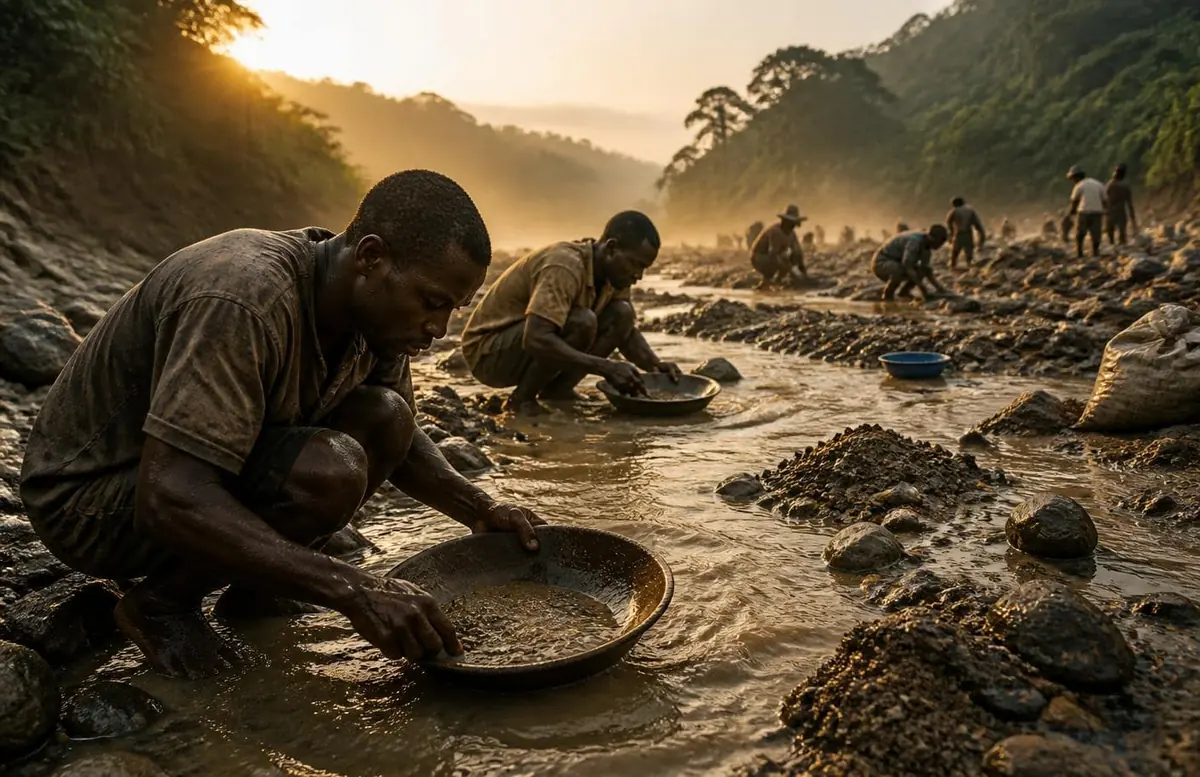
The pit is four metres deep and shored with cut branches. Two men work at the bottom filling rice sacks with grey sediment; a third hauls them up on a rope. At the river's edge, a fourth swirls the contents of a shallow steel pan with a motion so practised it looks lazy, letting the light sediment run over the lip until only a dark heavy residue remains. Somewhere in that residue is the gold.
This scene — with local variation in tools, geology and language — accounts for a substantial share of world gold production and the overwhelming majority of the people who produce it. Estimates of the workforce run into many millions across dozens of countries, against a large-scale mining industry that employs a small fraction of that number and produces the rest.
The economics of the pan
Artisanal mining is often described as a livelihood of last resort, which is accurate but incomplete. It is also, in many regions, the highest-earning work available without capital or credentials, and it is frequently seasonal — agricultural households mining between planting and harvest, converting labour into a commodity that stores value better than the local currency.
That combination shapes everything downstream. A miner earning daily needs to be paid daily. A miner without a bank account needs cash. A miner whose claim has no legal title cannot borrow against it, so equipment is financed by the buyer — who then sets the price. The informal buyer at the roadside is not merely a middleman; he is the credit system.
Why mercury wins
Panning recovers coarse gold well. It recovers fine gold poorly, and much of the value in a typical alluvial deposit is in particles too small for gravity alone to capture reliably. Mercury solves that problem with brutal elegance: added to the concentrate, it wets and binds the fine gold into a soft amalgam that can be squeezed through cloth and separated by hand.
Burning the amalgam drives off the mercury and leaves a porous sponge of gold. The whole sequence takes an afternoon, costs almost nothing beyond the mercury itself, needs no electricity, and requires no understanding of chemistry. Against those advantages, every alternative is competing uphill.
The cost lands on lungs and rivers. Burning is frequently done in the open, sometimes indoors, sometimes by the same people who then eat in that room. Vaporised mercury is absorbed efficiently through the lungs and is a potent neurotoxin. What escapes into waterways is methylated by bacteria into a form that accumulates up the food chain, concentrating in the fish that downstream communities eat.
The alternatives, and their catch
Better gravity
Sluices with proper riffle design, shaking tables and centrifugal concentrators can recover a much higher share of fine gold without any chemistry at all. They are the first-line intervention in most programmes because they are chemically benign and can pay for themselves through improved recovery.
The catch is capital and maintenance. A centrifugal concentrator needs power, spares and someone who can service it. Interventions that supply the machine but not the maintenance chain produce a familiar landscape: functional equipment abandoned within eighteen months, and everyone back on mercury.
Borax smelting
The direct smelting method, promoted after documentation of long-standing practice in parts of the Philippines, uses borax as a flux to lower the melting point of a heavy concentrate so that gold can be melted out directly. It removes mercury from the process entirely and uses a material available in any hardware market.
It also demands a higher-grade concentrate than panning typically produces, which means it must be paired with improved gravity separation to work. As a package the two are strong; as an isolated substitution it disappoints, and disappointed miners revert.
Cyanide, which is not obviously an improvement
Cyanide leaching recovers fine gold at high rates and is standard in industrial operations, where it is run in engineered circuits with destruction of residual cyanide before discharge. In an informal setting, without containment or destruction, it substitutes an acute hazard for a chronic one — and where cyanide is applied to tailings already contaminated with mercury, it can mobilise that mercury into a more transportable form.
- Gravity first: it is the only intervention with no toxic downside and immediate revenue benefit.
- Retorts as a bridge: a simple condenser recaptures much of the mercury during burning, cutting exposure sharply even where use continues.
- Bundle equipment with training, spares and a maintenance route, or expect reversion within two seasons.
- Assess whether an intervention changes the miner's daily cash position; if it does not, it will not be adopted.
Formalisation is a permitting problem
Almost every policy document concludes that the answer is formalisation: legal title, recognised claims, access to finance, an obligation to meet standards in exchange for the ability to sell into legitimate markets. The logic is sound and the implementation is where it fails.
In many jurisdictions the permitting regime was designed for industrial applicants. The process assumes documentation, a fixed address, legal representation and the capacity to wait months without income. A miner working a seasonal pit with six relatives cannot satisfy it, not because of unwillingness but because the form does not describe him.
“They tell us to become legal. I went to the office three times. Each time it was a different list. Meanwhile the buyer at the road pays cash today and asks nothing.”
Where formalisation has worked, it has generally involved simplified permits designed specifically for small operations, cooperatives able to aggregate volume and hold title collectively, and a legal buyer physically present at a price competitive with the informal one. Remove any of the three and the chain breaks at that link.
Traceability from the refinery end
Downstream, the pressure is real. Refiners face due-diligence expectations, jewellery brands face consumer and regulatory scrutiny, and an accredited refiner risks accreditation by accepting undocumented material. The result is a set of certified supply routes that pay a premium for gold with a verified origin.
These routes work, at limited scale, and their limitation is structural: certification costs money and takes time, and it therefore reaches the miners who are already best organised. The pits with the worst practices are precisely the ones least able to enter the scheme that would improve them. The result can be a bifurcated market in which certified material is clean, uncertified material is invisible, and the aggregate mercury emission is unchanged.
What honest progress looks like
Nothing about this sector responds to a single intervention, and the interventions that have worked share an unglamorous quality: they treat the miner as a rational operator with a cash-flow constraint rather than as a person to be educated out of a bad habit.
Retorts distributed with the small subsidy that makes recaptured mercury worth reusing. Gravity plants owned cooperatively and serviced under contract. Permits a person can complete in an afternoon. Buyers licensed to operate at the mine site, paying same-day. None of this is a breakthrough. It is plumbing.
The metal that emerges from these pits is chemically identical to the metal poured in a refinery in Switzerland, and once refined it carries no record of its origin. That is the fundamental asymmetry of the gold supply chain: the harm is entirely upstream, the value is realised entirely downstream, and only deliberate, expensive, maintained documentation connects the two. The documentation is the intervention. Everything else is a preference.
Who buys at the roadside, and why the price is what it is
The buyer at the edge of an artisanal mining site is usually cast as an exploiter in accounts of the sector, and the characterisation is often earned, but it obscures a more useful economic fact: that buyer is frequently the only source of working capital available to the miners at all. He advances mercury, fuel and food against future production, prices the gold himself with no independent scale in sight, and takes his margin from a spread the miner has no way to verify. Removing him without replacing the credit function he performs does not help the miner; it removes the only financing mechanism the miner has access to.
Prices paid at the mine gate typically sit well below the international spot price, and the discount is usually defended as compensation for the buyer's risk in moving undocumented material through a chain that becomes progressively more regulated the closer it gets to a refinery. Whether that discount is fair or extractive depends heavily on how much competition exists among buyers in a given district — a single buyer serving an isolated site can set almost any price he likes, while districts with several competing itinerant traders show discounts that narrow considerably.
Where the gold actually crosses into the formal chain
Somewhere between the roadside buyer and the refinery, undocumented artisanal gold typically passes through one or more aggregation points — a regional trading house, an export licence holder, sometimes a neighbouring country with laxer controls — where it is blended with other lots, weighed formally for the first time, and issued paperwork that will travel with it from that point onward. This is the moment at which origin information is most easily lost, deliberately or otherwise, and it is the point at which most credible traceability interventions try to intervene, because it is far more tractable to monitor a few dozen aggregation points than tens of thousands of individual pits.
- Mine-gate buyer: cash, no paperwork, price set unilaterally, functions as the miner's only credit line.
- Regional trading house: first formal weighing, blending of lots from multiple sites, origin becomes harder to trace.
- Export licence holder: paperwork generated here often becomes the only documented origin record for the entire lot.
- Refinery: melts and homogenises; once poured, the metal carries no chemical trace of any individual mine.
Health effects beyond mercury
Mercury dominates the public conversation about artisanal mining's health costs, deservedly, but it is not the only occupational hazard in a sector defined by informal, unregulated labour. Pit collapse is a routine cause of death in many mining districts, driven by unsupported shafts dug by hand into unstable ground with no engineering oversight. Silicosis from dust in dry ore-crushing operations is common and chronically under-diagnosed, because affected miners rarely have access to the imaging needed to identify it before the disease is advanced.
Child labour remains a documented feature of some artisanal sites, particularly in ore processing rather than pit work itself, where children are used for tasks perceived as lower-risk, such as sorting or panning, even though those tasks carry their own mercury exposure. International buyers and certification schemes have made child labour a specific and non-negotiable exclusion criterion, which has had a genuine effect at certified sites but, as with mercury, has done comparatively little to change practice at the much larger number of sites that never enter a certification programme at all.
“Everyone asks about the mercury. Fewer people ask about the pit that collapsed on my brother, because there is no treaty about that.”
What the certification schemes actually verify
Responsible-sourcing schemes operating in the artisanal sector vary considerably in what they actually check, and reading past the marketing language matters. Some verify only that mercury handling meets a minimum safety standard at the point of use; others additionally verify labour conditions, the absence of child labour, and that the site does not overlap with a designated conflict zone. A smaller number attempt full chain-of-custody tracking from pit to refinery, which is the most rigorous standard and also the most expensive to maintain, which is precisely why it reaches the fewest miners.
Millions
Estimated global ASGM workforce across dozens of countries
~1/3
Rough share of global gold output estimated to come from artisanal and small-scale sources
Largest
ASGM's ranking among anthropogenic mercury emission sources worldwide
Hours
Typical time from ore to recovered gold using mercury amalgamation
Two geologies, two very different mines
Alluvial working
Alluvial deposits — gold that has weathered out of its original host rock and been carried and concentrated by water into riverbeds, floodplains and old terraces — are the entry point for most artisanal mining because they require no drilling, blasting or ore crushing. A pit dug into a floodplain, sediment run over a sluice or through a pan, and the coarse gold falls out through density alone. The barrier to entry is close to zero: a shovel, a pan and access to water are enough to begin, which is why alluvial sites see the highest turnover of casual and seasonal miners and the least capital investment per worker.
Hard-rock working
Hard-rock artisanal mining is a different proposition entirely. Here the gold is still locked in quartz veins or sulphide ore that must be physically broken out, usually by hand with hammers and chisels in the smallest operations, dragged to the surface, and then crushed — traditionally by hand with heavy stones or increasingly with small diesel-powered stamp mills — before any separation can begin. This is dramatically more labour-intensive and more dangerous, since it requires tunnelling into unstable ground, and it is also where mercury use is most entrenched, because the crushed ore is finer and more thoroughly liberated than sediment ever is, making gravity-only recovery even less effective relative to amalgamation.
The distinction matters for policy as much as for geology, because interventions designed around one type routinely fail when applied to the other. A gravity concentration package that transforms recovery at an alluvial site does comparatively little at a hard-rock site where the ore must first be crushed to a fine enough size for any separation method to work at all, and crushing capacity — not separation technology — is often the actual bottleneck constraining a hard-rock miner's output and, by extension, their exposure to mercury as the fastest available finishing step.
Women in the workforce
Discussions of artisanal mining tend to default to an image of men working underground, and men do dominate pit labour in most regions. But women make up a substantial proportion of the total ASGM workforce, concentrated overwhelmingly in the processing stages that happen after ore reaches the surface — sorting, crushing, panning and, critically, amalgam handling and burning. These tasks are frequently characterised, including by the workers themselves, as less dangerous than pit work, a perception that understates the direct mercury exposure involved in handling amalgam and standing over a burn.
The consequences fall unevenly. Mercury is a recognised reproductive and developmental toxin, and women of childbearing age handling amalgam face risks that extend to pregnancy outcomes and infant development, an exposure pathway that receives markedly less attention in policy documents than the headline occupational and environmental statistics. Programmes that have taken this seriously have generally done so by targeting protective equipment and safer burning practice specifically at processing roles rather than assuming that interventions aimed at pit workers cover the sector's female workforce by extension — an assumption that, in practice, they usually do not.
What is left on the land
Mercury dominates coverage of artisanal mining's environmental footprint, but the physical disturbance of the land itself is a separate and cumulatively larger problem in many districts. Alluvial mining reshapes riverbeds and floodplains directly, altering watercourses, increasing turbidity that smothers downstream aquatic life, and stripping riparian vegetation that would otherwise stabilise banks against erosion. Hard-rock sites leave waste rock piles and tailings dams, frequently unengineered, that can fail catastrophically in heavy rain and bury or contaminate land far beyond the original mining footprint.
Because most artisanal operations have no closure obligation and often no continuous legal presence to enforce one even where it nominally exists, rehabilitation is rare and site abandonment is the norm rather than the exception. A worked-out alluvial stretch typically remains as a scarred, waterlogged landscape of unfilled pits for years, sometimes indefinitely; agricultural land converted to mining is disproportionately unlikely ever to return to agricultural use, both because the physical damage is substantial and because the economic incentive to rehabilitate land that no longer has visible gold in it is essentially absent for an operator who has already moved on.
“Nobody comes back to fill in the holes. Why would they? The gold is gone and so is the money to do it.”
Deforestation and the frontier effect
In forested regions — parts of the Amazon basin and Central Africa in particular — artisanal gold mining is also a direct driver of deforestation, both from the clearing required to access alluvial deposits along forest rivers and from the roads, camps and informal settlements that follow a productive discovery. Satellite monitoring of mining-driven forest loss has repeatedly shown that the affected area expands and contracts with the gold price with a lag of roughly a year or two, a correlation tight enough that some researchers now treat deforestation extent in mining frontiers as an indirect, real-time proxy for informal mining activity that official production statistics miss entirely.
The frontier effect compounds the direct footprint. A mining camp draws in itinerant workers, and workers need food, which draws in hunting and small-scale agriculture into forest that would otherwise remain intact; a road cut for mining access becomes a corridor for logging that has nothing to do with gold at all. By the time an area's mining activity is formally documented, the ecological change it has triggered often extends well beyond the boundary of any individual pit, which is one reason environmental groups increasingly treat artisanal mining as a forest-governance issue as much as a mineral-sector one.
Financing beyond the roadside buyer
Not all artisanal mining finance runs through the informal buyer described earlier. In some districts, cooperatives have negotiated small-scale credit lines with microfinance institutions or, less commonly, formal banks willing to lend against a recognised claim, and these arrangements consistently produce better outcomes for miners on price and equipment quality than the roadside model, precisely because they separate the lender from the buyer and remove the conflict of interest embedded in a single actor performing both roles.
These arrangements remain the exception rather than the rule, limited by the same collateral and documentation problems that undermine formalisation more broadly — a lender still needs some form of security, and an unregistered claim on customary land offers little. Where governments have experimented with group titling specifically to make cooperative borrowing possible, uptake has generally followed, which suggests the constraint is institutional rather than a lack of demand for better-structured credit among miners themselves.
What buyers and brands can actually verify
Jewellery brands that make sourcing claims about artisanal gold face a genuine verification gap, and the more honest ones are candid about its limits. Chain-of-custody documentation can establish that a given lot of metal passed through a named, audited site at a specific date, but it cannot, on current technology, prove that the atoms in a finished ring came from that lot rather than another melted alongside it, because refining homogenises the metal completely and no isotopic or trace-element fingerprint survives the process reliably enough to serve as routine proof in a commercial supply chain.
What this means in practice is that most credible artisanal-gold sourcing claims describe a mass-balance system rather than a physical one: a brand purchases and pays a premium for a documented volume of certified artisanal gold entering the supply chain, and commits to using an equivalent volume in its products, without claiming that any specific piece contains those specific atoms. This is a legitimate and increasingly common model in commodity sourcing generally, but it is frequently misunderstood by consumers who assume a sourcing claim on a label describes the individual object in their hand rather than the aggregate volume behind it — a distinction worth asking about directly before paying a premium for it.
Frequently asked
Questions readers ask
- What is artisanal and small-scale gold mining?
- ASGM refers to mining carried out by individuals or small groups using low-mechanisation methods, typically outside or at the margins of formal permitting, and often on a subsistence or seasonal basis.
- Why is mercury used?
- Mercury binds gold particles into an amalgam that can be separated from sediment by hand and then burned off, recovering visible gold within hours. It requires almost no equipment or capital.
- What is the Minamata Convention?
- A global treaty addressing mercury, which specifically requires signatory states with significant ASGM to produce national action plans to reduce and where feasible eliminate mercury use in the sector.
- How much of world gold supply comes from artisanal mining?
- Estimates vary because much of the output is undocumented, but the sector is generally credited with a high single-digit to low double-digit percentage of annual mined supply, while employing many times more people than the industrial mining industry.
- Are there mercury-free alternatives for small-scale miners?
- Yes. Gravity concentration with sluices, shaking tables and centrifuges, sometimes combined with borax smelting, can match or beat mercury recovery. Adoption is limited less by the technology than by upfront cost, training and the fact that mercury delivers visible metal the same day.
- Is artisanal gold ever sold into the formal market?
- Frequently. Metal moves from site buyers to regional traders to exporters and refiners, and by the time it is cast into a bar its origin is often untraceable. Certified programmes exist that pay a premium for documented, mercury-free production, but they cover only a small share of the sector.
- Why do formalisation programmes so often fail?
- Because permits, equipment standards and tax obligations are usually written for industrial operators. When compliance costs more than a miner earns in a season, and the informal buyer pays cash at the pit that afternoon, the informal route wins regardless of the law.
- What role do women play in artisanal gold mining?
- Women make up a large share of the ASGM workforce worldwide, though they are concentrated in processing, sorting and amalgam handling rather than pit work itself, roles often perceived as lower-risk that in fact carry significant direct mercury exposure, alongside the additional burden of childcare frequently performed at or near the work site.
- What happens to the land after an artisanal mine closes?
- Often very little formal rehabilitation, since most sites operate outside frameworks that require it. Pits fill with stagnant water, tailings containing residual mercury leach into waterways, and cleared vegetation is slow to recover, leaving agricultural and fishing communities dealing with degraded land and contaminated water long after the miners have moved to the next site.