Investigation
The Refiner's Ledger
Somewhere between a mine's doré bar and a Good Delivery brick sits a chain of chlorination furnaces, electrolytic cells, assay labs and accreditation committees that decides which gold the world's markets will accept without question — and which gold gets quietly refused.

A bar of doré arriving at a Swiss refinery looks, to the untrained eye, like nothing worth the armed escort that typically accompanies it. It is a rough, unglamorous ingot, greyish-yellow, cast in a simple mould at or near a mine site thousands of kilometres away, its surface uneven, its exact composition genuinely unknown until it is assayed. It might be sixty per cent gold or it might be ninety, mixed with silver and a residue of base metals that varies from mine to mine and even from batch to batch at the same mine. Nobody in the wholesale gold market will accept it at face value, and that refusal is the entire point of what happens to it next.
Between that rough ingot and the stamped, serial-numbered, 999.9-fine bar that eventually sits in a central bank vault or an exchange-traded fund's custodial account lies a chain of chemistry, measurement and institutional trust that most people who own gold, in any form, never think about. This is the refiner's ledger: the sequence of furnaces, electrolytic cells, assay balances and accreditation audits that turns geologically ambiguous material into the single most fungible commodity on earth.
From ore to doré: the mine's half of the job
Refining, properly understood, begins before the gold ever leaves the mine site. Crushed and milled ore is treated, typically through cyanide leaching or, for higher-grade material, gravity and flotation methods, to produce a gold-bearing solution or concentrate, which is then processed on site to produce doré — a crude alloy bar containing gold, silver and residual impurities, poured in relatively simple furnaces that most mining operations can run themselves without the specialised equipment a full refinery requires.
Doré production exists because shipping raw ore or unrefined concentrate any meaningful distance is uneconomic; the vast majority of a tonne of ore is worthless rock, and concentrating the valuable fraction into a dense, transportable ingot before it leaves the mine site saves enormous freight and security costs. But doré is explicitly not a finished product. Its composition is imprecise, its silver and base-metal content varies, and no wholesale buyer will treat it as fungible bullion, because fungibility requires a guarantee of exact composition that a mine-site pour simply cannot provide.
The refinery floor: chlorination, electrolysis and the chase for four nines
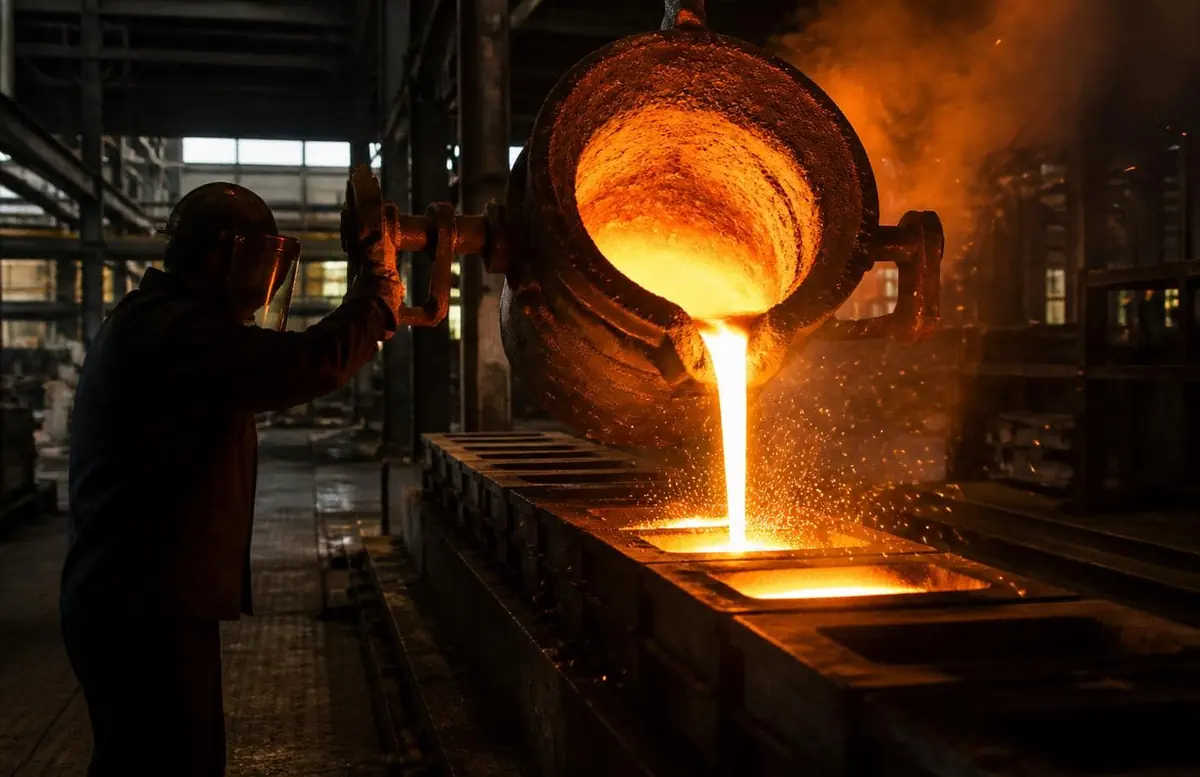
A doré bar's journey through an accredited refinery typically runs through two distinct purification technologies, chosen according to how pure the final product needs to be. The Miller process, developed in the 1860s and still in wide industrial use, bubbles chlorine gas through the molten doré; base metals react with the chlorine and are drawn off as chlorides, leaving behind gold at roughly 995 parts per thousand fineness within a matter of hours. It is fast, relatively cheap, and produces exactly the purity required for London Good Delivery large bars, which is why it remains the workhorse process for the bulk of the world's newly mined gold.
Where a higher purity is required — for the 999.9-fine kilobars that dominate much of the Asian retail and jewellery market, or for specialised industrial and electronics applications — refiners turn to Wohlwill electrolysis, a slower and more capital-intensive process in which impure gold is dissolved as an anode in an electrolytic cell and re-deposited as pure metal at the cathode, leaving silver and base metals behind in the solution and anode slime. Wohlwill refining can push purity above 999.9 fine, but it ties up substantially more metal inventory for longer and costs considerably more per unit processed, which is why refiners run Miller and Wohlwill lines side by side, routing material to whichever process matches the fineness the end customer actually needs.
- Miller chlorination: fast, cost-effective, reaches roughly 995 fine — the London Good Delivery standard for large bars.
- Wohlwill electrolysis: slower and more expensive, reaches 999.9 fine or better — required for premium kilobars and specialised industrial uses.
- Fire assay (cupellation): the reference method used to verify fineness precisely, treated as the final arbiter in disputes over a bar's actual purity.
- Every batch is independently sampled and assayed before a refiner will stamp and certify the resulting bars, regardless of which purification method was used.
Assay: measurement as the industry's real product
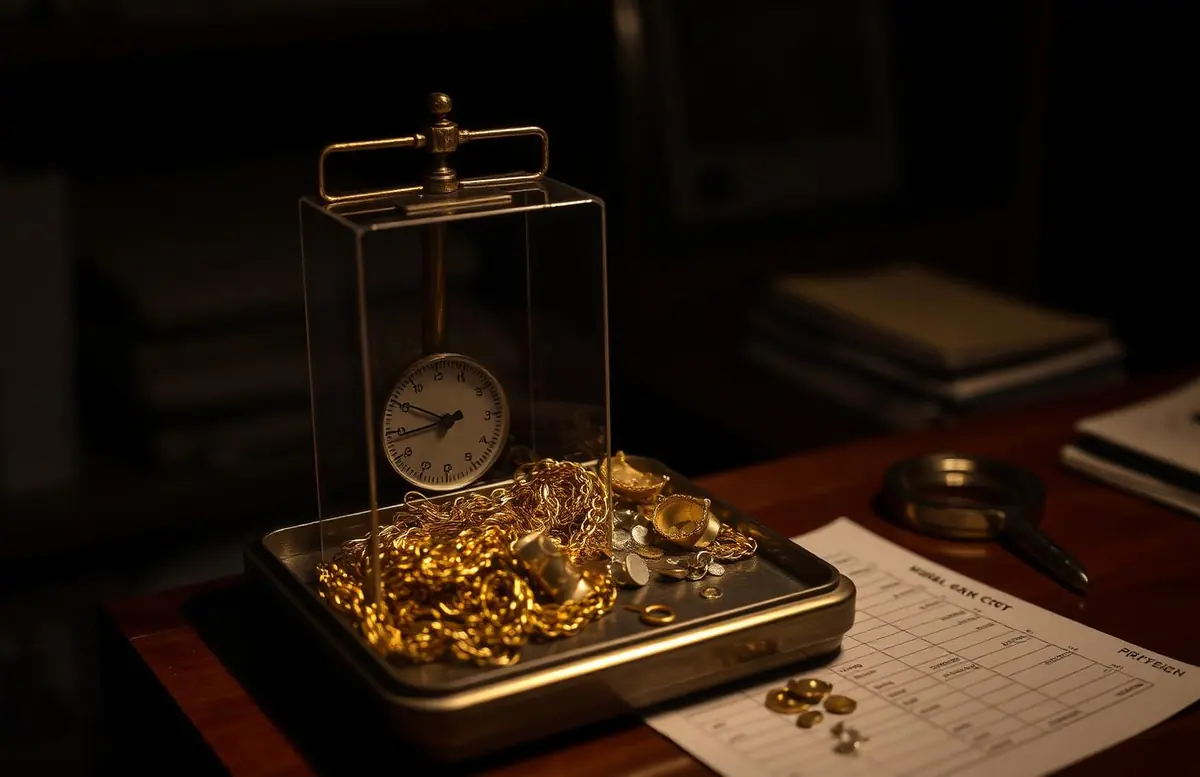
If refining is the industry's chemistry, assay is its epistemology — the set of measurement practices by which a refiner and, ultimately, the wholesale market can state with confidence exactly how much gold sits inside a given bar. The reference method remains fire assay, or cupellation, a technique with roots stretching back millennia: a sample of the metal is fused with lead and other reagents in a small clay cupel and heated in a furnace, the lead absorbing base metals and oxidising away while the precious metals remain as a small button that is then weighed with extraordinary precision. Modern refineries supplement fire assay with instrumental techniques — X-ray fluorescence for rapid non-destructive screening, inductively coupled plasma spectrometry for trace-element analysis — but fire assay remains the method trusted to settle disputes, because its underlying chemistry has not fundamentally changed since it was refined by medieval and early-modern assayers testing coinage.
“Every technology in this building is new except the one we trust most. When two numbers disagree, the fire assay wins, because it has never once been fooled by anything we've thrown at it in five hundred years of people trying.”
Good Delivery: a list, not a law
The mechanism that makes refined gold genuinely fungible at wholesale scale is not chemistry at all; it is a list. The London Bullion Market Association maintains the Good Delivery List, a register of refiners whose bars are accepted for settlement in the London market without independent re-assay, because each listed refiner has passed a rigorous initial accreditation process and continues to be monitored against ongoing standards covering technical competence, financial standing, and responsible sourcing practice. A refiner on the list can ship a bar to a bullion bank, a central bank or a vault operator anywhere in the world, and the counterparty will accept its stated weight and fineness on trust — the entire foundation of gold's status as the most interchangeable physical commodity in global finance.
Accreditation is deliberately difficult to obtain and, more importantly, is not a one-time achievement. Listed refiners are subject to ongoing proactive monitoring, including periodic reassay of production samples and audits of their sourcing due diligence, and the List's operators have both suspended and permanently removed refiners found to have fallen short, whether on pure technical grounds — bars that failed to meet stated fineness — or, increasingly over the past fifteen years, on responsible-sourcing grounds, following the discovery of inadequately traced or conflict-linked material entering a refiner's supply chain.
Switzerland's outsized role, and who is catching up
For most of the twentieth century, a small cluster of Swiss refineries handled a disproportionate share of the world's large-scale gold refining, a position built on early investment in Wohlwill electrolytic capacity, a reputation for technical rigour, and Switzerland's broader standing as a stable, discreet, financially sophisticated jurisdiction that both mining companies and central banks were comfortable dealing with. That concentration meant that for decades, an enormous share of the world's newly mined gold — from Latin American, African and Asian mines alike — passed through the same handful of Swiss furnaces before re-entering global circulation as internationally recognised bullion.
That dominance has eroded, gradually and then more sharply, as refining capacity has expanded closer to the sources of supply. The United Arab Emirates, and Dubai specifically, has built substantial refining and gold-trading infrastructure over the past two decades, positioning itself as a hub for gold moving out of Africa in particular, alongside growing capacity in India, China and elsewhere in Asia serving those countries' own enormous jewellery and investment demand directly rather than routing material through Europe first. The practical effect has been a genuine diversification of where the world's gold is actually refined, even as the accreditation standards that decide whose output the wholesale market will accept without question remain concentrated in the hands of a small number of internationally recognised bodies, chief among them the LBMA.
Responsible sourcing: the audit built on documents that are easiest to fake where it matters most
The most consequential change to refining practice over the past fifteen years has had nothing to do with chemistry and everything to do with paperwork. Following international concern over gold financing armed conflict in parts of Africa — echoing the earlier, better-known 'blood diamond' controversy — the OECD published due-diligence guidance for responsible mineral supply chains from conflict-affected and high-risk areas, and Good Delivery refiners are now required to build and maintain due-diligence systems that trace incoming gold back through its supply chain, flag red-flag indicators of illegitimate sourcing, and refuse or investigate material that cannot be adequately traced.
In principle, the system works by pushing responsibility down the chain: a refiner cannot simply accept a supplier's word that gold is legitimately sourced, but must document the chain of custody back toward the mine of origin, retain records, and submit to independent third-party audits of both its documentation systems and a sample of actual transactions. In practice, the weakest link sits precisely where verification is hardest and the incentive to falsify records is greatest — at the point where gold first enters the formal chain from artisanal, small-scale or conflict-affected mining areas, frequently through a series of local traders and intermediate export hubs whose own record-keeping is minimal, inconsistent or, in some documented cases, deliberately fabricated to disguise the metal's true origin.
- Formal, industrial mines with corporate ownership structures generate relatively strong, auditable documentation from extraction onward.
- Artisanal and small-scale mining, supplying a meaningful share of world output, typically generates weak or no formal documentation at the point of extraction.
- Gold is frequently mixed — legitimately and illegitimately sourced material blended together at trading hubs — well before it reaches an accredited refinery.
- Falsified export certificates and mislabelled countries of origin have been documented repeatedly by investigative researchers and by UN and NGO panels monitoring conflict-affected regions.
Refiners are not, for the most part, complicit in this system's weaknesses through deliberate negligence; the more common failure mode is a due-diligence process that is genuinely rigorous on paper and genuinely difficult to enforce against counterparties several steps removed in a chain the refiner does not control. A refinery can require documentation, run its audits, and reject material that raises clear red flags, and still receive gold that has been laundered through several layers of intermediate trading precisely to defeat exactly that kind of scrutiny. The system's honest failure point is not the refinery's furnace; it is the several hundred kilometres and several sets of hands between an artisanal pit and the refinery's loading dock, where the paper trail is thinnest and the audit's reach is weakest.
When accreditation is withdrawn
The commercial stakes of getting sourcing compliance wrong are severe and immediate. A refiner delisted from the Good Delivery register loses, in effect overnight, the ability to have its bars automatically accepted into the deepest and most liquid tier of the wholesale gold market, forcing it either to sell into lower-tier, discounted markets willing to accept unaccredited material, or to halt large-scale commercial refining altogether until it can demonstrate the corrective action required for reinstatement — a process that can take years and offers no guarantee of success. Several refiners across different jurisdictions have experienced exactly this consequence over the past decade and a half, following findings related either to sourcing failures or to technical non-compliance with fineness standards, and the swiftness of the commercial fallout in each case has reinforced, across the industry, just how seriously refiners treat ongoing compliance with accreditation requirements.
What the ledger actually protects
Step back from the furnaces and the audit committees, and the refiner's role in the gold supply chain resolves into something close to a single function: manufacturing fungibility out of geological and political chaos. Gold arrives at a refinery from a thousand different sources — industrial mines with immaculate paperwork, artisanal operations with almost none, recycled jewellery and electronic scrap of entirely unknown provenance, doré bars of variable and uncertain composition — and leaves as bars that are, by design, indistinguishable from one another to any buyer anywhere in the world, each one carrying the same guarantee of fineness and, increasingly, the same guarantee of legitimate sourcing.
That transformation is the genuinely valuable service the refining industry provides, and it is also the point in the chain where the system's honesty is most severely tested, because fungibility is precisely what allows illegitimately sourced gold to disappear into a pool of legitimately sourced gold the moment it is melted, assayed and re-stamped. Every improvement in responsible-sourcing practice over the past fifteen years has been an attempt to slow that disappearing act down — to force documentation to survive the melt even when the metal itself cannot carry any trace of where it came from once it has been poured into a new bar.
The unglamorous work that keeps the market honest
None of this is likely to change the experience of anyone buying a wedding ring or a small investment coin, who will never see a chlorination furnace or read a due-diligence audit report and has no particular reason to. But it is the reason that gold, alone among major commodities, can move seamlessly between a central bank vault, an exchange-traded fund's custodial account, a jeweller's display case and a small investor's safe deposit box, all treating the metal as functionally identical regardless of where on earth it was originally dug out of the ground. That seamlessness is manufactured, deliberately and continuously, by a small number of refineries and an even smaller number of accreditation bodies, working through processes that have not fundamentally changed in their chemistry for a century and are still, even now, only partially adequate to the documentation challenge the modern supply chain has placed in front of them.
The Chemistry of Recycled Gold: The Infinite Loop
While most of the focus in the gold trade is on newly mined metal, a significant and growing portion of the market is supplied by recycled gold — the 'infinite loop' of the industry. Because gold is chemically inert, it can be melted down and re-refined a thousand times without losing its purity or its value. The wedding ring of a Victorian bride, the bonding wire of a discarded 1990s motherboard, and the dental gold of a previous generation all eventually find their way back to the refinery. This 'secondary' supply accounts for roughly a quarter to a third of total annual gold supply, providing a critical buffer when mine production falls short or when high prices tempt consumers to part with their heirlooms.
Refining recycled gold is a fundamentally different business from refining doré. While mine-site doré arrives in large, uniform ingots with a relatively predictable range of impurities, recycled gold (often called 'scrap') arrives in a chaotic variety of forms. It might be high-purity jewellery, low-grade electronic waste, or 'sweeps' (the dust and filings from a jeweller’s workbench). Each of these requires a different pre-treatment process before it can enter the main refining circuit. Electronic waste, in particular, is a complex metallurgical challenge, containing not just gold but silver, palladium, copper, and a cocktail of hazardous materials that must be carefully managed. The 'urban mine' is vast, but it is far messier than the one in the desert.
The ethics of recycled gold have also come under intense scrutiny. In the wake of stricter 'conflict gold' regulations for mines, there have been concerns that some illicitly mined gold is being 'laundered' by being declared as scrap. Because scrap gold has no identifiable origin once it is melted, it is the perfect vehicle for metal that cannot pass a responsible-sourcing audit. Refiners have responded by tightening their due diligence on scrap suppliers, requiring them to prove that they are dealing in legitimate jewellery or industrial waste rather than 'pseudo-scrap' that is actually newly mined metal in disguise. The battle for a clean supply chain is now being fought at the jeweller’s counter as much as at the mine gate.
“Gold is the only commodity that is never truly consumed. We aren’t just refiners; we are the stewards of a multi-millennial inventory that just keeps coming back to us for a bath.”
Refinery Geopolitics: The Shift Eastward
For over a century, the axis of the gold refining world ran through Switzerland and London. The 'Big Four' Swiss refineries set the global standard for purity and trust, benefiting from Switzerland’s neutrality and its proximity to the world’s major bullion banks. However, the last two decades have seen a tectonic shift in the geography of the trade. As the centres of gold consumption have moved decisively toward Asia — driven by the insatiable demand for jewellery and investment bars in China and India — refining capacity has followed. Today, state-of-the-art refineries in Shanghai, Mumbai, and Dubai are challenging the dominance of the European giants, offering lower costs and faster turnaround times for the local markets.
Dubai, in particular, has emerged as a formidable hub, positioning itself as the 'City of Gold' for the 21st century. By building massive refining capacity and world-class logistics infrastructure, the UAE has become the primary transit point for gold moving out of Africa and toward the consuming markets of the East. This growth has not been without controversy; Dubai’s relatively light regulatory touch and its proximity to high-risk sourcing regions have led to repeated clashes with the LBMA and other Western accreditation bodies. The result is a 'two-tier' global market: a high-trust, high-compliance tier centred on London and Switzerland, and a faster-growing, more opaque tier centred on the new hubs of the East. The tension between these two worlds is the defining conflict of the modern gold trade.
This shift is not merely about where the metal is melted; it is about who sets the rules of the game. China’s Shanghai Gold Exchange now operates its own 'certified refiner' list, which is increasingly influential in the Asian market. If a refiner can sell all of its output to Chinese or Indian buyers who trust the Shanghai or Dubai standards, the threat of losing an LBMA 'Good Delivery' accreditation becomes less of an existential crisis. We are moving toward a multi-polar gold market where the Western monopoly on 'trust' is being challenged by new institutions that reflect the shifting economic balance of power. The refiner’s ledger is being written in more languages, and more scripts, than ever before.
50%+
Share of global consumer gold demand from China and India
40+
Number of accredited refiners on the Shanghai Gold Exchange list
$100B+
Estimated annual value of gold transiting through Dubai
10 days
Typical turnaround time for a high-volume Asian refinery
Blockchain in the Supply Chain: Mapping the Unseen
The greatest challenge facing the modern refinery is not metallurgical, but informational. In an era of radical transparency, 'trust us' is no longer a sufficient answer to questions about where a bar of gold came from. To meet this demand, the industry is increasingly turning to blockchain technology to create a 'digital passport' for every bar. The goal is to create an immutable, end-to-end record of the metal’s journey, from the specific mine site where it was extracted, through the transport and refining stages, to the final vault or retail customer. By linking the physical bar to a digital token that contains its entire audit trail, refiners hope to eliminate the possibility of conflict gold entering the system.
Several competing platforms are now vying to become the industry standard for this digital mapping. Some use DNA-based tracers or microscopic laser engraving to physically link the metal to its digital twin, ensuring that the two cannot be separated. Others rely on a 'chain of custody' model, where every participant in the supply chain — the miner, the transport company, the refiner, and the bank — must digitally sign off on the metal’s provenance. This creates a powerful deterrent for fraud, as any attempt to inject unverified metal into the system would leave a clear, permanent trail on the blockchain. The refiner, sitting at the chokepoint of the supply chain, is the natural gatekeeper of this new digital reality.
However, the 'last mile' of the supply chain remains the most difficult to map. While a multi-billion dollar industrial mine can easily integrate blockchain into its operations, a lone artisanal miner in a remote part of the Congo or the Amazon cannot. There is a risk that the push for digital transparency will effectively 'de-bank' the world’s most vulnerable miners, cutting them off from the formal market because they cannot provide the cryptographic proof that Western refiners now demand. The challenge for the next decade is not just building the technology, but ensuring that it is inclusive enough to support a truly responsible global trade. The refiner’s ledger is becoming a digital map of the world, but there are still many 'terra incognita' regions that no blockchain has yet reached.
- Digital passports provide a permanent, tamper-proof audit trail for every bar.
- Laser engraving and DNA markers link physical metal to its digital record.
- Smart contracts can automatically trigger payments to miners once their gold is refined.
- Provenance tracking reduces the risk of 'pseudo-scrap' laundering in the recycling market.
The refiner's ledger, in the end, is the least visible and most consequential document in the entire gold trade: a running, audited record of exactly what went into a bar and where it came from, standing behind every claim of purity the market makes and behind every promise that the metal in your hand, whatever its ultimate origin, is precisely what its stamp says it is.
Frequently asked
Questions readers ask
- What is doré and why can't it be sold directly?
- Doré is a semi-pure alloy of gold and silver, with residual base metals, poured into rough ingots at or near the mine site as the first stage of processing raw ore. Its exact composition varies from batch to batch and mine to mine, typically running somewhere between 60 and 90 per cent precious metal content. Because its purity is variable and unverified to wholesale-market standards, doré cannot be sold as investment-grade bullion; it must be shipped to an accredited refinery, assayed precisely and re-refined to a guaranteed fineness before it can enter the fungible bullion market.
- What does Good Delivery status actually certify?
- Good Delivery is a list, maintained by the London Bullion Market Association, of refiners whose bars are automatically accepted for settlement in the London wholesale gold market without further assay, because the refiner has demonstrated, through a rigorous accreditation process and ongoing proactive monitoring, a sustained record of accurate fineness, responsible sourcing and financial and operational stability. It is fundamentally a trust credential: it lets the market treat one refiner's bar as interchangeable with another's without re-testing every bar, which is what makes gold genuinely fungible at wholesale scale.
- Why are Swiss refineries so central to the gold trade?
- A handful of Swiss refineries built, over the twentieth century, an outsized share of the world's large-scale refining capacity, technical expertise in high-purity processes such as Wohlwill electrolysis, and — crucially — a reputation for rigorous, independently verifiable sourcing standards that the wholesale market came to rely on. Switzerland's role as a historically neutral, financially stable jurisdiction with strong rule of law reinforced that position, and Swiss refiners still process a very large share of the world's newly mined and recycled gold, though their historic dominance has eroded somewhat as refining capacity has expanded elsewhere.
- Has Dubai become a major refining centre, and why?
- Yes, substantially so over the past two decades. The United Arab Emirates, and Dubai in particular, has built significant refining capacity and become a major transit and processing hub for gold moving out of Africa and parts of Asia, offering proximity to those supply regions, favourable tax and regulatory treatment, and fast-growing logistics infrastructure. The growth has brought scrutiny alongside it: several investigations and reports by researchers and journalists have raised concerns about weaker enforcement of sourcing documentation for some gold transiting the region compared with the more established Swiss and London accreditation regimes, prompting UAE authorities to strengthen their own due-diligence requirements in response.
- How does conflict-gold auditing actually work?
- Refiners operating under recognised responsible-sourcing standards, built largely on OECD due-diligence guidance for conflict-affected and high-risk areas, are required to trace incoming gold back through its supply chain, identify red flags such as sourcing from armed-group-controlled mining areas or the use of intermediaries with no verifiable operations, and refuse or investigate further any material that cannot be adequately traced. Independent third-party auditors periodically review refiners' due-diligence systems and sampled transactions against these standards, and refiners that fail can lose Good Delivery accreditation.
- Where does the responsible-sourcing system actually break down?
- Almost entirely at the documentation stage closest to extraction. Large industrial mines with formal corporate ownership produce auditable paper trails relatively easily. Artisanal and small-scale mining, which supplies a meaningful share of global gold output, generates far weaker documentation, and gold from conflict-affected or poorly governed regions is frequently laundered through intermediate trading hubs, mixed with legitimately sourced material, or accompanied by falsified export documentation before it ever reaches a refinery's door — precisely the point in the chain where verification is hardest and where the incentive to falsify records is greatest.
- What happens if a refiner loses its Good Delivery accreditation?
- The commercial consequences are immediate and severe. A delisted refiner's bars are no longer automatically accepted for wholesale settlement in London, which effectively locks it out of the deepest and most liquid segment of the global gold market until, if ever, it can demonstrate corrective action and be reinstated. Because so much of the value of Good Delivery status lies precisely in not having to re-prove trustworthiness on every transaction, delisting functions less like a fine and more like an abrupt commercial exile, which is why refiners generally treat compliance with accreditation standards as an existential priority rather than a routine cost of doing business.