Verification
How Fake Gold Is Detected
Counterfeiting gold is not about making something that looks right. It is about defeating a specific test, and the industry's defences are an escalating conversation between forgers and instruments.
The popular image of gold fraud is a plated brick — something that looks right and fails the first serious test. Real counterfeiting is more disciplined than that, because the counterfeiter is not trying to fool a person. They are trying to fool a specific test at a specific point in the chain, and they know which test that is.
That reframing explains everything about how authentication has developed. Each defence closed a route; each closure pushed forgers towards a harder and more expensive one. The current state of play is an equilibrium in which sophisticated fakes are technically possible and economically marginal.
Why tungsten, and why it broke the old test
For most of history, density was sufficient. Gold is extraordinarily dense at 19.32 grams per cubic centimetre, and nearly everything cheap enough to substitute — lead at 11.3, copper at 8.96, brass lower still — is dramatically lighter. Weigh the object, measure its displacement, divide. A lead-cored bar of the right weight is visibly too large; one of the right size is far too light.
Tungsten ends that comfort. At 19.25 g/cm³ it sits within a third of one percent of gold, comfortably inside the error band of any field density measurement. It is cheap, industrially available, and — this is the part that matters — machinable into a core that can be encased in genuine gold. The resulting object has the correct mass, the correct dimensions, the correct density and a completely genuine surface.
The layered approach
No dealer runs one test. Authentication is a sequence, ordered by cost and speed, in which each stage is designed to catch a different class of forgery. A bar that reaches the end of the sequence has been examined by methods with independent physical bases, which is the actual source of confidence — not any single instrument.
- Visual and provenance check: refiner marks, serial number, casting texture, and whether the bar has a documented custody record. Most fakes fail here, on details a specialist notices instantly.
- Dimensional gauging: calipers to a hundredth of a millimetre against published mint or refiner specifications.
- Precision weighing: to 0.01 g, cross-checked against the stated fineness and nominal mass.
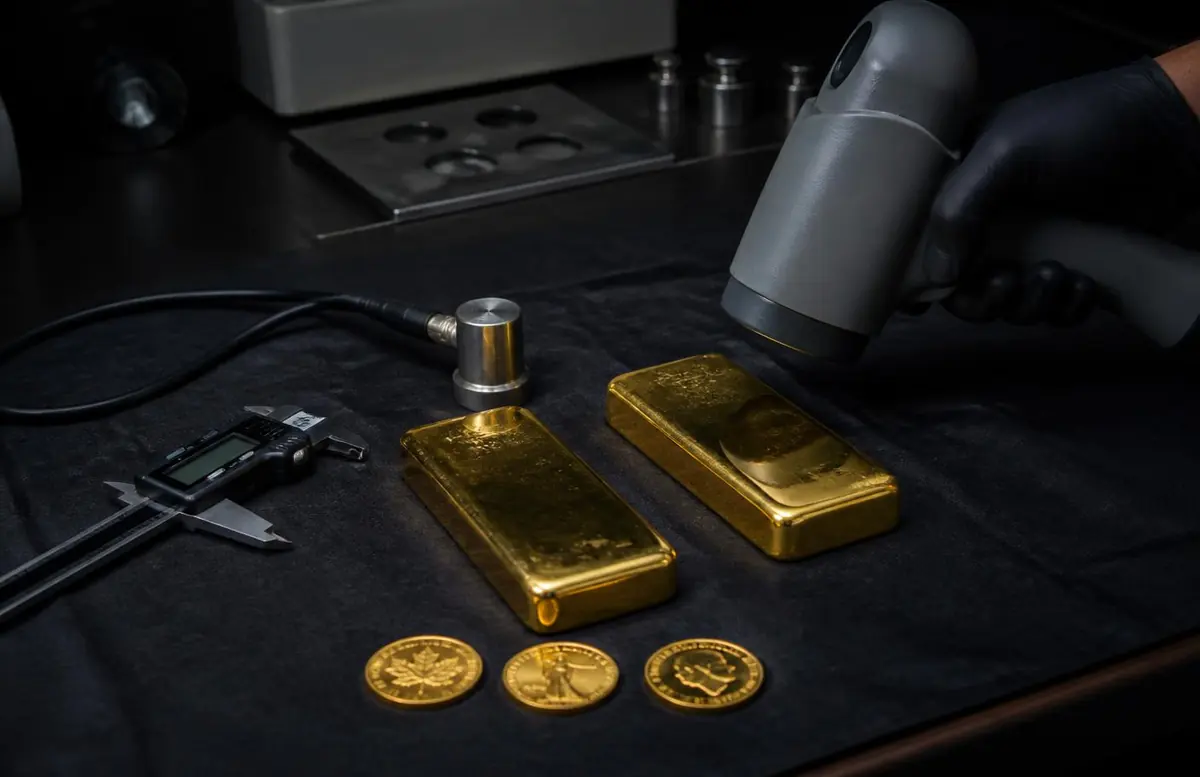
- XRF spectrometry: surface elemental composition in seconds, non-destructive.
- Ultrasonic velocity: transit time through the object, the primary defence against core filling.
- Conductivity or magnetic-response testing: eddy-current and related methods that probe deeper than XRF.
- Fire assay: destructive, definitive, and reserved for settlement disputes and refinery intake.
XRF: fast, non-destructive, and shallow
X-ray fluorescence works by exciting inner-shell electrons in the sample and reading the characteristic X-rays emitted as the atoms relax. The spectrum identifies elements present and quantifies them well. It takes seconds, requires no preparation, and damages nothing, which is why every serious dealing room owns one.
Its limitation is not a calibration problem to be solved but a physical one. The exciting radiation penetrates only tens of microns into a dense metal, and the fluoresced X-rays that escape come from the same shallow layer. A tungsten core under two millimetres of genuine gold produces a perfect 9999 reading, because the instrument is genuinely looking at 9999 gold — all of the gold it can see.
Ultrasound: listening to the inside
The technique that actually addresses core filling borrows from industrial non-destructive testing. A transducer couples to the bar's surface and emits a pulse; the instrument times the echo from the far face. Because thickness is known from the calipers, transit time yields the speed of sound through the material.
Gold transmits longitudinal sound at roughly 3,240 metres per second. Tungsten manages over 5,100. That is not a subtle difference requiring statistical judgement — it is a failed reading. A layered bar also produces an internal reflection at the interface between shell and core, which shows up as an anomalous intermediate echo. The test takes under a minute and costs a fraction of an assay.
19.32 / 19.25
Density of gold vs tungsten (g/cm³)
3,240 / 5,180
Sound velocity, gold vs tungsten (m/s)
~30 µm
Practical XRF sampling depth in gold
±0.01 mm
Dimensional tolerance a modern mint holds
Coins are a different problem
Bullion coins are, counter-intuitively, harder to counterfeit convincingly than bars, and the reason is manufacturing tolerance. A sovereign mint strikes to specifications published to a hundredth of a millimetre and a hundredth of a gram, from dies whose relief and lettering are executed at a standard that is expensive to reproduce.
A forger must therefore match diameter, thickness, mass and design simultaneously, in an object too thin to hide a useful core. Slide gauges — machined blocks that accept a genuine coin and reject anything outside tolerance — catch the overwhelming majority of fakes in seconds. What remains is die-quality forgery, which requires real tooling investment and tends to appear in numismatic rather than bullion markets, where a premium above metal content makes the effort worthwhile.
Fire assay, and why the old method survives
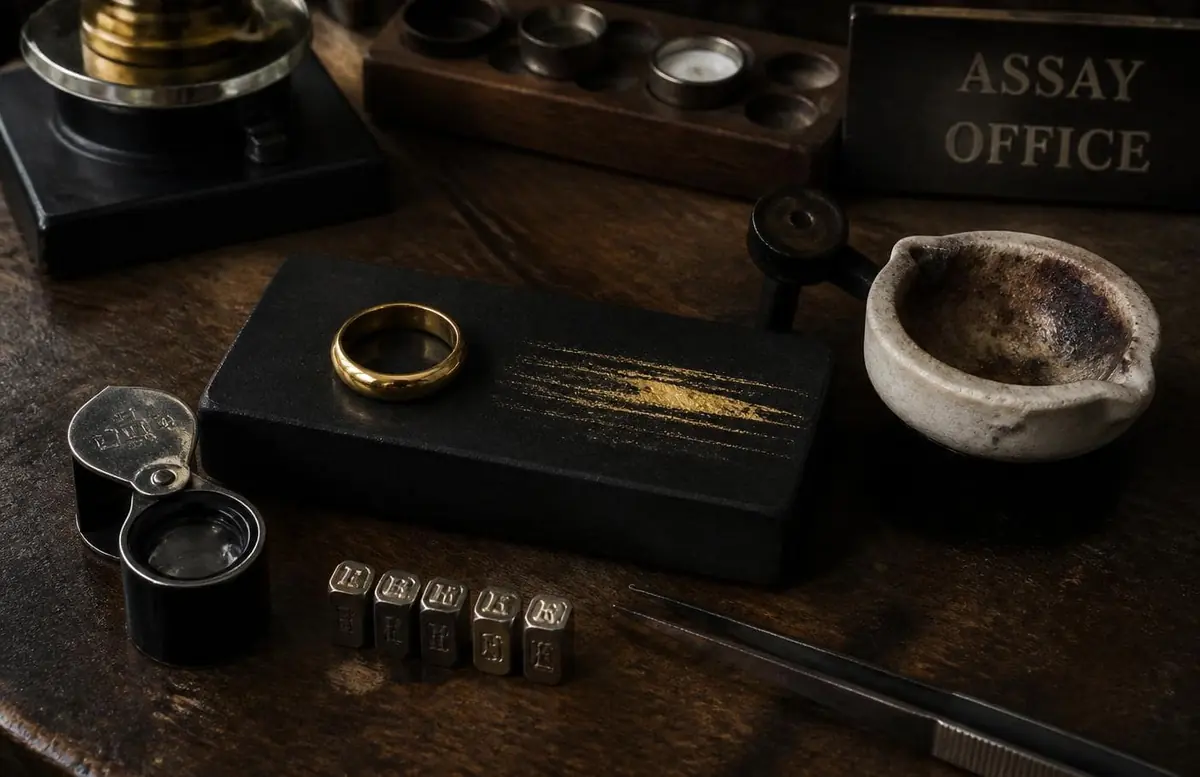
Everything above is a proxy. The reference method is cupellation, essentially unchanged in principle since antiquity. A drilled or cut sample is wrapped with silver and lead and fused in a bone-ash cupel; the lead oxidises and carries base metals into the porous cupel wall, leaving a precious-metal bead. The bead is parted in nitric acid to dissolve the silver, and the remaining gold is annealed and weighed.
It destroys the sample, takes hours, and is the only method that measures the entire sample rather than a surface, an echo or an electromagnetic response. Refineries assay on intake for exactly this reason, and every non-destructive instrument in the chain is ultimately calibrated against results obtained this way.
“Non-destructive testing tells you what to worry about. Assay tells you what you have.”
The practical conclusion
Sophisticated fakes are real, and they are also rare in the wholesale market, because the chain of integrity means that most institutional metal never leaves accredited custody and therefore never needs re-verification. Fraud concentrates where the chain is broken: private sales, informal dealers, and marketplaces where the buyer's only test is a photograph.
The defence that costs nothing is structural rather than technical. Buy within the accredited chain, keep the documentation, and treat any deep discount to spot as what it almost always is — a price that reflects a risk the seller understands better than the buyer does.
The tungsten problem, and why density alone stopped being enough
Tungsten is the reason modern verification is layered. Its density is 19.25 grams per cubic centimetre against gold's 19.32 — a difference of under half a percent, comfortably inside the tolerance of a shop-floor water-displacement test. A tungsten core clad in a substantial gold jacket therefore passes weight, passes dimensions, passes specific gravity, passes a surface acid streak and passes handheld XRF, because every one of those methods reads either the bulk average or the outer few microns.
What defeats it is any method that probes the interior. Ultrasonic velocity through gold and through tungsten differ substantially, so a pulse-echo instrument reports a discontinuity at the cladding boundary. Electrical conductivity measured by eddy current differs likewise. A drilled sample or a full melt settles it absolutely, at the cost of the item. The practical consequence is that no serious counterparty relies on a single test: the standard is one bulk method plus one sub-surface method, and a melt for anything entering the wholesale chain from outside it.
The three categories of fake, and which one should worry you
- Outright base-metal fakes — brass or gilded lead, defeated instantly by weight or a magnet-slide test, and aimed at buyers who test nothing.
- Clad and cored bars — a real gold shell over a density-matched core, expensive to make, aimed at large-value private transactions with no melt step.
- Counterfeit branding — genuine gold of the stated fineness in packaging that impersonates a well-known refiner, which is fraud against the brand rather than against the buyer's metal content.
- Underkarating — the quiet one: jewellery stamped 18-karat that assays at 16, where the theft is a few percent per item across thousands of items.
Underkarating is by volume the most costly of the four and generates the least alarm, because nothing about the piece looks wrong and only an assay reveals it. It is also the category that statutory hallmarking exists to suppress, which is why jurisdictions with independent assay offices and mandatory marking report materially different rates of purity fraud from jurisdictions where the maker stamps its own claim.
Why provenance is doing more work than testing
The direction of travel across the trade is away from testing individual items and toward never breaking the chain in the first place. Serialised bars with published registries, tamper-evident assay cards, vault records that track a specific serial from refinery to storage, and increasingly digital custody records mean that the metal most people transact never leaves an environment where its identity is documented.
That is also the honest limitation of the consumer-grade verification market. A pocket conductivity tester is a useful sanity check, but it is not the reason the wholesale market has so little fraud in it. The wholesale market has little fraud because metal that leaves the chain of integrity must be reassayed before it comes back, and everyone in the chain knows it.
How dealers price out the risk
A reputable bullion dealer prices two things simultaneously when they buy scrap or secondhand bars: the metal content, and the cost of the verification needed to be sure of it. That second cost is invisible in the headline spread but it explains why a dealer will pay closer to spot for a sealed, assay-carded bar from a recognised refiner than for an identical-looking bar with no papers, even when both, on testing, turn out to be genuine.
The economics of a melt
Melting a suspect item destroys any collector or numismatic premium and costs money, so dealers reserve it for cases where non-destructive tests disagree or where the item's origin is unclear enough that no other test will satisfy a buyer downstream. For a single coin the melt cost can exceed the value at stake; for a pallet of unverified bars entering a refinery's intake, it is simply routine processing.
Insurance and warranty as a substitute for testing
Large dealers increasingly manage counterfeit risk the way insurers manage any tail risk: by pricing a guarantee rather than inspecting every unit exhaustively. A dealer who buys back its own sold bars at spot, no questions asked, is implicitly betting that its outbound authentication was thorough enough that the return flow will rarely contain a fake — and pricing that confidence into the spread it charges on the way out.
- A tight buy-back spread from an established dealer is itself a signal: it means the seller trusts its own verification enough to re-accept the item without a fresh full test.
- A widening spread on unbranded or generic bars is a market-based tungsten tax — a price the whole category pays for the fraud risk a minority of items carry.
- Numismatic coins carry an additional layer of expert authentication (die analysis, provenance) beyond bullion-grade testing, because the premium above metal value is exactly what a forger of rare coins is chasing.
- Institutional buyers increasingly require a documented chain of custody rather than relying on any point-of-sale test at all, pushing verification cost upstream to the refinery.
What buyers get wrong
The most common mistake among first-time buyers is treating a single reassuring test as proof, when every individual test has a known and specific blind spot. A magnet test proves nothing about tungsten. A jeweller's acid streak proves nothing about a plated surface thicker than the acid can penetrate. A weight-and-callipers check proves nothing once the counterfeiter has matched density. Confidence should scale with the number of independent physical properties tested, not with the reassurance of any one result.
The second common mistake is anchoring on price. A seller offering bullion meaningfully below the prevailing spot price is not doing the buyer a favour; in the overwhelming majority of documented cases, a discount that large reflects either theft, forgery, or a seller under enough financial pressure to accept unfavourable terms rather than wait for a fair-value buyer, none of which are a good sign for anyone standing on the other side of the transaction.
The direction the technology is heading
The next generation of authentication is aimed less at testing an object harder and more at making the object self-describing. Refiners are embedding microscopic surface patterns, secure QR-linked serial records and, in some cases, sub-surface markings readable only by proprietary scanners, so that a bar can be checked against a manufacturer's own database rather than relying solely on generic physical testing.
None of that displaces the physics discussed above; a marked bar with a tungsten core is still a fraud, and still needs an ultrasonic check to prove it. What the new layer adds is speed and confidence at the point of sale for buyers who are not equipped to run a full sequence themselves, shifting the burden of proof from the buyer's toolkit to the refiner's records — which is, in miniature, the same trend already reshaping bullion logistics more broadly: less reliance on testing an object, more reliance on never letting its identity become uncertain in the first place.
Seconds
Typical time for an ultrasonic core-fill check
Hours
Typical turnaround for a destructive fire assay
0
Reported forgeries within unbroken LBMA chain-of-custody bars
Rising
Trend in serialised, database-linked bar authentication
Jewellery: the fraud that hides in plain sight
Bars and coins get the headlines because a tungsten core is a dramatic story, but the fraud that moves the most money quietly through the retail trade is simpler: karat fraud in jewellery. A piece stamped 18-karat (750 fineness) that actually assays at 14- or 15-karat cheats the buyer by a fixed percentage of the item's declared gold content, and because the difference is invisible to the eye, to a magnet, and often to a casual acid streak test, it survives in circulation indefinitely unless someone submits the piece for a proper assay.
The scale is what makes it significant. A single underkarated ring cheats a buyer by a modest sum; underkarating applied systematically across a manufacturer's output, or across an entire regional market with weak enforcement, represents a transfer of value from consumers to producers that dwarfs the total value ever recovered in bar-counterfeiting cases, precisely because nobody tests a wedding ring the way a bank tests a bar.
Why hallmarking regimes differ so much in effectiveness
Jurisdictions with compulsory, independent assay-office hallmarking — where a government or delegated body tests and marks an item before it can legally be sold at a stated fineness — report materially lower rates of purity fraud than jurisdictions relying on maker's-mark self-certification. The difference is structural rather than cultural: self-certification asks the party with the incentive to overstate fineness to also be the party who verifies it, while independent hallmarking inserts a disinterested tester between the claim and the sale.
Even robust hallmarking systems are not immune to fraud at the margins — counterfeit hallmarks and altered marks exist — but they change the economics meaningfully: forging a government assay mark convincingly is a materially harder and more heavily penalised crime than simply overstating fineness on a self-applied stamp, so enforcement effort concentrates on a smaller and more tractable problem.
Why sophisticated bar fraud stays rare: the economics of getting caught
A tungsten-cored Good Delivery-format bar is a serious undertaking: sourcing tungsten stock, precision-machining a core, casting or fitting a gold shell of sufficient thickness to defeat casual XRF and visual inspection, and replicating a credible refiner stamp and serial number well enough to pass initial handling. The unit economics only work at meaningful scale and against a buyer who will not run an ultrasonic or conductivity check — which describes almost nobody inside the accredited wholesale chain and a shrinking share of private buyers as awareness spreads.
That is the real explanation for why confirmed cases of core-filled Good Delivery bars remain rare relative to the enormous tonnage that moves through the market each year. It is not that the fraud is technically difficult in isolation — the physics has been understood for decades — it is that the fraud only pays if it defeats the buyer's actual test, and the set of buyers who skip sub-surface testing on a large purchase is small and shrinking. Fraud migrates instead to markets where testing is weak: informal private sales, cash transactions between individuals, and regions where sub-surface testing equipment is scarce or expensive.
A short history of the arms race
Gold counterfeiting is as old as gold currency itself — Roman and medieval authorities executed people for clipping and debasing coinage, and touchstones and specific-gravity balances go back centuries as counter-measures. What has changed is the sophistication available to a well-resourced forger and, in response, the sophistication available to a well-equipped dealer, and the two have moved together rather than one simply defeating the other permanently.
Tungsten substitution is a late-twentieth and early-twenty-first century development, made practical by cheap tungsten stock and precision machining tools that were previously available only to specialist manufacturers. Ultrasonic and conductivity testing as a routine bullion-trade defence is a direct, comparably recent response, adopted broadly across major dealers and refiners only after several high-profile discoveries of core-filled bars made the risk concrete rather than theoretical. The pattern is consistent across the whole history of the trade: a new substitution technique appears, causes losses, and is answered within a few years by a test aimed specifically at the physical property the substitute cannot replicate.
Centuries
Documented history of gold coin clipping and debasement
2012
Year multiple tungsten-filled bar discoveries drew wide industry attention
750
Standard millesimal fineness mark for 18-karat gold
Independent
Type of assay office associated with lower jewellery fraud rates
Training the eye: how professionals learn to spot fakes fast
Experienced dealers develop a fast, largely tacit first-pass judgement — the weight of a coin in the hand, the ring it makes when tapped, the precise colour of genuine bullion under a specific light — that catches a surprising share of crude fakes before any instrument is used. This is not mysticism; it is pattern recognition built from handling thousands of genuine items, and it is the reason apprenticeship on a trading floor still matters even in an era of handheld analysers. The instinct catches what looks wrong; it never replaces the instruments that prove what actually is wrong.
Professional bodies and major refiners run structured training precisely because tacit skill alone is unreliable and un-transferable: a new hire cannot inherit a veteran's calibrated hands, but can be taught, systematically, which physical property each instrument tests, which forgeries defeat which tests, and why the sequence matters. That formalisation of what was once informal trade knowledge is itself part of the story of how the industry has professionalised its response to an increasingly capable adversary.
What buyers can realistically do at each price point
The appropriate level of verification scales with the transaction, and treating every purchase as though it warrants a full laboratory sequence is neither necessary nor realistic. A small piece of jewellery bought from an established retailer with a hallmark is adequately protected by the hallmarking system itself. A single bullion coin from a reputable dealer is reasonably covered by that dealer's own reputation and buy-back policy. A large private purchase of bars, especially outside an accredited dealer network, is exactly the transaction that justifies paying for an independent ultrasonic or XRF check before money changes hands.
- Retail jewellery: rely on hallmarking and buy from retailers who will accept independent assay if asked, rather than testing every item yourself.
- Bullion coins from an established dealer: dimensional and weight checks plus dealer reputation are normally sufficient; request an XRF reading for anything unusual.
- Bars from an established, accredited dealer: confirm serial number, assay card and chain-of-custody documentation; testing beyond that is rarely necessary within the accredited chain.
- Any private, informal or secondhand purchase of significant value: commission an independent ultrasonic or conductivity test before paying, regardless of how reputable the seller appears.
The unifying principle across every price point is the same one that runs through the whole authentication industry: match the rigour of the check to the size of the loss if the check is skipped, and never let a seller's confidence substitute for a buyer's own verification on anything that cannot easily be reversed.
Frequently asked
Questions readers ask
- Does a magnet test prove gold is real?
- It disproves some fakes and proves nothing. Gold is diamagnetic, so it is not attracted to a magnet, but neither are the copper, brass, lead or tungsten alloys used in the better forgeries. A magnet catches only crude steel-cored fakes.
- Why can a fake bar have exactly the right weight and size?
- Because tungsten has a density of 19.25 g/cm³ against gold's 19.32 — a difference of about a third of a percent. A tungsten core wrapped in a genuine gold shell can be machined to the correct mass and dimensions simultaneously, which is what defeats the classic Archimedes test.
- Is XRF enough to authenticate a bar?
- No. X-ray fluorescence excites atoms only in the outermost tens of microns, so a plated or shelled fake reads as pure gold. XRF is excellent for detecting alloy fraud in jewellery and for confirming surface fineness; it is structurally incapable of seeing a core.
- What does ultrasonic testing actually measure?
- The speed of sound through the object. Longitudinal velocity in gold is roughly 3,240 metres per second; in tungsten it is over 5,100. A probe that measures transit time against a known thickness will flag a core-filled bar immediately, even when density, dimensions and surface assay all pass.
- What is fire assay and why is it still used?
- A cupellation method dating to antiquity: the sample is fused with lead, oxidised in a bone-ash cupel that absorbs base metals, and the remaining precious bead is parted and weighed. It destroys the sample and takes hours, and it remains the reference standard for settlement because it measures the whole sample rather than a surface or a proxy.
- How common is underkarated jewellery compared with fake bars?
- Far more common in aggregate value, even though it attracts less attention. A tungsten-cored bar is a rare, deliberate, high-value fraud; a batch of jewellery stamped 18-karat that actually assays at 15 or 16 is quiet, distributed across thousands of pieces, and usually only discovered when the item is later sold and independently assayed.
- Does hallmarking guarantee a piece of jewellery is genuine?
- It substantially improves the odds where an independent assay office applies the mark, because the maker's own claim is checked by a third party before sale. It guarantees little where the maker self-certifies, which is why purity fraud rates differ measurably between jurisdictions with compulsory independent hallmarking and those without.
- Can a home test kit reliably detect a fake gold bar?
- It can catch crude fakes — base metal, heavy gold plate, obvious density mismatches — but it cannot detect a well-made tungsten-cored bar, because acid streak tests and simple electronic testers only sample the surface. A home kit is a useful first filter, not a substitute for an ultrasonic or assay-based check on any high-value purchase.