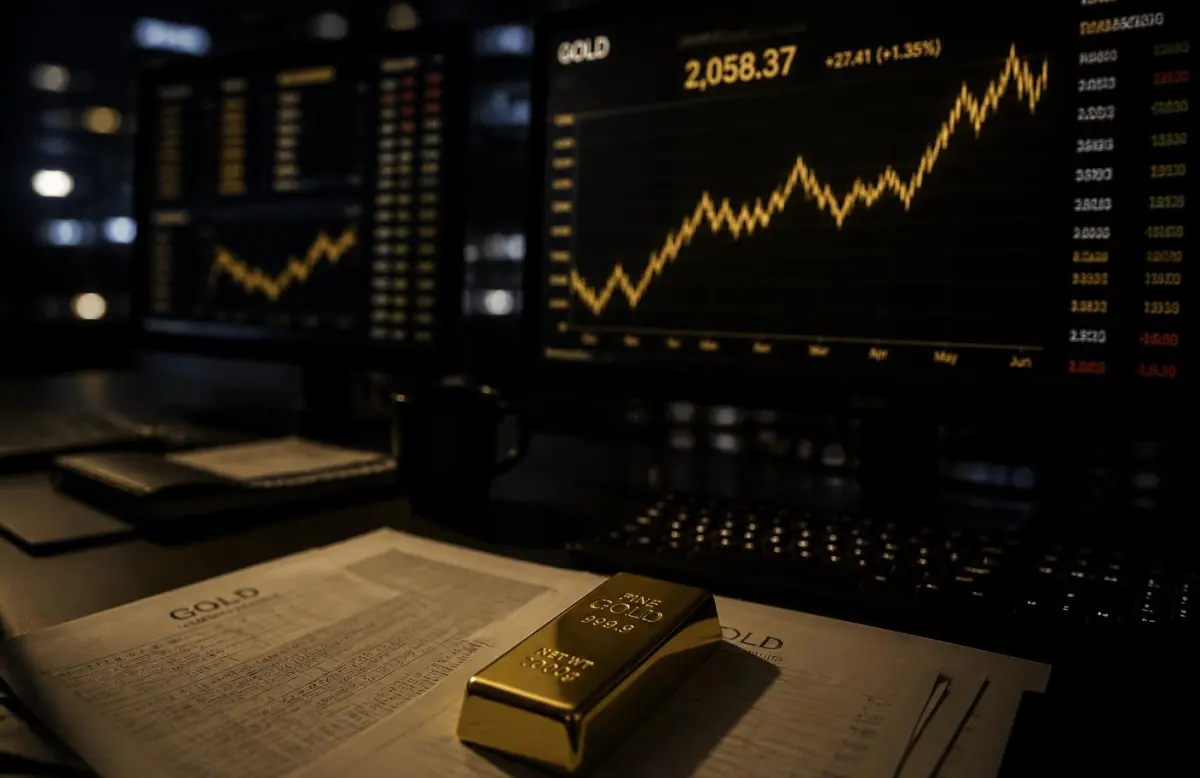
Synthetic Gold
Made, Not Mined: Synthetic Gold and the Future of the Global Gold Trade
For two thousand years, making gold was the definition of a fool's errand. Physicists can now do it — in particle colliders, in reactors, and soon, some start-ups claim, as a by-product of fusion power. What follows is a sober look at what synthetic gold really is, what it costs, and whether it could ever unsettle a market built on the idea that gold cannot be made.
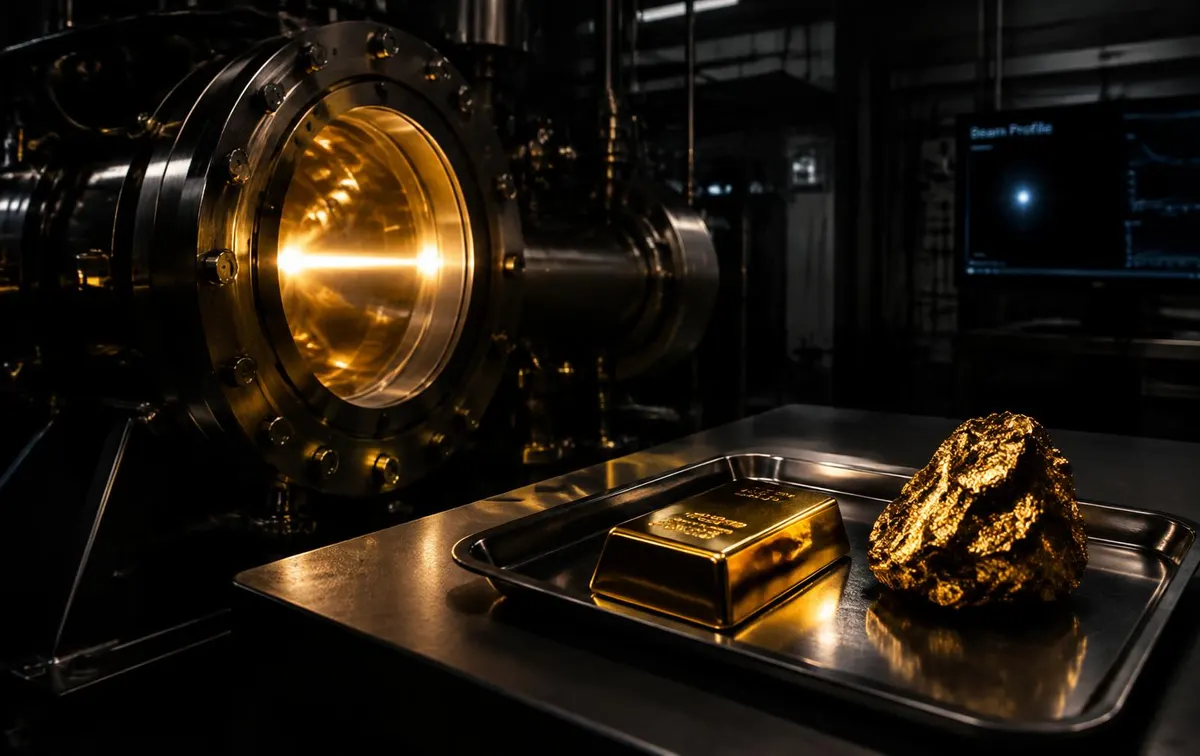
There is an old joke among metallurgists that every generation rediscovers alchemy and every generation goes broke doing it. The medieval adept boiling mercury and sulphur in a sealed flask, the eighteenth-century court chemist promising his prince a furnace full of ducats, the twentieth-century fraudster selling 'gold-making' machines to credulous investors — all were chasing the same impossibility. Gold, the joke goes, is the one thing you cannot make. That is why it is worth anything at all.
The joke is now, strictly speaking, out of date. Physicists have been making gold for more than eighty years. They have done it in nuclear reactors, in particle accelerators and, most spectacularly, in the Large Hadron Collider, where in 2025 researchers reported that glancing collisions between lead nuclei had knocked out exactly the three protons needed to leave gold behind. A small number of start-ups now talk openly about producing gold by the tonne as a by-product of fusion power. The headlines have followed — 'alchemy achieved', 'the end of gold mining', 'could science crash the gold price?' — and with them a steady stream of questions to this magazine from readers who own gold, sell gold or simply wonder whether the oldest store of value on Earth is about to be engineered into irrelevance.
This piece is an attempt to answer those questions without either the breathlessness of the headlines or the reflexive dismissal of the gold industry. It sets out what synthetic gold actually is, how it has been made, what it would cost to make in quantity, which of the newer proposals deserve to be taken seriously, and — the question that matters most to the trade — what its arrival, if it ever comes, would and would not do to the market for the metal.
First, a definition: what 'synthetic gold' is and is not
The phrase is used loosely enough to cause real confusion, so it is worth being precise. Gold is element 79: every atom of gold has 79 protons in its nucleus. Almost all natural gold is a single isotope, gold-197, with 118 neutrons. 'Synthetic gold' in the scientific sense means gold-197 — or other gold isotopes — created by changing the nucleus of another element. Once any unstable by-products have decayed away, the result is not a substitute or a simulant. It is gold, with the same density, colour, conductivity, malleability and resistance to corrosion as metal dug from the Witwatersrand.
That makes synthetic gold fundamentally different from three things it is often lumped together with. Imitation gold — brass, 'Nordic gold' coin alloys, tombac, gilding metal — is a different material made to look golden. Gold-plated or gold-filled items are base metal with a thin layer of real gold on the surface. And so-called 'lab-grown gold' in jewellery advertising is, almost always, simply recycled gold that has been refined in a laboratory setting and given a modern-sounding label. None of these involves nuclear physics, and none would pass a fire assay as pure gold.
The distinction matters for the trade because the first three categories are old, well understood and covered by existing hallmarking and consumer-protection law. The fourth is new, and the rules that would govern it — how it is assayed, labelled, accepted by the London market or taxed — do not yet exist in any jurisdiction. That gap, rather than any immediate effect on price, is where the synthetic gold story touches the real economy first.
Why gold was so hard to make
The alchemists were not stupid. They were working at the wrong scale. Chemistry rearranges electrons; it can join atoms into molecules and pull them apart again, but it cannot change the number of protons in a nucleus, which is what decides which element an atom is. Turning lead or mercury into gold is a nuclear operation, requiring energies around a million times greater than those of any chemical reaction. No furnace, acid or catalyst available to a sixteenth-century laboratory could come close.
The irony is that the alchemists' favourite starting materials were, in nuclear terms, sensible choices. Mercury, element 80, sits immediately next to gold in the periodic table; strip one proton from a mercury nucleus, or convert one proton to a neutron, and you can arrive at gold. Platinum, element 78, sits on the other side. Lead, element 82, is three protons away. The intuition that these heavy, dense, lustrous metals were close relatives of gold was correct. The tools were missing.
Those tools arrived in the twentieth century in the form of neutron sources and particle accelerators. Once physicists could fire neutrons, protons or other nuclei at a target with enough energy, transmutation became routine — the same physics that makes medical isotopes in hospital cyclotrons and turns uranium into plutonium in reactors. Making gold specifically was never a priority, because there was no scientific reason to want it and no economic reason either. But it was done, more or less as a demonstration, on several occasions.
A short history of making gold for real
1941: mercury in the cyclotron
The first well-documented production of gold isotopes from another element came from fast-neutron bombardment of mercury in American cyclotron experiments around 1941. The gold produced was radioactive — isotopes that decayed within days — and in quantities measured by counting radiation rather than by weight. It was a footnote in nuclear physics, but it settled the ancient question in principle: base metal could be turned into gold. It simply could not be done profitably.
1980: Seaborg and bismuth
The most famous demonstration came at the Lawrence Berkeley Laboratory in 1980, when a team including the Nobel laureate Glenn Seaborg used the Bevalac accelerator to bombard bismuth, element 83, with high-energy carbon and neon nuclei. Collisions chipped protons and neutrons off the bismuth, leaving among the debris a few thousand atoms of gold, including stable gold-197. Seaborg later estimated that producing an ounce of gold this way would cost something on the order of a quadrillion dollars at the time. The experiment was a triumph of nuclear chemistry and a definitive answer to anyone hoping accelerators might become money machines.
“It would cost more than one quadrillion dollars per ounce to produce gold by this experiment.”
Reactors: gold as a nuisance
In research and power reactors, gold appears less as a goal than as a by-product and, occasionally, a nuisance. Neutron capture by platinum or mercury impurities can yield gold isotopes, and gold foils are themselves widely used in reactors as neutron detectors precisely because gold-197 readily absorbs neutrons and becomes radioactive gold-198, whose decay can be measured. In other words, reactor physicists have spent decades turning gold into other things — mostly mercury — rather than the other way round. The reverse direction, mercury into gold, is possible, but requires the right isotope and the right neutron energies.
2025: the LHC and the gold flash
In May 2025 the ALICE collaboration at CERN published an analysis of so-called ultra-peripheral collisions at the Large Hadron Collider, in which lead nuclei travelling at almost the speed of light pass close to one another without actually hitting. The intense electromagnetic field around each nucleus can knock protons out of its neighbour. Remove three protons from lead-208, and the remainder is a gold nucleus. Across the collider's second operating run, from 2015 to 2018, the team estimated that roughly 86 billion gold nuclei had been created in this way — a total mass of around 29 picograms, or 29 trillionths of a gram. Each nucleus existed for a tiny fraction of a second before slamming into the collider's beam pipe or collimators and fragmenting.
The result was physics of real value: understanding these electromagnetic dissociation processes matters for beam losses and machine protection in colliders. As a contribution to the world's gold supply it was, by an astonishing margin, the most expensive gold ever produced. It also, inevitably, generated the latest round of 'alchemy solved' headlines — and, for the first time in a generation, prompted gold traders to ask their analysts whether any of this mattered.
1941
First documented production of gold isotopes by bombarding mercury
1980
Seaborg's team transmutes bismuth into a few thousand gold atoms at Berkeley
~29 pg
Total gold created in LHC lead collisions over 2015–2018, per CERN's ALICE team
≈216,000 t
Estimated above-ground stock of mined gold ever produced
The fusion proposal: gold as a by-product of clean power
What changed the conversation in 2025 was not the collider result but a paper from Marathon Fusion, a San Francisco start-up working on fuel-cycle technology for future fusion reactors. Its researchers argued that fusion power plants, which produce enormous fluxes of high-energy neutrons, could be designed to turn mercury into gold as a valuable by-product of electricity generation. The proposal was released as a preprint and had not, at the time of its publication, been peer-reviewed. It nonetheless drew attention from physicists, investors and, quietly, the gold industry, because it was the first serious attempt to put production numbers on synthetic gold at an industrial scale.
How the reaction would work
The idea centres on a single isotope, mercury-198, which makes up roughly ten percent of natural mercury. Most designs for deuterium-tritium fusion plants surround the reacting plasma with a 'blanket' that captures neutrons, both to extract heat and to breed fresh tritium fuel from lithium. Marathon's proposal places mercury enriched in mercury-198 inside that blanket. A fast fusion neutron striking mercury-198 can knock out a second neutron — a so-called (n,2n) reaction — leaving mercury-197. Mercury-197 is unstable and, with a half-life of about 64 hours, decays into stable gold-197. In principle the plant would periodically extract the mercury, chemically separate the gold that had formed, and return the mercury to the blanket.
On the company's modelling, a fusion plant of one gigawatt thermal output could produce on the order of five tonnes of gold a year without significantly compromising its primary job of making electricity and breeding fuel. At gold prices of the time, that output would be worth hundreds of millions of dollars annually — enough, the authors suggested, to roughly double the revenue of a fusion power station and materially improve the economics of a technology that has always struggled to compete on cost.
Why physicists are interested — and cautious
Specialists who reviewed the proposal publicly were broadly agreed on two points. The nuclear reaction itself is real and well characterised; nobody doubts that fast neutrons on mercury-198 make gold. What is uncertain is almost everything around it. A working commercial fusion power plant does not yet exist. Every gram of neutron flux devoted to gold is, at the margin, a gram not devoted to breeding tritium, without which a deuterium-tritium plant cannot refuel itself. Placing a heavy liquid metal in a reactor blanket raises materials, safety and licensing questions. And enriching mercury-198 at scale would require isotope-separation capacity that does not currently exist and would carry its own costs.
There is also the matter of what else forms in the blanket. Neutron reactions on mercury yield not only stable gold but radioactive isotopes, including gold-196 and gold-198 and a range of mercury isotopes. Some of these decay in days. The proposal suggested holding product gold in storage for a period — some commentators discussed figures of up to around fourteen to eighteen years for full regulatory comfort, depending on the impurity profile and jurisdiction — before it could be sold as ordinary, non-radioactive metal. That is a long time to tie up inventory, and it makes 'fusion gold' a product whose first bars would be sold well after the first plants switched on.
“It is impressive to see that our detectors can handle head-on collisions producing thousands of particles, while also being sensitive to collisions where only a few particles are produced at a time, enabling the study of rare electromagnetic 'nuclear transmutation' processes.”
When could it matter?
Timelines for commercial fusion have a long history of slipping, and even the more optimistic private developers talk about first grid-connected demonstration plants in the 2030s, with any meaningful fleet arriving later still. If one adds the time to enrich feedstock, license a mercury blanket, run it, extract product and cool it, the earliest date at which fusion gold could plausibly reach the market in tonnage is likely to sit somewhere in the 2040s or beyond. That does not make it irrelevant to a long-term holder of gold — forty-year horizons are normal for central banks and pension funds — but it does place it firmly in the category of structural risk rather than market event.
What it would cost: the economics of making an ounce
Every method of making gold has to clear the same bar: the market price. In late 2026, with gold trading at historically high levels, that bar is higher than ever, which is one reason synthetic gold has attracted renewed attention. But the cost structures of the different routes are wildly different, and only one of them comes within shouting distance of profitability, even on paper.
Accelerator transmutation is the least economical. The proportion of beam energy that ends up producing gold nuclei is tiny; most of it goes into heat, other fragments and radioactive waste. The Berkeley and CERN experiments were not trying to be efficient, but no conceivable optimisation brings the cost per gram anywhere near commodity territory. Fission reactors are somewhat better, because neutrons are abundant, but the neutrons they produce are mostly of the wrong energy for the efficient mercury-198 route and are needed for sustaining the chain reaction. A dedicated fission gold-maker would be burning valuable neutrons and uranium fuel to produce a metal worth far less than the electricity that could be generated instead.
Fusion is different chiefly because deuterium-tritium fusion produces neutrons of very high energy — around 14 million electron volts — which are well suited to the (n,2n) reaction on mercury-198, and because a fusion plant must surround its plasma with a neutron-absorbing blanket in any case. Gold production would be a modification to something the plant already has to do. That is why the economics look plausible on paper: the marginal cost of making gold falls dramatically when the neutrons are a by-product of a power station that pays for itself by selling electricity.
- Isotope enrichment: separating mercury-198 from natural mercury at industrial scale is energy-intensive and has never been done in tonnage.
- Opportunity cost: neutrons used to make gold cannot breed tritium fuel or contribute as fully to power output.
- Chemical separation: gold must be recovered from highly radioactive mercury in hot cells, adding handling and waste costs.
- Storage: product gold may need to be held for years to allow radioactive isotopes to decay before sale.
- Regulation and insurance: licensing a new nuclear product stream would be slow and costly in every major jurisdiction.
- Capital: none of this can begin until a fusion plant exists, is financed and runs reliably.
Set against a mine, the comparison is instructive. A typical modern gold mine reports all-in sustaining costs — the industry's preferred measure of what it costs to keep producing an ounce — that have historically sat well below the market price, giving the industry healthy margins at current prices. A mine also produces gold the market already knows how to accept, without a cooling period or a regulatory question mark. For synthetic gold to compete, it does not merely need to be cheaper than the market price; it needs to be cheaper than the marginal mine, accepted by buyers, and produced at a volume large enough to matter. None of these conditions is currently met, and only the fusion route offers a theoretical path to meeting all three.
The diamond comparison, and why it mostly fails
Whenever synthetic gold comes up, someone mentions diamonds. It is an understandable reflex. Laboratory-grown diamonds — real diamond, carbon in the same crystal structure as mined stones, made by high-pressure or chemical-vapour-deposition processes — moved from industrial curiosity to mass-market jewellery in barely a decade. Their prices collapsed as production scaled, and they dragged the price of many categories of natural diamond down with them. Major mining houses wrote down diamond assets, and the industry's long-standing scarcity narrative took lasting damage. If it could happen to diamonds, the argument runs, why not gold?
The answer lies in the differences, and they are substantial. Diamonds have no meaningful monetary role. Nobody holds diamonds as a reserve asset; central banks do not buy them; there is no deep, liquid, standardised market in which a one-carat stone can be sold at a transparent price in seconds. Diamond prices were always partly a product of managed supply and brilliant marketing, which made them unusually exposed to a cheaper, identical substitute. Crucially, a diamond is consumed as jewellery and rarely resold, so there is no huge above-ground stock acting as a price anchor.
Gold is the opposite on almost every count. Its above-ground stock — about 216,000 tonnes by the most commonly cited estimates — represents nearly all the gold ever mined, because gold does not corrode and is overwhelmingly recycled rather than lost. Annual mine supply of around 3,600 tonnes adds less than two percent a year to that stock. The price is set not by how much new gold appears each year but by the willingness of holders of the existing stock to sell or buy. Even a fusion industry producing several tonnes per plant would need dozens of plants running for years before it added as much as a single year's worth of mining — and the effect on a stock of 216,000 tonnes would be modest.
≈3,600 t
Approximate annual gold mine production in recent years
<2%
Mine supply as a share of the existing above-ground gold stock each year
~5 t/yr
Gold output per gigawatt fusion plant, on Marathon Fusion's own optimistic modelling
~36,000 t
Gold held by central banks — none of it by any means a diamond-style consumer good
The jewellery segment is the one place where the diamond comparison carries some weight. If synthetic gold were cheap, abundant and accepted, jewellers could in principle market it as 'new' or 'mine-free' gold, much as lab diamonds are sold as conflict-free. But here the economics cut differently, too. A lab diamond is cheap because the process of growing it is now cheap. Synthetic gold, on any realistic timeline, would be sold at or near the market price of gold, because it is fungible with mined metal and there is no reason for a producer to sell it for less. Unlike a lab-grown stone, it would not create a cheaper product category; it would simply be more gold.
“It gets dug out of the ground in Africa, or someplace. Then we melt it down, dig another hole, bury it again and pay people to stand around guarding it. It has no utility. Anybody watching from Mars would be scratching their head.”
What it would actually do to the gold trade
If price collapse is the wrong fear, what are the right questions? Conversations with refiners, assayers, analysts and market-structure specialists for this article produced a fairly consistent list. Synthetic gold, if it arrives in quantity, would matter less as a supply shock than as a challenge to the plumbing of the trade: to standards, to provenance systems, to the investment narrative, and to the politics of mining-dependent economies.
1. Price: a sentiment effect, not a supply effect
Gold's price responds to real interest rates, the dollar, central bank buying, investor flows and geopolitical fear far more than to the marginal tonne of supply. A credible, scalable production route would nonetheless erode one pillar of the investment case — the idea that gold's quantity is fixed by nature. Even if the volumes were small, a narrative shift could affect speculative positioning, particularly in the futures and exchange-traded fund markets, where prices move on expectations. The most likely effect would be episodic: rallies and sell-offs around fusion milestones and headlines, rather than a sustained repricing. Over a longer horizon, a permanent new source of supply would act as a mild ceiling on the price in extremely bullish scenarios, because high prices would accelerate investment in production — exactly as they do for mines today.
2. Standards and Good Delivery
The wholesale gold market runs on standardised large bars produced by accredited refiners and accepted under the London Bullion Market Association's Good Delivery rules. Accreditation covers fineness, weight, bar markings and, increasingly, responsible sourcing. None of the current rules contemplate gold produced by a nuclear facility. Before synthetic gold could trade at scale, accreditation bodies would need to decide whether such metal is acceptable at all, how radioactivity is certified to be absent, how the producing facility is audited, and whether the bar must disclose its origin. These are not insurmountable questions, but they would take years to settle — and how they are settled would largely determine whether synthetic gold trades at par with mined gold or at a discount.
3. Provenance and disclosure
Over the past fifteen years the gold industry has invested heavily in provenance — tracing metal from mine to refinery to vault, in response to concerns about conflict gold, money laundering and illegal mining. Synthetic gold would arrive in that context with an awkward profile. On one hand, it would be the most traceable gold imaginable: produced in a licensed facility, weighed and documented from the moment of creation, untouched by artisanal supply chains. On the other, if it entered the refining stream and was melted together with mined metal, its origin would be lost, raising questions of consumer disclosure that the diamond industry spent a decade arguing about.
Could synthetic gold be detected after the fact? Pure gold-197 is gold-197, whatever made it, so a perfectly refined synthetic bar would be isotopically identical to a mined one. In practice, fusion-made gold might carry characteristic trace impurities — residual mercury, for instance, or tiny amounts of long-lived radioactive species — that differ from the impurity fingerprints of mined gold, and laboratories already use trace-element analysis to help identify the source of gold in forensic and anti-smuggling work. But once refined to four nines purity and mixed with other metal, any such signature would be faint or absent. The honest expectation is that disclosure would depend on paperwork, not chemistry, exactly as responsible-sourcing assurance does today.
4. Mining economies and labour
Gold mining is a major source of export revenue and employment in countries from Ghana and Mali to Peru, Uzbekistan and Papua New Guinea, and artisanal and small-scale mining supports tens of millions of people worldwide. Even a remote prospect of synthetic supply invites questions about these economies. In the near and medium term the realistic answer is that synthetic gold poses little direct threat: volumes would be small, prices would remain set by the stock, and mine output would continue to be absorbed. Over a longer period, if synthetic production grew into a meaningful share of new supply, the first casualties would be the highest-cost mines — deep, low-grade or remote operations whose margins depend on high prices. Large, low-cost producers would be the last to feel it.
There is a more hopeful reading, voiced by some development economists: that a credibly traceable, mine-free source of gold could reduce demand for gold from the most damaging illegal and mercury-intensive artisanal operations, particularly if jewellery brands and electronics makers chose synthetic metal for supply-chain reasons. The irony that the proposed process uses mercury, the toxic metal at the centre of artisanal mining's environmental harm, has not been lost on campaigners — though in a reactor the mercury would be contained and recycled rather than released into rivers.
5. The central bank question
Central banks have been the most important source of gold demand in recent years, buying at historically high rates as they diversify away from dollar assets and seek a reserve asset that carries no counterparty risk. Would synthetic gold change that calculus? Probably not directly. A central bank's gold is valued precisely because it is a physical, final asset outside the financial system; whether a bar was mined or made is irrelevant to that function, provided it is pure and certified. But the political symbolism of reserve gold is powerful, and it is not hard to imagine some institutions declining synthetic metal on reputational grounds, or insisting on bars of mined origin. If that happened, a two-tier market — 'natural' and 'synthetic' gold — could emerge, and the premium on natural gold would become a new and contestable source of value.
“Gold is a currency. It is still, by all evidence, a premier currency. No fiat currency, including the dollar, can match it.”
The 'mine-free' marketing temptation
One of the more predictable consequences of synthetic gold, should it reach the market, is a marketing contest. Jewellery is where gold meets consumer values most directly, and 'mine-free' or 'zero-extraction' gold would be an attractive story for brands that have already embraced lab diamonds and recycled metals. The environmental credentials, however, are less straightforward than they appear. Mining gold carries a heavy footprint — energy, water, waste rock, cyanide and, in artisanal settings, mercury — but so would a fusion-based process when one accounts for isotope enrichment, plant construction and radioactive handling. Lifecycle assessments do not yet exist, because the process does not yet exist.
Recycled gold, by contrast, is available now. Roughly a quarter to a third of annual gold supply already comes from recycling, mostly old jewellery and, increasingly, electronics. For a consumer who wants gold with a lower environmental footprint today, recycled metal from an accredited refiner is the realistic choice. Synthetic gold may one day join it as an option. It would be a mistake, though, to assume that 'made' automatically means 'cleaner', and a bigger mistake for regulators to allow such claims without evidence. Consumer-protection authorities that have already acted against misleading 'eco' claims for lab diamonds and recycled metals would be expected to apply the same scrutiny.
Separating the signal from the noise
Synthetic gold is, unfortunately, also fertile ground for fraud. The history of gold-making promises is long and colourful, and the arrival of credible science has not stopped the incredible variety. Retail investors should be aware that claims of 'room-temperature transmutation', 'cold fusion gold', tabletop devices that make gold from base metals, or tokens backed by 'lab-made gold reserves' are, at present, either unproven or fraudulent. Legitimate research into transmutation is conducted by recognised laboratories and published in scientific journals or reputable preprint servers, and no legitimate company is currently selling transmuted gold to the public.
- Any claim of gold production without high-energy neutrons, accelerators or nuclear reactions should be treated as false.
- No regulated exchange or accredited refiner currently accepts or sells synthetic gold.
- Investment schemes promising returns from 'gold-making technology' have a long history as frauds; verify any company through regulators and peer-reviewed work.
- 'Lab gold' in jewellery advertising almost always means recycled gold — ask the seller directly.
- Credible fusion-gold proposals talk about decades, not quarters, and depend on power plants not yet built.
For journalists and analysts the discipline is similar: distinguish what has been demonstrated (gold made in tiny quantities at extraordinary cost), what has been modelled (gold made at scale in hypothetical fusion plants), and what has been asserted (anything more). The first is a fact. The second is a serious hypothesis that deserves scrutiny and further work. The third is, as yet, marketing.
Scenarios: how the next thirty years could unfold
Forecasting a technology that does not yet exist is a humbling exercise, but it is possible to sketch the range of outcomes that market participants are quietly considering. None of these should be read as a prediction; they are a way of organising the uncertainty.
Scenario one: curiosity forever
Commercial fusion takes longer than hoped, or arrives in forms — such as aneutronic fuels or designs without suitable blankets — that do not suit gold production. Transmutation remains a laboratory phenomenon producing picograms, cited in headlines every few years and ignored by the trade. This is, on the balance of history, the most likely outcome over the next two decades, and in it synthetic gold has no measurable effect on the market.
Scenario two: a niche premium product
A small number of fusion plants come online in the 2040s, and a few produce gold as a by-product. Output is measured in tens of tonnes a year globally, less than a few percent of mine supply. The metal is certified, cooled and sold, initially into jewellery and technology markets that prize its traceability, perhaps even at a modest premium as 'mine-free' gold. The wholesale market adopts disclosure standards; the price impact is negligible, but the provenance conversation changes permanently. This is the scenario most consistent with the more optimistic fusion timelines.
Scenario three: a new supply pillar
Fusion becomes a major energy source in the second half of the century, and gold production from blankets becomes a standard revenue line. Synthetic output reaches hundreds of tonnes a year, a significant fraction of mine supply. High-cost mines close; mining jurisdictions face fiscal pressure; the investment narrative shifts from 'fixed supply' to 'elastic supply at a high cost'. Gold would remain valuable — the existing stock would still dominate, and the cost of production would still be high — but its scarcity premium would narrow and its role as a hedge against monetary debasement would become a more nuanced argument. This is a long-horizon possibility, not a market-relevant forecast for current holders.
What the industry is doing now
Publicly, the gold industry's response to synthetic gold has been calm, bordering on dismissive, and for good reason: there is nothing to respond to commercially. Privately, the conversations are more interesting. Several refiners and assay laboratories have begun considering what testing protocols would be needed to certify non-radioactive status and to characterise trace-element signatures of reactor-derived metal. Market-structure specialists have raised the question of whether Good Delivery rules should explicitly address origin. And at least some mining companies now include a brief discussion of 'technological substitution' or 'alternative supply' in their long-term risk assessments, a category that used to be reserved for recycling and new extraction technologies.
Analysts at banks and research houses have, by and large, reached the same conclusion as this article: that synthetic gold is a long-dated, low-probability risk to price and a nearer, more practical issue for standards and disclosure. Their advice to clients has been to watch the fusion sector's progress — itself a matter of keen interest for energy markets — rather than to adjust gold allocations on the basis of headlines.
“In truth, the gold standard is already a barbarous relic.”
That last point deserves emphasis. A world in which fusion power is abundant enough to make gold in tonnes is also a world in which energy, one of the largest inputs to gold mining, is far cheaper. Lower energy costs would reduce mining costs, potentially making lower-grade deposits economic and increasing mine supply as well. The net effect on the gold market of a fusion economy would be shaped far more by its effect on energy, interest rates, growth and inflation than by the gold coming out of reactor blankets.
A note on the philosophy of value
It is worth, finally, stepping back from the engineering. Gold's value has never rested solely on its physical rarity. Platinum, palladium, rhodium and iridium are all rarer in the Earth's crust, and several have, at times, been cheaper. Gold's value comes from a combination of properties — beauty, durability, malleability, chemical inertness — and from a long social history in which it has served as money, ornament, offering and reserve across almost every human culture. The scarcity that matters is not absolute rarity but the reliable difficulty of producing more: the knowledge that nobody, not a king, a central bank or a technology company, can conjure up large quantities at will.
Synthetic gold, in its most plausible form, does not overturn that principle. It confirms it. Making gold remains enormously difficult; even in the optimistic fusion scenario it requires one of the most complex machines ever built, decades of development and years of cooling for every bar. The cost of production is high, the volume is modest, and the process is visible and regulated. Gold made this way would be scarce in exactly the sense that matters. The alchemists' dream — gold from nothing, at will, for anyone — remains as impossible as ever. What physics has delivered instead is gold from a great deal, slowly, for a few.
What readers should take away
For holders of gold, the practical conclusion is reassuring but not complacent. Synthetic gold is real, and the science behind the most credible proposal is sound. It is also distant, expensive and constrained by the existence of an above-ground stock so large that no foreseeable production route could swamp it. The headlines that will inevitably accompany every fusion milestone are worth reading for what they say about energy, not about the price of your bullion.
For the trade — refiners, dealers, jewellers, standards bodies and regulators — the conclusion is different. The time to decide how synthetic gold would be certified, disclosed and accepted is before it arrives, not after. The diamond industry's experience suggests that ambiguity is the enemy: a market that cannot tell its customers clearly what they are buying loses trust faster than it loses price. Gold, whose entire value proposition rests on trust in the metal, has every reason to settle these questions early.
And for everyone else, there is the simple pleasure of an old story with a new ending. For two thousand years making gold was the archetype of a foolish ambition. In the twenty-first century it has become, instead, a respectable problem in nuclear engineering — one whose most important lesson may be that gold was never valuable because it could not be made, but because making it would always cost nearly as much as it was worth.
Frequently asked
Questions readers ask
- Is synthetic gold real gold?
- Yes. Gold made by nuclear transmutation is the same element as mined gold — atoms with 79 protons — and once any radioactive isotopes have decayed it is chemically indistinguishable from it. This is quite different from 'imitation gold', gold-plated base metals or brass alloys, which only look like gold.
- Has anyone actually made gold from another element?
- Yes, several times. Researchers produced gold isotopes from mercury and platinum in early reactor and accelerator experiments, Glenn Seaborg's team turned bismuth into tiny amounts of gold at Berkeley in 1980, and in 2025 CERN's ALICE experiment reported that lead-nucleus collisions at the Large Hadron Collider had briefly created gold nuclei. All of these produced quantities far too small to see or weigh.
- How much does it cost to make gold artificially today?
- With current accelerator or reactor methods, the cost per gram is so high it is not meaningfully quoted — the energy, equipment and isotopic feedstock costs exceed the market value of the output by many orders of magnitude. No commercial producer of transmuted gold exists.
- Could fusion reactors produce gold cheaply?
- A 2025 proposal from a US fusion start-up suggested that neutrons from a fusion plant could convert mercury-198 into gold-197 as a valuable by-product, potentially several tonnes per year per gigawatt of plant. The idea is physically plausible but unproven at scale, depends on fusion power stations that do not yet exist commercially, and has not been independently demonstrated.
- Would synthetic gold crash the gold price?
- Not plausibly in the foreseeable future. Even optimistic fusion scenarios would add a modest fraction to annual mine supply of roughly 3,600 tonnes, against an above-ground stock of about 216,000 tonnes. A credible, cheap and scalable production route would weigh on sentiment, but gold's price is driven mostly by demand for the existing stock, not by the flow of new metal.
- Is transmuted gold radioactive?
- Freshly made gold can contain unstable gold isotopes such as gold-196 and gold-198, which are radioactive. Most have half-lives of days, so the metal could be stored until activity falls to background levels, but any producer would need to prove this before sale, and some proposals involve storage periods of years for regulatory comfort.
- Would buyers be told if a gold bar was made in a reactor?
- There are currently no rules, because there is no product. Industry bodies and assayers have begun discussing disclosure and certification, by analogy with lab-grown diamonds, where regulators require clear labelling. Isotopic and trace-element signatures could in principle help distinguish synthetic from mined gold, though perfectly purified synthetic gold would be very hard to tell apart.
- Is 'synthetic gold' the same as recycled or ethical gold?
- No. Recycled gold is previously mined gold that has been melted and refined again; it is sometimes marketed as an environmentally lighter option. Synthetic gold, by contrast, would be newly created metal that was never in the ground. The two are often confused in marketing, which is one reason disclosure rules matter.