Custody and Freight
Moving Bullion: The Logistics Nobody Prices
Between the vault and the buyer sits an industry of armoured vehicles, sealed cargo, bonded warehouses and insurance clauses. It rarely makes news, and it is the reason a spot price in London can diverge from a bar in New York.

The gold market's public face is a screen: a spot price updating continuously, quoted per troy ounce, apparently describing one homogeneous global commodity. Beneath it sits a physical industry that behaves nothing like a screen. Metal is heavy, insurable, jurisdictionally located, and available in incompatible formats. Moving a tonne of it between two cities is a project with a manifest, an armed escort and a re-casting queue.
Most of the time none of this is visible in the price. When it becomes visible, commentators reach for conspiracy, and the true explanation is usually a warehouse, a refinery shift roster and an aircraft.
Custody: who actually owns the bar
The first distinction in bullion logistics is legal rather than physical. Allocated metal consists of specific bars, identified by refiner, serial number and assay, recorded on a weight list in the client's name. The custodian holds them as bailee. They are not on its balance sheet, they cannot be lent, and if the custodian fails they are not part of the estate.
Unallocated metal is a different animal wearing similar clothing. The client has a claim against the bank for a quantity of gold, settled in the ordinary way against the bank's own pooled position. It is cheaper — no storage fee, tighter dealing spreads — and it is the working currency of the wholesale market, because netting book entries is enormously more efficient than shifting pallets. It is also unsecured credit exposure, which is a fact clients rediscover only in the conditions where it matters.
The chain of integrity
A Good Delivery bar's value rests on a documented history: refined by an accredited refiner, and held since then only in approved vaults, moved only by recognised carriers. That continuity is the guarantee. The bar itself carries stamps, but stamps are forgeable and the market does not rely on them alone.
The practical consequence surprises people who buy bullion privately. Take an approved bar out of the chain — store it at home, however carefully — and its documented custody ends. To sell it back into the wholesale market at full value it will typically need assay or re-refining, because the counterparty is buying the record and the record has a hole in it. This is not a scam; it is the same logic that makes an unbroken provenance matter for a painting.
How metal actually travels
Bullion moves by road between vaults and airports, and by air between cities. The road leg uses armoured vehicles operated by specialist secure-logistics firms, crewed to a protocol that treats route variance, communications and dwell time at the loading bay as the principal risks. Value per vehicle is capped by insurance rather than by capacity: a truck could carry far more gold than it is permitted to.
The air leg is the part outsiders find least intuitive. Most gold flies as valuable cargo in the belly holds of scheduled passenger aircraft. The reasons are frequency, existing secure handling at major hubs, and density — a tonne of gold is a cube roughly 37 centimetres on a side, so a consignment worth tens of millions occupies a fraction of a pallet. Airlines run dedicated valuable-cargo procedures, and a small number of routes carry a substantial share of global movements.
12.4 kg
Nominal weight of a London Good Delivery bar
1 kg
Standard bar format on most Asian exchanges
~37 cm
Edge length of a one-tonne cube of gold
0.15–0.6%
Typical annual all-in cost of allocated vault storage
Because gold travels this way, bullion logistics inherits aviation's constraints. When passenger capacity on a corridor collapses, as it did comprehensively in 2020, the physical arbitrage that keeps regional prices aligned becomes expensive and slow, and spreads that normally sit within a couple of dollars can blow out to double figures.
Format: why you cannot simply fly a London bar to a New York vault
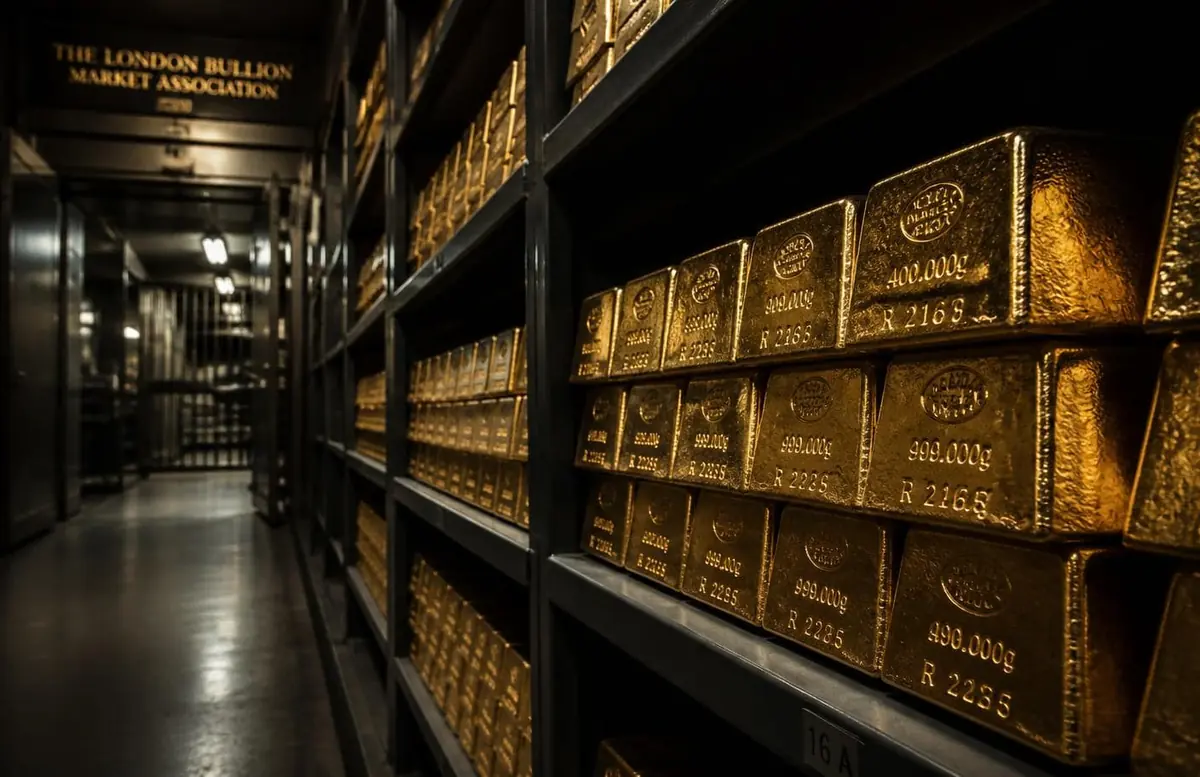
The London market clears in 400-ounce bars of variable weight, refined to a minimum 995 fineness. Comex futures deliver against 100-ounce bars and kilobars. Most Asian markets, and the retail demand behind them, want kilobars at 9999 fineness. These are not interchangeable objects.
Relocating metal between those markets therefore means shipping it to a refinery — frequently in Switzerland, which sits at the centre of this trade for exactly this reason — melting it, re-casting to the destination format, re-assaying and re-stamping, and only then flying it onward. Refining capacity is finite and scheduled. In a stressed market, the queue at the refinery is a real component of the arbitrage cost.
“The spread did not widen because someone was manipulating it. It widened because there were no flights and the casting lines were full.”
Insurance, and the clauses that matter
Every stage of this chain is insured, and the cover is where operational risk is actually priced. The instructive questions are narrow: is the policy all-risks or named-perils; what is the per-location aggregate limit and how does it compare with the value held; is metal covered in transit, at rest, and during the handover between carriers, or does a gap open at the interface; what are the war, terrorism and government-confiscation exclusions; and is the client an insured party or merely a beneficiary of the custodian's own policy?
Retail storage products are where these questions most often go unanswered. A provider may hold genuine cover and still leave the individual client with no direct recourse, because the policy names the operator. It is a distinction worth reading for before, rather than after, the event that tests it.
Reading dislocations correctly
When New York futures trade meaningfully above London spot, the exchange-for-physical spread is telling you the cost of physically closing the gap — freight, re-casting, financing, insurance and the risk of not making delivery. It is a logistics quote expressed as a price difference. Treating it as evidence of a rigged market misreads a supply chain as a conspiracy.
The reverse is also true, and less often said. A spread that stays tight through a period of stress is real information: it means capacity was available, the chain of integrity held, and the market's plumbing worked. Most of the time it does work, silently, which is why almost nobody knows it exists.
Insurance is the constraint, not the truck
Specie insurance — the cover written specifically for precious metals, cash and valuables in transit and in storage — dictates almost every operational decision in bullion logistics. The underwriter sets the maximum value permitted in a single conveyance, specifies vehicle and crew standards, mandates route and stop protocols, requires named and audited vault locations, and defines exactly when risk transfers from one party to another.
This is why a large transfer is broken into multiple movements rather than consolidated into one efficient shipment: the per-conveyance limit, not the payload capacity, sets the parcel size. It is also why unscheduled deviations are treated so seriously. A vehicle that stops somewhere not on the agreed route may, depending on the wording, be uninsured for the duration of that stop.
The document trail exists for the same reason. Each transfer generates a chain of receipts recording bar numbers, gross and fine weights, assay marks and refinery of origin, and the moment of transfer is a signature against a specific list of serial numbers. Custody in this business is not a location; it is an unbroken sequence of signed acceptances.
Allocated, unallocated, and why the distinction is the whole point
A holder of unallocated gold is an unsecured creditor of a bullion bank, owed a quantity of metal rather than owning any particular bars. It is the working currency of the wholesale market: cheap, instantly transferable and unencumbered by any physical movement. A holder of allocated gold owns identified bars, listed by serial number, held in custody and outside the custodian's balance sheet in an insolvency.
Nearly all physical logistics activity is generated by conversions between these two states, or by moves between vaults holding the allocated form. Allocation costs money — a fee per ounce per year, plus the bar-list administration — and the demand for it rises sharply whenever counterparty risk is on people's minds, which is why vault movement statistics spike during financial stress rather than during price rallies.
Why bars move between vaults at all
Metal sitting in a vault earns nothing and costs storage, so movement implies a reason worth paying for. In practice there are four: an exchange delivery obligation that specifies a particular warehouse, a jurisdictional preference by an owner who no longer wants metal held in a given country, an arbitrage between a futures contract and a physical market wide enough to cover freight and insurance, and a bar-format mismatch — Asian markets buy kilobars of 999.9 fineness, while the wholesale market holds 400-ounce Good Delivery bars, and converting between the two means shipping metal to a refinery and back.
That last one is the least visible and the most consequential. Sustained Eastern demand does not just move metal east; it routes it through Swiss refineries that remelt London bars into kilobars, which is why refinery throughput and Swiss trade statistics are read as a proxy for physical flow direction long before any of it shows up in official demand data.
The vault network, city by city
Physical gold pools in a small number of hub cities chosen for history, regulation and infrastructure, and the network moves metal between those hubs rather than to any point on the globe with equal ease.
London: the settlement centre
London's dominance rests on a historical concentration of refining, insurance and shipping expertise around the City, reinforced by the Bank of England's own vaults, among the largest gold repositories anywhere. Most unallocated trading still references London prices and settles through London vaults, even when neither counterparty is British.
Zurich and the Swiss refining corridor
Switzerland's role is industrial: a handful of large refineries process a disproportionate share of the world's newly mined and recycled gold, converting it between the bar formats different regional markets demand. Swiss customs data on gold imports and exports is one of the closest things the market has to a real-time map of physical flow direction.
New York and the futures delivery chain
New York's vaults matter less for total tonnage than for the mechanics of exchange delivery: COMEX-approved depositories exist specifically to service futures settlement, and metal registered there rises and falls with delivery expectations far more than with underlying investment flows.
Singapore, Dubai and the newer hubs
Asian and Middle Eastern hubs have grown around free-trade-zone status, proximity to physical demand centres, and a policy ambition in several jurisdictions to reduce dependence on Western custody chains. Their growth has added redundancy rather than displacing London, which matters more than it sounds: a market with one plumbing system has one point of failure.
~400,000 bars
Approximate gold bar count held in London vaults
6,000+ tonnes
Typical Bank of England custodial gold holdings
3
Countries handling the bulk of global gold refining capacity
24/5
Effective trading hours of the global spot market
A worked example: moving ten tonnes
A fund wants to convert ten tonnes of unallocated London gold into allocated kilobars stored in Singapore, to satisfy a client mandate requiring physical segregation in the region.
- The unallocated position is converted to allocated 400-ounce London bars, requiring the counterparty bank to set aside specific serial numbers against the claim.
- Those bars travel under specie insurance to an accredited Swiss refinery, since London bar format does not match the kilobar standard required in Singapore.
- The refinery melts, assays and re-casts the metal into 1-kilogram bars at 999.9 fineness, generating new serial numbers and certificates — days to weeks depending on the order book.
- The new bars fly as valuable cargo, typically in the belly hold of a scheduled passenger service, to Singapore and clear the free-trade-zone's bullion protocols.
- On arrival, the bars are checked against the refinery's weight list into an accredited vault, and only then does allocation formally transfer to the client's name.
Every step has a cost and a delay, covered by continuous transit-and-storage insurance negotiated to avoid a gap at the handovers. None of it shows as a single line a retail investor would see; it is absorbed into the spread the fund's custodian quotes, which is why sophisticated buyers ask for that spread itemised rather than accepting one bundled figure.
“People imagine gold logistics as a vault door. It is closer to a supply chain for a perishable good that happens never to perish — the choreography is otherwise identical.”
Why the industry resists full automation
Digital initiatives — blockchain-based bar registries, tokenised allocated gold, electronic assay certificates — have cut paperwork and cross-referencing errors, and several major vault operators now offer digital bar tracking as standard. None has replaced physical inspection: a registry states what a bar should weigh and where it should be, but only a scale, an assay and a human signature confirm that the bar in front of you matches the record.
Sanctions, customs and jurisdictional risk
Physical gold crosses borders under an increasingly dense layer of regulatory scrutiny that has little to do with theft or fraud and everything to do with politics. Export controls, anti-money-laundering rules and sanctions regimes can make metal that is entirely legally owned administratively immovable — stuck in a vault whose jurisdiction has frozen transfers to or from a particular counterparty, or unable to clear customs because its declared origin cannot be verified to a regulator's satisfaction.
This risk sits outside conventional specie insurance, which covers physical loss and damage but routinely excludes government action, confiscation and sanctions-driven freezes. Large holders manage it the way they manage any political risk: by diversifying custody across jurisdictions with different legal systems and different alliances, on the theory that no single government action can freeze the whole position at once. It is the same logic that drives currency reserve diversification, applied to a physical asset that happens to need a truck and an armed escort to move.
Conflict gold and the documentation problem
Refiners and major dealers now operate supply-chain due-diligence programmes explicitly modelled on frameworks developed for the mining industry, tracing gold back towards its mine of origin to exclude material linked to armed conflict or serious human-rights abuses. The practical effect on logistics is significant: an accredited refiner will not accept doré or scrap gold without documentation establishing a plausible chain of custody, which means informally sourced material faces a widening gap between the metal's spot value and the price any accredited buyer will actually pay for it.
That documentation requirement has become a de facto second chain of integrity, running alongside the assay-and-custody chain described earlier: one proves the metal is what it claims to be, the other proves it was not extracted or moved in ways the formal market has agreed to exclude. Material that fails either test can still be sold, but only at a discount, and typically only outside the accredited system altogether.
Refining capacity as the hidden bottleneck
The number of refineries capable of producing Good Delivery bars to LBMA standard is small — a few dozen worldwide, concentrated overwhelmingly in Switzerland, with meaningful additional capacity in a handful of other countries. That concentration is rarely visible in ordinary conditions, because throughput comfortably exceeds demand for conversions. It becomes visible the moment demand for a particular conversion spikes: a rush to convert London bars into kilobars for Asian delivery, for instance, competes for the same finite furnace time as every other order already in the queue.
Refiners do not typically hold large stand-by capacity, because idle furnace time is expensive and demand for conversion is lumpy. The result is that a genuine supply-and-demand imbalance in the metal itself and a purely logistical bottleneck in refining capacity can produce an identical symptom — a widening spread or a slower delivery — and only an operator with visibility into the refineries' order books can tell the two apart from the outside.
Insider risk and the human element in secure transport
Armoured vehicles, biometric vault access and continuous CCTV address external threats well. The harder problem, acknowledged candidly within the industry, is insider risk: the loading-bay staff, drivers and vault technicians who have legitimate access to the metal and whose vetting, rotation and dual-control procedures are what actually stand between a shipment and a well-planned theft or substitution.
Standard mitigations include split knowledge — no single individual has both the access and the information needed to divert a shipment unnoticed — dual signature requirements at every handover, unpredictable routing and timing decided at the last possible moment, and background vetting refreshed on a cycle rather than performed once at hiring. None of this eliminates the risk; it raises the number of people who would need to collude, which is the realistic ceiling on what any security system can achieve against a determined insider.
- Dual control: no single employee can authorise a movement or access a vault alone, regardless of seniority.
- Unpredictable scheduling: routes and departure times are finalised as late as operational security allows, reducing the window for a leak to be exploited.
- Rotation and vetting refresh: staff with standing access are re-vetted periodically rather than cleared once and trusted indefinitely.
- Segregation of duties: the person who packs a shipment, the person who transports it and the person who signs for receipt are never the same individual.
What a routine week looks like inside a bullion carrier
Away from the rare, newsworthy dislocation, the daily business of moving gold is unglamorous scheduling. A secure-logistics firm plans routes days in advance, batches shipments to fill insured conveyance limits efficiently, and coordinates arrival windows with vault staff so metal spends the minimum possible time outside a controlled facility. Most of the operational skill in the industry is spent not on any single dramatic transfer but on making hundreds of routine ones boring, predictable and fully documented.
Weather, airline schedule changes and customs delays are the actual disruptors of ordinary bullion logistics, far more often than crime. A cancelled flight forces a same-day decision between re-booking, holding the metal in a bonded facility overnight, or routing via a different hub, and each option has a different cost and a different insurance implication that has to be checked before the decision is made, not after.
The cost stack: what a client actually pays for
A quoted bullion logistics fee bundles several distinct costs that are worth separating conceptually even where the invoice does not. Storage is a small, steady annual percentage of value. Insurance is priced against the underwriter's assessment of route, vault security and historical loss experience on that corridor specifically. Armoured transport and secure air freight are priced per movement, largely independent of value once above a low threshold, because the marginal cost is the vehicle, crew and flight capacity rather than the cargo. Refining, where a format conversion is required, is priced per unit of weight processed plus a queue-dependent premium in busy periods.
Clients who understand this decomposition negotiate differently from those who accept a single bundled spread. Asking a custodian to itemise which of these four components is driving a quoted cost — rather than accepting 'market conditions' as an explanation — routinely reveals that one specific link in the chain, usually refining capacity or insurance renewal timing, is doing almost all of the work.
Frequently asked
Questions readers ask
- What is the difference between allocated and unallocated gold?
- Allocated gold is specific, serial-numbered bars held in custody for you and recorded on a weight list; it is your property and sits off the custodian's balance sheet. Unallocated gold is a claim on a bank for a quantity of metal, ranking as an unsecured creditor. Unallocated is cheaper and more liquid; allocated survives the custodian's insolvency.
- Why does gold fly on passenger aircraft?
- Because scheduled passenger flights offer frequency, security infrastructure at both ends, and hold capacity that dedicated freighters cannot match on the same routes. Gold is dense, so a commercially meaningful consignment occupies very little volume and sits comfortably within belly-hold weight limits.
- What is the chain of integrity?
- The set of accredited refiners, approved vaults and recognised carriers within which a Good Delivery bar can move without losing its status. Metal that leaves the chain — held privately, for example — can re-enter, but normally only after assay or re-refining, because the guarantee rests on continuous custody rather than on the bar itself.
- Why do London and New York prices diverge?
- Because the two markets trade different things: London trades 400-ounce bars in a spot market, New York trades futures deliverable in 100-ounce and kilobar formats. Arbitrage requires physically moving and often re-casting metal, so when freight, refining or vault capacity tightens, the exchange-for-physical spread widens by roughly the cost of closing the gap.
- Is stored gold insured?
- Professional vaults carry all-risks cover, but the terms matter more than the headline. Read for the per-location limit, whether cover applies in transit and at rest, what exclusions apply for war and confiscation, and whether the policy names the client or only the custodian.
- How is gold actually moved across international borders?
- Under specie-insurance protocols that specify approved carriers, sealed and manifested consignments, and pre-cleared customs declarations, usually as belly cargo on scheduled flights between hub airports with dedicated valuable-cargo handling. Sanctions screening and export licensing checks happen before the shipment moves, not on arrival, because a consignment refused entry is far costlier to resolve mid-transit.
- Can gold in a vault be frozen or seized?
- Yes. Sanctions, court orders and government confiscation are excluded from most standard specie insurance policies precisely because they are political rather than criminal risks. Jurisdictional diversification — holding metal across more than one legal system — is the main private-sector hedge against this, which is why some buyers deliberately choose vaults outside their home jurisdiction.
- Why does it take days or weeks to convert gold between bar formats?
- Because re-casting requires melting, re-assaying and re-stamping at an accredited refinery, and refining capacity is finite and scheduled around existing customer orders. In calm markets the queue is short; in a stressed market, when many holders want the same conversion at once, the queue itself becomes the primary component of the cost and delay.