Reserve Management
Why Central Banks Started Buying Gold Again
For three decades official institutions were net sellers of bullion, and the policy consensus treated the metal as a museum piece. Then, quietly, the world's reserve managers reversed. The reasons are less about inflation than about the plumbing of settlement.

In the late 1990s, a person could hold a serious conversation in a European finance ministry about disposing of the national gold reserve entirely. The argument was not eccentric. Gold paid no coupon, cost money to store, sat on the balance sheet earning nothing, and had spent two decades falling. Sovereign bonds paid a yield, settled instantly, and were issued by governments that everyone in the room assumed would remain solvent and friendly. Several countries acted on that logic and sold, some of them close to the bottom of the market.
Three decades on, the official sector buys. Not loudly, not all at once, and not in the countries that sold — but consistently enough that central banks are now among the most reliable sources of demand in the market. Understanding why requires setting aside the two explanations that dominate popular commentary, inflation fear and speculative enthusiasm, neither of which describes how a reserve manager actually thinks.
What a reserve portfolio is for
A central bank's foreign reserves are not an investment fund. Their purpose is to let the state meet obligations denominated in currencies it cannot print, to defend or smooth the exchange rate if it chooses to, and to survive an episode in which the country loses access to international funding. That last mandate is the important one, because it is the only one that cannot be met by holding assets that perform well in ordinary conditions.
Reserve managers therefore optimise in an unusual order: safety first, liquidity second, return a distant third. A pension fund that loses two percent has a bad quarter. A central bank that cannot settle an import bill for fuel has a political crisis. The asymmetry explains why reserves are dominated by short-dated sovereign paper of a handful of issuers, and why the residual allocation to a non-yielding metal has always been defended on grounds that sound, to an asset manager, faintly irrational.
~1/5
Share of above-ground gold held by the official sector
1999
First Washington Agreement caps coordinated European sales
2010
Official sector turns net buyer for the first time in a generation
400 oz
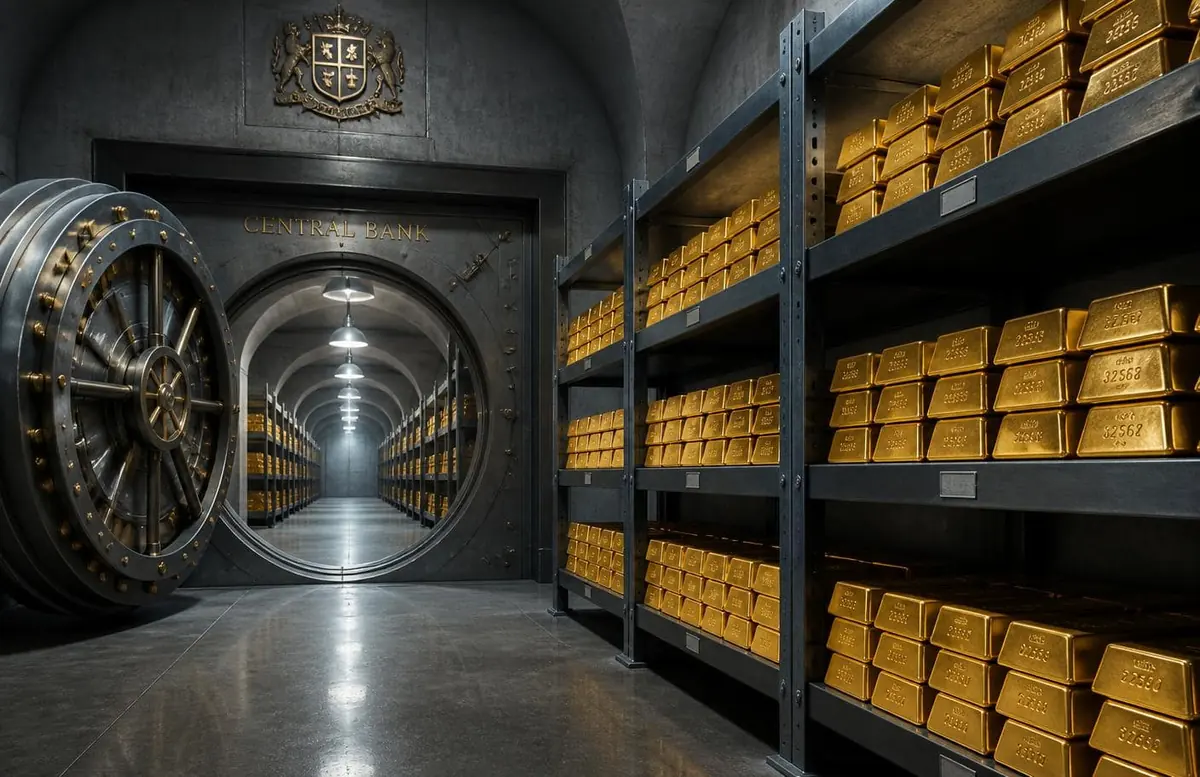
Good Delivery bar size in which reserves are almost always held
The Basel III effect
The reclassification of gold under Basel III regulations has subtly but profoundly altered the calculus for commercial and central banks alike. By elevating gold to a Level 1 high-quality liquid asset, regulators have acknowledged its liquidity and stability during periods of extreme market stress. This shift has encouraged banks to hold gold as a Tier 1 reserve asset, putting it on an equal footing with cash and government bonds in certain regulatory frameworks.
For reserve managers, this regulatory tailwind provides a formal justification for increasing gold allocations. It simplifies the compliance burden associated with holding non-currency assets and enhances the overall resilience of the bank's balance sheet. As more jurisdictions adopt these standards, the structural demand for gold within the formal banking sector is expected to remain robust, regardless of short-term price fluctuations.
Furthermore, the Basel III framework has prompted a re-evaluation of how gold is accounted for in risk-weighted asset calculations. By reducing the hair-cuts applied to gold collateral, the regulations have made it more attractive for use in secured lending and other financial operations. This integration into the core of modern banking regulation marks a significant departure from the 'barbarous relic' narrative of the late twentieth century.
“Gold is the ultimate insurance policy because it is the only asset that is not someone else's liability.”
Gold as a geopolitical buffer
In an era of increasing geopolitical fragmentation, gold serves as a vital buffer for nations seeking to maintain financial autonomy. Unlike foreign exchange reserves held in overseas accounts, physical gold stored within a country's own borders is immune to seizure or freezing by foreign powers. This 'sanction-proof' nature has become a primary driver for central bank accumulation in several regions, particularly those wary of their reliance on the global dollar-based settlement system.
The strategic value of gold in this context is not about its price performance but about its availability. In the event of a total exclusion from international financial networks, a nation's gold reserves provide a means of settling essential trade balances, such as for energy or food imports, through bilateral agreements. Several recent examples have demonstrated that gold remains a tradeable asset even when a country's currency and bond markets are effectively closed to the world.
This trend toward 'financial sovereignty' is reflected in the growing number of central banks that have chosen to repatriate their gold from traditional hubs like London and New York. While the logistical costs of domestic storage are higher, the reduction in jurisdictional risk is deemed a worthwhile trade-off by many treasuries. The shift represents a fundamental move toward a more multipolar reserve system where physical assets play a larger role.
The transparency paradox
The official sector's relationship with gold is characterised by a persistent tension between the need for transparency and the desire for discretion. While the International Monetary Fund encourages member states to report their gold holdings accurately and promptly, many central banks view their accumulation strategies as sensitive national security information. This leads to a situation where the true scale of official demand is often larger than the figures reported in public databases.
Discreet accumulation is often achieved through domestic production offtake or opaque transactions involving state-owned enterprises that do not report to the central bank's balance sheet. These 'hidden' reserves can grow for years before being officially acknowledged, often in a single large adjustment to the reported figures. For market analysts, this means that official demand must often be inferred from trade flows and refinery data rather than taken directly from official statements.
The paradox is that while the market craves transparency to price gold accurately, central banks require opacity to execute their mandates without causing disorderly market moves. If a major central bank were to announce a large-scale buying programme in advance, the resulting price spike would make their own objective harder to achieve. Consequently, the official sector will likely remain the most significant but least visible participant in the global gold market for the foreseeable future.
The selling era, and why it was orderly
The 1990s disposals are often recalled as a collective loss of faith. The record is more procedural than that. European central banks emerging into monetary union held very large gold allocations, inherited from a settlement system that no longer existed, and several concluded that the allocation exceeded any plausible use. The problem was that uncoordinated selling by institutions of that size would have collapsed the price they were selling into.
The 1999 Washington Agreement on Gold, and its successors, existed to solve that coordination problem: signatories capped their collective annual sales and pledged not to expand gold leasing. It was, in effect, a cartel formed to make an exit orderly. It worked. It also had a second effect nobody advertised at the time — by publishing a ceiling on official supply, it told the market exactly how much selling to expect, which removed the fear of an unbounded overhang.
“We did not sell because we thought gold was worthless. We sold because we held more of it than any conceivable use required, and we wanted to leave without slamming the door.”
The reversal, and who drove it
Around 2010 the arithmetic flipped, and it flipped in a different set of countries. The institutions accumulating were largely emerging-market reserve managers whose foreign holdings had grown enormously through trade surpluses and were overwhelmingly concentrated in the sovereign debt of two or three issuers. For them the question was not whether gold yielded anything. It was whether it was prudent for ninety-odd percent of national savings to consist of claims on governments over whose policy — and over whose willingness to honour those claims in a dispute — they had no influence at all.
Diversification into other currencies only partially answers that concern, because every currency reserve is still somebody's liability, held in an account that somebody else administers. Gold in a domestic vault is the only major reserve asset with no issuer, no counterparty, no maturity and no administrator. It is, in the precise sense, the asset of last resort: the one that still works when the relationships underpinning everything else have failed.
Sanctions changed the discount rate on trust
The immobilisation of large sovereign reserve balances in recent years converted an abstract tail risk into an observed event. Every reserve manager on earth watched a peer institution discover that the liquid, safe, highly rated portion of its portfolio could be rendered unusable by administrative decision in another capital. Whatever one thinks of the politics, the professional lesson was unambiguous, and it was drawn in treasuries that had no involvement in the underlying dispute.
The response has not been dramatic reallocation. Reserve portfolios move slowly, and the alternatives to deep sovereign bond markets are thin. What has changed is the marginal allocation: a somewhat larger share of new accumulation directed to gold, a preference for holding it domestically, and a noticeably reduced appetite for lending it out for a few basis points of return.
How the buying is actually done
A central bank does not call a broker and buy a thousand tonnes. Purchases are executed in ways designed to be invisible: standing arrangements to acquire domestic mine production at a benchmark price, discreet over-the-counter accumulation through a small number of bullion banks, occasional purchases from other official institutions. Where domestic production exists, buying it locally has the additional advantage of paying in local currency and never crossing a border.
- Domestic production offtake — the mine sells to the central bank rather than exporting, often at the London benchmark less a small discount.
- Over-the-counter accumulation — small, irregular tranches through bullion banks, deliberately sized not to move the fix.
- Official-sector transfers — direct purchases from another central bank or a multilateral institution, settled by title transfer without the metal moving.
- Refining and upgrading — converting existing holdings of older, lower-fineness bars into current Good Delivery specification so they are tradeable without assay disputes.
What this does and does not mean for the price
It is tempting to read official buying as a bullish signal in the way a fund manager's position would be. That reading misunderstands the participant. A reserve manager buying gold is not forecasting a higher price; in most cases the institution would prefer a lower one, since it intends to keep buying for years. The flow is slow, price-insensitive and largely indifferent to the news cycle, which makes it a poor predictor of any given quarter and an unusually durable component of demand across a decade.
The practical effect is on the shape of drawdowns rather than the height of rallies. When investment demand retreats and exchange-traded funds are net sellers, a bid that does not care about momentum absorbs metal that would otherwise have to clear at lower prices. Several of the shallow corrections of recent years look, in the flow data, less like enthusiasm and more like the absence of a seller of last resort.
None of which makes official buying permanent. Reserve policy is policy: it can reverse when the institutions driving it decide their allocation is adequate, or when a government under fiscal pressure discovers a saleable asset in the basement. That has happened before, in living memory, in countries that now teach it as a cautionary tale. The current direction is well established. It is not a law of nature.
The institutions that publish the numbers
The picture of official-sector demand that reaches the public is assembled from a handful of sources, each with its own gaps. The International Monetary Fund's reserve template captures gold reported by member states, but reporting is voluntary in its granularity and several large holders disclose only aggregated figures on an infrequent schedule. Industry bodies survey central banks directly and supplement the official data with estimates for institutions that do not report at all, producing a figure that is closer to informed inference than audited fact for a meaningful share of the total.
The unreported buyer problem
A number of purchases attributed retroactively to a reporting period turn out to have been executed years earlier and simply not disclosed at the time — a pattern that recurs often enough that analysts treat any sudden jump in a single country's reported holdings with caution, checking first whether it represents new buying or a delayed correction to the record. Some purchases are booked through sovereign wealth funds, state mining companies or other vehicles that sit outside the central bank's own balance sheet and therefore outside standard reserve reporting entirely, even though the gold is unambiguously held for the state.
This opacity is not usually deliberate deception so much as institutional caution: a central bank that reveals it is accumulating gold in real time invites front-running by exactly the market participants it is trying to buy from quietly. The lag in reporting is, in this sense, functional. It protects the price the institution pays, at the cost of the market's ability to see clearly what is happening until well after the fact.
The mechanics of a reserve manager's decision
Inside a central bank, the decision to add gold to reserves is rarely a single dramatic vote. It typically emerges from a strategic asset allocation review conducted every few years, in which the reserve management department models the currency and asset composition of reserves against a set of stress scenarios — a funding crisis, a sudden need to defend the exchange rate, a freeze on access to a major reserve currency — and proposes a target allocation range for each asset class, gold included.
That target is usually expressed as a band rather than a fixed number, giving the operational desk latitude to buy opportunistically within it over subsequent years, rather than executing a single large purchase that would move the market and reveal the institution's hand. A central bank raising its long-run gold target from five to ten per cent of reserves, for instance, might spend the better part of a decade actually closing that gap, a pace dictated as much by market absorption capacity as by any urgency in the underlying strategic logic.
“The target is set in a boardroom in an afternoon. Reaching it takes years, because the market has a memory and we do not want it remembering us.”
Gold leasing, and why appetite for it has shrunk
For much of the twentieth century, central banks that held large gold reserves would lease a portion of them to bullion banks for a modest fee, allowing the borrower to sell the gold and use the proceeds while remaining obligated to return an equivalent quantity later. It was, for the lending central bank, a way to extract some yield from an otherwise non-earning asset, and for the bullion bank, a source of metal to meet hedging and jewellery-trade financing needs.
The practice has become markedly less common, for a reason directly connected to the sanctions-era rethink of counterparty risk: a leased bar is, for the duration of the lease, exactly the kind of claim on someone else's promise that a reserve manager is trying to get away from. A central bank that leases out its gold no longer holds the metal in the specific sense that made it valuable in the first place — it holds a claim against a bullion bank's obligation to return equivalent gold, which reintroduces the counterparty risk gold was bought to avoid. Several institutions have wound down leasing programmes explicitly on these grounds, judging the modest fee income not worth the erosion of the asset's core property.
What the gold means for the currencies these banks issue
There is a recurring but overstated claim that rising official gold reserves in a given country signal preparation for a gold-backed alternative to existing reserve currencies. The scale involved makes this implausible in any near-term sense: converting even a large economy's monetary base into a fully gold-backed system would require multiples of the gold that exists in the ground, let alone in that country's vaults, at a price wildly different from anything currently quoted.
- Gold reserves as insurance — the dominant and best-evidenced motive, aimed at surviving a crisis rather than underpinning day-to-day currency issuance.
- Gold reserves as diplomatic signalling — a visible, publicly reportable way for a state to demonstrate financial resilience to domestic and international audiences alike.
- Gold reserves as settlement collateral — increasingly used bilaterally between some trading partners to settle balances without routing through a third country's banking system.
- Gold reserves as a full currency backing — technically conceivable, discussed periodically, and unsupported by the scale of any state's actual holdings relative to its money supply.
10+ years
Typical span over which a reserve manager closes a new gold allocation target
Declining
Trend in central bank gold leasing activity since the mid-2010s
Multiples
Gap between existing gold reserves and what full currency backing would require in most economies
The long view
Strip away the geopolitics and the official sector's behaviour looks less like a story about gold and more like a story about how institutions relearn old lessons after long enough forgetting them. The reserve managers who sold in the 1990s were not wrong about the world as it then appeared; a system of broadly trusted, broadly convertible reserve currencies made a non-yielding metal look like an expensive anachronism. The reserve managers buying now are not wrong either; they are pricing a world in which that trust is conditional in ways it was not thought to be twenty years ago. Both generations were doing the same job with the same tools, arriving at opposite conclusions because the environment they were insuring against had genuinely changed.
Frequently asked
Questions readers ask
- Why do central banks hold gold at all if it pays no interest?
- Because a reserve portfolio is insurance, not an income strategy. Government bonds pay a yield but are somebody else's liability and can be frozen, redenominated or defaulted on. Gold pays nothing and cannot be created by anyone, which is exactly the property a reserve manager wants in the tail scenario the rest of the portfolio cannot survive.
- Which central banks have been buying?
- The buying since 2010 is concentrated in emerging-market institutions — notably in Asia, the Middle East, Central Asia and Eastern Europe — rather than in the legacy holders of Western Europe and North America, whose allocations were already large and mostly unchanged.
- Does central bank buying push the gold price up?
- It supports it more than it spikes it. Reserve managers accumulate in modest, regular tranches, often through domestic production or discreet over-the-counter purchases, precisely to avoid moving the price against themselves. The effect is a persistent bid rather than a visible rally.
- Is repatriating gold the same as buying it?
- No. Repatriation moves existing holdings from a foreign vault to a domestic one and changes custody risk, not the quantity owned. The two trends are related — both express a preference for reserves that no other jurisdiction can immobilise — but only one adds demand.
- Why has central bank gold leasing declined?
- Leasing gold to a bullion bank converts an unencumbered asset into a claim on that bank's promise to return equivalent metal later, which reintroduces exactly the counterparty risk reserve managers are trying to avoid by holding gold at all. Several institutions have wound the practice down for this reason, judging the small fee income not worth the erosion of the asset's defining property.
- Could a country back its currency fully with gold again?
- Not at anything like current holdings. Comparing declared reserves to a country's monetary base shows a gap of several multiples in almost every major economy, so claims that a state is quietly preparing full gold backing should be treated as rhetorical rather than a description of an imminent, arithmetically feasible policy.
- How does the IMF treat gold?
- The IMF holds one of the world's largest gold reserves and permits member states to include gold in their official reserve assets. However, the IMF itself has not bought gold since the 1970s, and any sales of its holdings require a supermajority vote by its board of governors.