Monetary History
The Gold Standard: How a Soft Yellow Metal Became Money
For roughly five thousand years, humanity kept returning to the same element to settle its debts. The story is less about greed than about the unusually boring chemistry of atomic number 79.
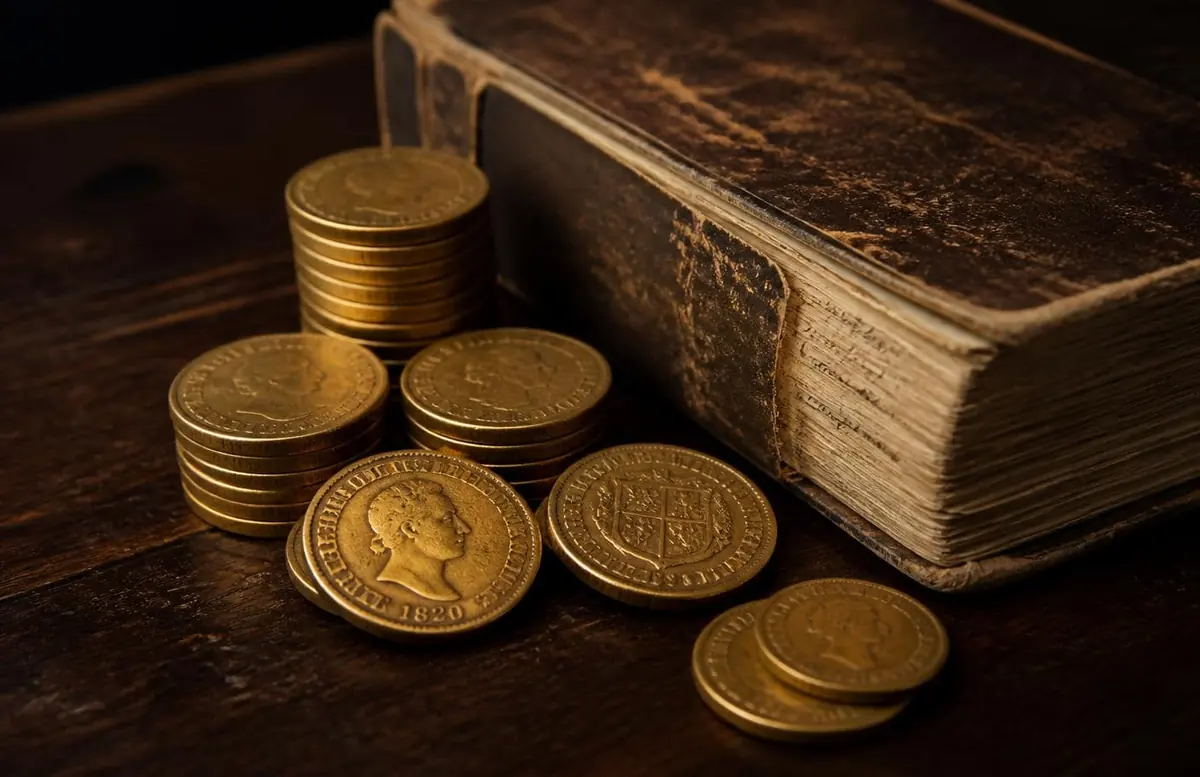
There is a temptation to treat the monetary history of gold as a morality tale — a story about avarice, conquest and the human weakness for shiny things. It is a satisfying story and it is mostly wrong. The reason gold ended up in the vaults of every serious state on earth has less to do with human psychology than with a stubborn set of physical facts about element 79, facts that were true before anybody was around to admire them and remain true now that most transactions are lines in a database.
Consider what a money must survive. It must pass through thousands of hands without degrading. It must be cut into pieces and reassembled without loss. It must be recognisable by someone who does not trust you and cannot read. It must be scarce enough that it cannot be conjured, yet common enough that ordinary commerce is possible. Run those constraints across the periodic table and the field narrows with almost comic speed.
The chemistry of trust
Most of the table is disqualified immediately. The noble gases will not sit still in a purse. The alkali metals catch fire in damp air. Anything radioactive is self-evidently unsuitable. Iron and copper corrode; lead is soft and dull and, as the Romans learned slowly, poisonous. That leaves a small cluster of noble metals: silver, gold, platinum and the platinum group.
Silver tarnishes. Platinum melts at 1,768°C, well beyond the reach of a pre-industrial furnace — which is precisely why the Spanish, encountering it in Colombian riverbeds, dismissed it as platina, 'little silver', and occasionally threw it back in the water. Gold melts at 1,064°C, comfortably within the range of a charcoal fire with a decent bellows. It does not oxidise. A coin dropped in a shipwreck in 1622 comes up in 1985 looking as it did the day it was struck.
“Gold's supreme monetary qualification is that almost nothing happens to it. Every other candidate for money has a history; gold has only a location.”
Density does the rest of the work. At 19.3 grams per cubic centimetre gold is nearly twice as dense as lead, which means a merchant could carry a year's income in a belt rather than a cart, and — crucially — that counterfeiting was hard. A gilded lead disc weighs wrong. Archimedes' famous problem was, at bottom, a payments-fraud problem.
Lydia, and the invention of the guaranteed lump
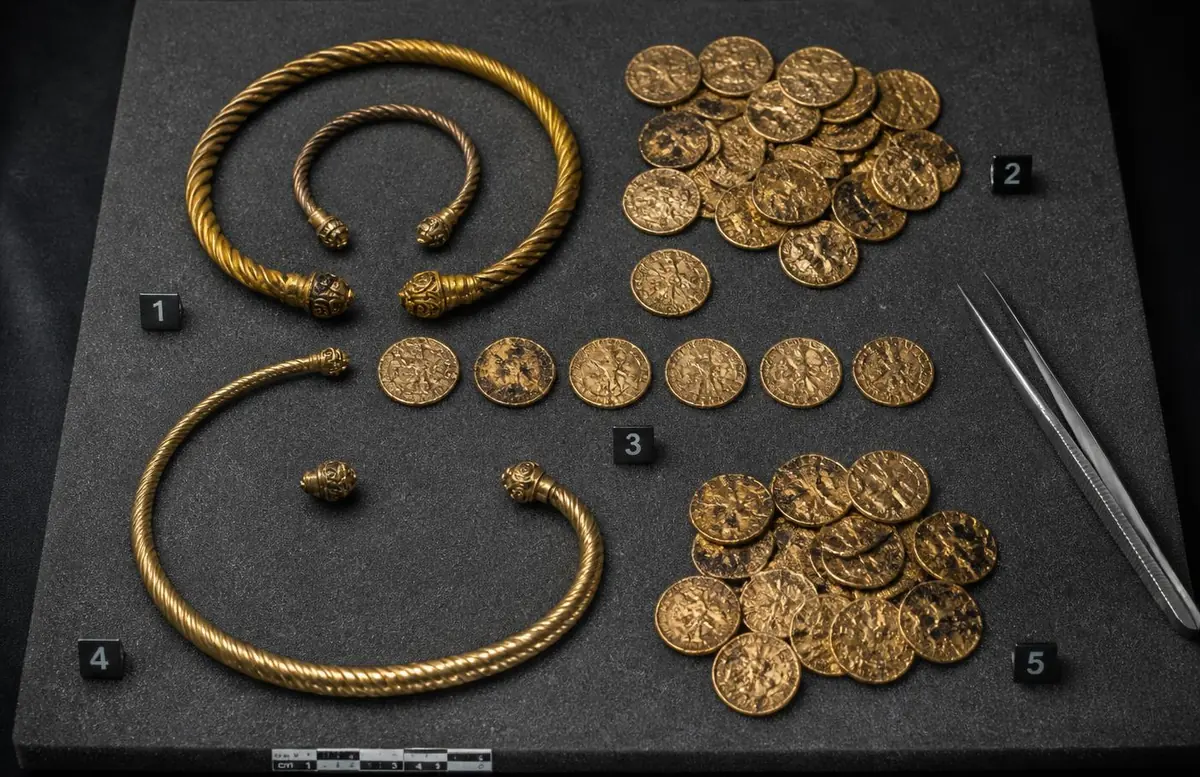
Gold circulated by weight for millennia before anyone thought to certify it. Egyptian tomb inventories record deben of gold; Mesopotamian contracts settle in weighed silver with gold reserved for temple and crown. The decisive innovation came around 600 BCE in Lydia, in what is now western Turkey, where the state began striking standardised lumps of electrum — a naturally occurring gold-silver alloy — with an official mark.
The mark was not decoration. It was an assay result, made portable. Before coinage, every transaction required a scale and a degree of metallurgical competence. After coinage, the buyer could accept a disc on the reputation of the issuer. This is the moment monetary history properly begins: not with gold, which was already valuable, but with the outsourcing of verification to an institution.
It is also the moment the central tension of monetary history appears. The issuer who guarantees the coin can also degrade it. Roman denarii lost silver content steadily through the third century; medieval European princes practised 'crying down' the coinage with such regularity that merchants kept parallel accounting units. Gold's chemical stability was never a defence against political instability — it merely made the debasement visible.
The classical gold standard was brief and strange
Popular usage treats 'the gold standard' as a natural condition that the modern world abandoned. In fact the classical international gold standard — a system in which the major economies simultaneously fixed their currencies to gold at declared rates and allowed largely free capital movement — lasted roughly from the 1870s to 1914. Forty-odd years. It was a historical episode, not a baseline.
It worked, when it worked, through a brutally simple adjustment mechanism. A country importing more than it exported paid the difference in gold. Gold leaving the country shrank the domestic money supply. Prices and wages fell. Exports became competitive again. Gold flowed back. The textbook calls this the price-specie-flow mechanism; David Hume described it in 1752 and it has been taught more or less unchanged ever since.
What the textbook underplays is the cost of the adjustment. 'Prices and wages fell' is an abstraction covering wage cuts, unemployment and industrial unrest borne by people with no say in monetary policy. The system's stability depended on a political order in which those people largely could not vote. Once the franchise widened, the willingness of governments to defend a parity by deliberately engineering recessions collapsed — and with it the standard itself.
1,064°C
Melting point of pure gold
19.3 g/cm³
Density — nearly twice that of lead
~212,000 t
Estimated above-ground stock ever mined
1971
Suspension of dollar–gold convertibility
Bretton Woods: gold at one remove
The system negotiated at Bretton Woods in July 1944 was a compromise between the discipline of gold and the need for policy room. Member currencies were pegged to the dollar; the dollar alone was convertible into gold, at $35 an ounce, and only for foreign official holders. Ordinary Americans had been barred from holding monetary gold since 1933.
This was gold as a wholesale settlement asset — the metal moved between vaults in New York and Basel, not between hands. For twenty-five years it underwrote the fastest sustained expansion in global output on record. Then arithmetic caught up with it. As dollar liabilities abroad grew faster than the US gold stock, the promise of convertibility became a claim that could not be honoured in full if presented at once.
The Belgian-American economist Robert Triffin named the trap in 1960: the reserve issuer must run deficits to supply the world with liquidity, and those very deficits erode confidence in convertibility. On 15 August 1971, President Nixon suspended it. The announcement was framed as temporary. It was not.
Nobody's liability
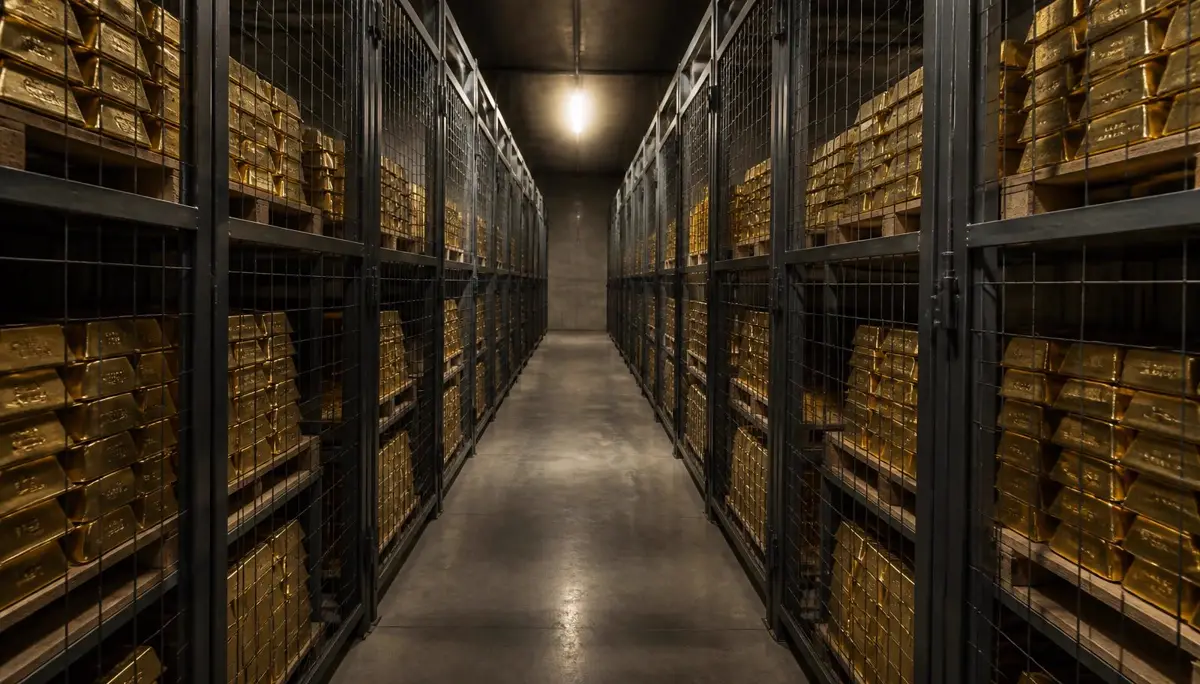
That last phrase is the key to gold's persistence after the end of the standard. A government bond is somebody's promise. A bank deposit is somebody's promise. A foreign-currency reserve is a promise made by a state that may one day be your adversary, held in a system that state can switch off. A bar of gold in your own vault is not a promise at all. It is simply there.
This is why the official sector never fully exited. Through the 1990s and early 2000s European central banks were net sellers, coordinating their disposals to avoid disorderly markets. That trend reversed. Reserve managers in emerging economies — for whom the sanctionability of foreign reserves is not a theoretical concern — have been steady buyers, and the composition of global reserves has shifted accordingly.
What a modern gold standard would require
- A credible commitment to defend a fixed parity through recessions, with no discretionary escape hatch.
- Wage and price flexibility sufficient to absorb external shocks that can no longer be absorbed by the exchange rate.
- Coordinated international rules on gold flows, or the system fragments the first time one large holder hoards.
- A political settlement in which voters accept unemployment as the price of the parity — the condition that failed in the 1930s.
Every serious proposal for restoration founders on the fourth item. The classical standard's discipline was inseparable from its distributional politics. You cannot import the mechanism and leave the consequences behind.
The residue
What survives, then, is not the standard but the metal, and a set of habits built around it. Gold is priced continuously in London and traded around the clock. It is held by states that trust each other imperfectly, by households in South Asia who have watched local currencies fail within living memory, and by funds that want an asset uncorrelated with the promises of any single government.
Roughly every ounce ever mined still exists somewhere — in vaults, in temples, in wedding jewellery, in the bonding wire of discarded electronics. That is the strangest fact about gold's monetary history and the most instructive. Currencies are events; gold is an inventory. The metal outlasts every institution that has tried to define it, which is both the reason states keep buying it and the reason no state has ever quite managed to own the idea of it.
The critics, and why they were not entirely wrong
No serious history of gold's monetary role can skip past the economists who spent careers arguing against it, because their objections were substantive and some of them were vindicated by events. John Maynard Keynes called the gold standard a 'barbarous relic' in 1923, and the phrase is quoted so often as an insult that its actual argument gets lost. Keynes's point was narrower and more technical: a currency pegged to gold surrenders control of the domestic money supply to whatever quantity of metal happens to be flowing through the country's ports that year, a quantity determined by mine output, trade balances and the policies of other governments rather than by domestic employment conditions.
Britain's return to the gold standard in 1925, at the pre-war parity and over Keynes's public objection, is the case study that proved his point. The overvalued pound made British exports uncompetitive, and the defence of the parity required exactly the kind of deflationary squeeze — wage cuts, high interest rates, industrial contraction — that the classical mechanism always required, at a moment when organised labour was in no mood to absorb it. The 1926 General Strike followed within a year, and Britain abandoned the gold standard again in 1931, having gained nothing from six years of painful defence beyond the demonstration that Keynes had been right.
“In truth, the gold standard is already a barbarous relic.”
The rebuttal from gold's defenders has never really disputed the mechanism; it disputes the alternative. A central bank with full discretion over the money supply can, in principle, smooth a recession that a gold standard would deepen — but it can also, and frequently has, inflate away debts, finance wars without raising taxes, and erode savings through decades of currency debasement that no gold-backed system would have permitted. The argument between the two camps is not really about gold. It is about whether human institutions or a fixed external constraint should be trusted with the power to create money, and neither side has produced a system immune to its own characteristic failure mode.
What the historical record actually supports is a more modest claim than either camp likes: the classical gold standard delivered impressive price stability over long periods precisely because it was harsh in the short run, and modern discretionary central banking has delivered milder recessions at the cost of a currency that buys a small fraction of what it bought a century ago. Both are real trade-offs. Neither is a free lunch, and gold's twentieth-century critics were not wrong to say so.
Digital gold: tokens, vaults and an old idea in new code
The most interesting recent development in gold's monetary story has nothing to do with central banks and everything to do with a technology nobody involved in Bretton Woods could have imagined. Since the mid-2010s, a growing number of platforms have issued blockchain-based tokens that represent a claim on a specific quantity of allocated, vaulted gold — typically one token per gram or per fine troy ounce, redeemable for physical metal or transferable instantly between digital wallets without the metal itself ever moving.
The pitch is a genuine improvement on a genuine friction. Buying and later reselling small quantities of physical gold has always meant paying a dealer's spread twice and finding secure storage in between; a tokenised claim settles in seconds, trades continuously, and can be split into fractions a physical bar cannot. Several jurisdictions have taken this seriously enough to regulate it directly, treating the tokens as a security or a commodity-backed instrument rather than a cryptocurrency, precisely because the underlying claim is on a physical, auditable asset rather than on nothing.
- The token is only as good as the audit behind it — a monthly bar list and an independent reserve attestation are the minimum a serious issuer publishes.
- Redemption terms vary sharply: some platforms deliver physical bars above a minimum size, others settle only in cash.
- Custody risk does not disappear; it relocates to whichever vault operator and issuing entity stand behind the token.
- Regulatory treatment differs by jurisdiction, and a token legal to hold in one market may be unavailable or restricted in another.
It would be a mistake to read tokenised gold as a step towards a new gold standard; it is closer to a more convenient unallocated account, wrapped in a settlement layer borrowed from cryptocurrency markets. The metal still sits in one vault, subject to one jurisdiction's law and one custodian's solvency. What has changed is the cost and speed of transferring a claim on it — the same problem coinage solved in Lydia twenty-six centuries earlier, addressed with a different technology and the same underlying motive: making a scarce, trusted asset easier to move without anyone having to touch it.
Gold rushes and the economics of a sudden discovery
If the classical gold standard shows what happens when states agree to be disciplined by gold, the nineteenth-century rushes show what happens when private individuals discover it first. California in 1848, Victoria in 1851, the Klondike in 1896, the Witwatersrand in 1886: each followed a similar arc, from a handful of alluvial finds to tens of thousands of migrants within a season, to an industrial mining sector within a decade, to a permanently altered regional economy.
The immediate economic effect was inflationary and global. The mid-century Californian and Australian rushes roughly tripled world gold output within a few years, and the new metal flowed into circulation and into bank reserves across the Atlantic economy. Prices in Britain and the United States drifted upward through the 1850s in a pattern later economists could trace directly to the assay offices of San Francisco and Melbourne.
The Witwatersrand exception
The South African case broke the alluvial pattern entirely. The Witwatersrand's gold sits in ancient, deeply buried conglomerate reef rather than a riverbed, low-grade and unglamorous, requiring shafts, stamp mills and, within a generation, cyanide processing plants that no individual prospector could finance. It converted a rush into an industry almost immediately, and it did so by drawing on a migrant labour system that shaped South African political economy for a century afterward. The gold was the same element; the institutions built to extract it were entirely new.
- California, 1848–1855: alluvial and hydraulic mining, roughly 370,000 migrants, statehood accelerated by the population surge.
- Victoria, 1851–1860s: doubled Australia's population within a decade and financed early federation-era infrastructure.
- Witwatersrand, from 1886: deep reef mining, the foundation of Johannesburg and of South Africa's twentieth-century industrial base.
- Klondike, 1896–1899: remote and short-lived, but it fixed the popular image of the lone prospector that outlived the reality by a century.
What the rushes share, beneath the folklore, is a pattern of rapid diminishing returns. Easy alluvial gold is exhausted within a few seasons; what remains requires capital, engineering and, in South Africa's case, an entire mining-finance industry centred on London and later Johannesburg itself. The prospector with a pan is a transitional figure, present at the discovery and largely absent from the extraction that follows.
Gold as household insurance: the Asian savings tradition
Western monetary history tends to treat gold's demonetisation as a settled fact and its remaining demand as a curiosity — jewellery, a hobbyist's coin collection, an exchange-traded fund line item. That framing collapses the moment you look at household savings behaviour in South Asia, where gold has functioned as a parallel currency for a poor and a wealthy household alike, often more trusted than the banking system itself.
In India, gold purchased at a wedding is simultaneously ornament, dowry, family reserve and collateral of last resort. Rural households with no bank account and no credit history can pledge jewellery at a gold-loan counter within the hour, a transaction that requires no paperwork beyond a scale and an assay. That liquidity, available to people the formal financial system does not reach, is not a relic of underdevelopment; it has proved remarkably resilient even as bank branches and mobile payments have spread.
“A bank can close its doors. A currency can be redenominated overnight. My grandmother's bangles have never once failed to be worth something.”
China's household gold demand follows a related but distinct logic, shaped by capital controls that restrict how far a family can diversify savings abroad. Gold bars and jewellery are among the few internationally priced assets an ordinary household can hold without navigating those controls, which is one reason Chinese retail demand tends to firm noticeably whenever confidence in domestic property or equity markets wavers.
The idea that will not quite die: gold today
Every decade since 1971 has produced a serious proposal to restore some link between currency and gold, and every decade the proposal has failed to attract the coalition of governments needed to implement it. What survives instead is a looser, more interesting arrangement: gold as one reserve asset among several, held not because any treaty requires it but because enough finance ministries have independently concluded that an asset with no counterparty is worth owning.
1848–1855
California gold rush period
1886
Witwatersrand reef discovered
~1,000 t/yr
Approximate recent global mine supply
5,000 yrs
Rough span of gold's continuous monetary use
That is a quieter conclusion than either gold's critics or its advocates tend to prefer. It is neither the barbarous relic of one camp nor the inevitable replacement currency of the other. It is a five-thousand-year-old technology for storing value across a discontinuity — a war, a default, a currency reform — that nobody can predict in advance and that every serious institution nonetheless plans for. The chemistry made that possible. The history is simply the record of everyone else catching up to the chemistry.
Frequently asked
Questions readers ask
- Why was gold chosen as money instead of other metals?
- Gold does not corrode, is easily divided and recombined, is dense enough to carry high value in small volume, and is scarce but not impossibly rare. Copper was too abundant, iron rusted, and platinum melted at temperatures pre-modern smiths could not reach.
- When did the gold standard end?
- In stages. Most countries suspended domestic convertibility during and after the First World War, the interwar restoration collapsed in the 1930s, and the last international link — dollar-gold convertibility under Bretton Woods — was suspended by the United States in August 1971.
- Do central banks still hold gold?
- Yes. Central banks and international institutions remain among the largest single holders of above-ground gold, and official-sector buying has been a significant source of demand in recent years.
- What did John Maynard Keynes mean by 'barbarous relic'?
- Keynes used the phrase in 1923 to attack the proposed restoration of the gold standard, arguing that tying a modern economy's money supply to the accidents of mine output subordinated employment and output to an arbitrary constraint. He was not dismissing gold's usefulness as a store of value; he was objecting to using it as the sole regulator of domestic monetary policy.
- Did gold finance wars, or did wars end the gold standard?
- Both. Gold reserves and gold-backed borrowing financed the belligerents of the First World War, but sustaining that finance required suspending convertibility almost everywhere, since no state could fight a total war while also promising to redeem its currency in metal on demand. The gold standard did not survive the war it helped fund.
- Is there a serious movement to bring back a gold standard?
- There are recurring proposals, mostly from political fringes in the United States and occasionally floated by individual legislators, but no major economy has assembled the coalition needed to attempt it, and no serious central bank research department treats restoration as a live policy option. The idea persists as a critique of monetary discretion rather than as an implementable plan.
- How is gold's monetary role likely to change next?
- Most plausibly through incremental shifts already under way: continued official-sector accumulation by reserve managers diversifying away from a handful of currencies, and experimentation with tokenised claims on allocated gold that settle instantly while the underlying bars stay in a vault. Neither amounts to a new gold standard; both extend gold's role as a reserve asset held outside any single government's control.